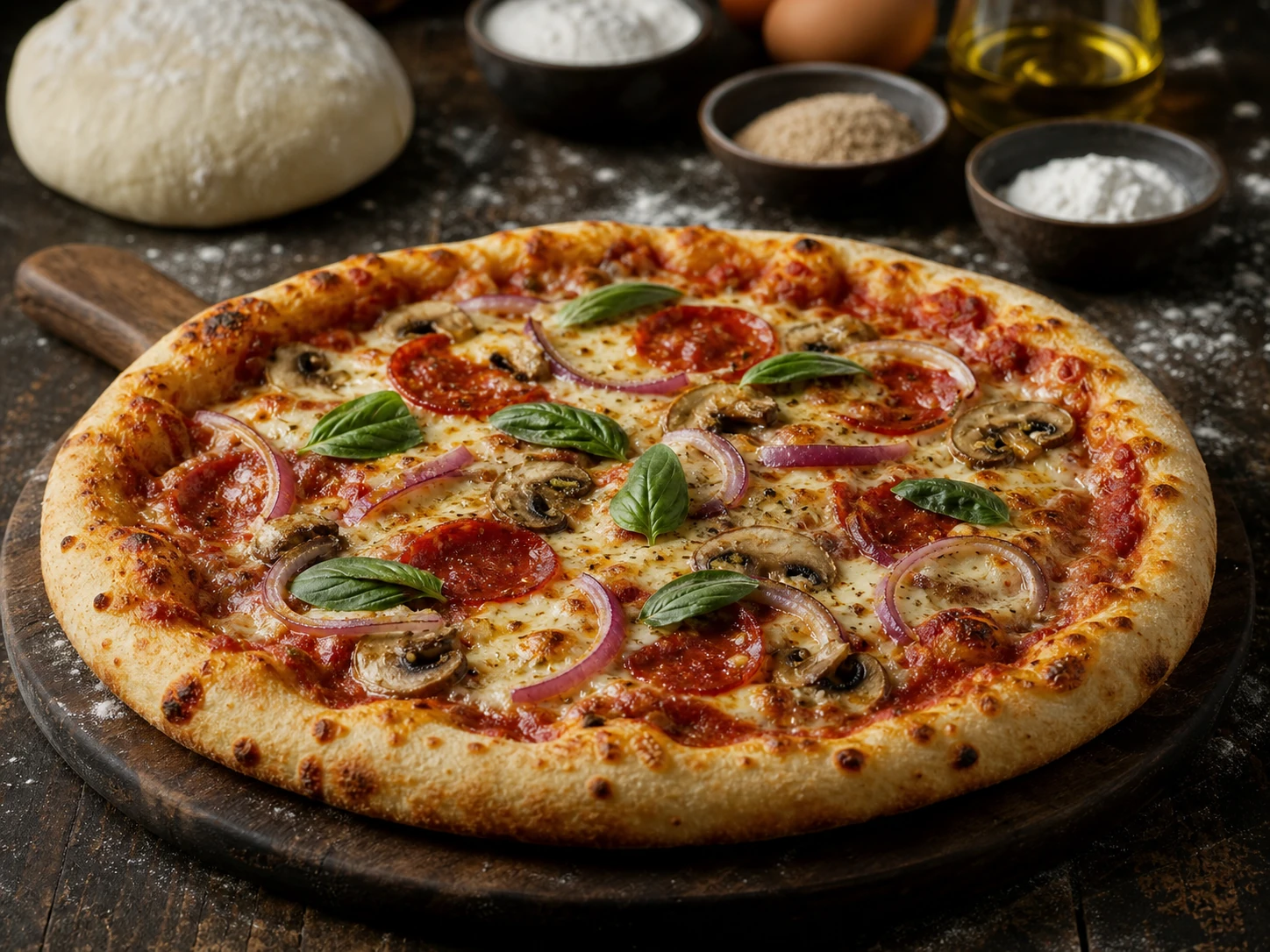
Why this formula works
Rice flour gives a clean base, tapioca supplies stretch and browning, and psyllium binds enough water to stop crumbling. Eggs reinforce the structure; this is therefore different from the egg-free psyllium dough elsewhere on the site. The mixture must hydrate before shaping and must par-bake before wet toppings. Every flour and baking powder package must be certified gluten-free when cross-contact matters.
Honest timing
| Active preparation | 20 min |
| Hydration / proof / preheat | 55 min |
| Cooking / baking | 22 min |
| Elapsed total | 1 h 37 min |
Ingredients
- fine white rice flour, certified gluten-free250 g (8.8 oz)
- tapioca starch, certified gluten-free100 g (3.5 oz)
- finely ground psyllium husk powder25 g (0.88 oz)
- gluten-free baking powder8 g (0.28 oz)
- fine sea salt7 g (0.25 oz)
- instant dry yeast6 g (0.21 oz)
- fine sugar5 g (0.18 oz)
- warm water, 32–35°C / 90–95°F330 g (11.6 oz)
- extra-virgin olive oil25 g (0.88 oz)
- apple cider vinegar10 g (0.35 oz)
- large eggs, room temperature2
Equipment
- digital scale
- stand mixer with paddle or sturdy spoon
- two sheets of baking parchment
- two 30 cm trays or pizza screens
- silicone spatula
- rack
Exact method
- 1. Whisk rice flour, tapioca starch, psyllium powder, baking powder, salt, yeast and sugar for 60 seconds so the powerful binder is evenly dispersed.
- 2. Whisk warm water, olive oil, vinegar and eggs until completely uniform.
- 3. Pour wet mixture into dry ingredients and beat with a paddle or sturdy spoon for 3 minutes. The mass should resemble a very soft sticky paste, not wheat dough.
- 4. Cover and rest 10 minutes. Psyllium will hydrate and turn the paste into a soft shapeable dough; do not add extra rice flour during this pause.
- 5. Divide into two equal portions of about 380 g. Press each between lightly oiled parchment to a 30 cm round, 4–5 mm thick, leaving a slightly thicker 1 cm edge.
- 6. Cover loosely and proof at 26–28°C / 79–82°F for 45 minutes. The bases should look aerated and slightly expanded, not double.
- 7. Preheat with the gluten-free par-bake table below. Dock only the center with a fork and brush any dry edge with a trace of oil.
- 8. Par-bake one base at a time until the surface is matte and the underside can be lifted in one piece; on steel or a preheated inverted sheet this is about 8–10 minutes.
- 9. Add no more than about 230 g well-drained topping and finish for 8–12 minutes according to the table. Rest 3 minutes on a rack before cutting so the psyllium crumb sets.
How to know it is ready
- Par-baked base lifts in one piece without a wet center.
- Finished edge is golden and bends slightly instead of crumbling.
- Tapioca gives a light chew, never a gummy translucent layer.
- Center supports a normal topping load after the rack rest.
Troubleshooting
- Crumbly dough: psyllium was coarse, hydration rest was shortened or ingredients were under-mixed.
- Gummy middle: base needed a longer par-bake or topping was too wet.
- Dense rim: do not roll the outer centimeter completely flat.
- Gluten concern: use certified ingredients and clean tools, surfaces and oven equipment.
How to adapt the base recipe
- For an egg-free base, use the separate vegan psyllium formula rather than guessing a direct egg replacement here.
- For one base, halve every ingredient precisely and use one egg only if it weighs about 50 g without shell.
- For stronger flavor, replace 30 g rice flour with 30 g certified gluten-free buckwheat flour.
Storage and food safety
Par-baked cooled bases keep wrapped in the refrigerator for 2 days or frozen with parchment between them for 2 months. Finish from chilled or thawed; do not store raw egg-containing dough at room temperature.
Allergens
Egg
Always verify every label and cross-contact risk; brand formulations can change.