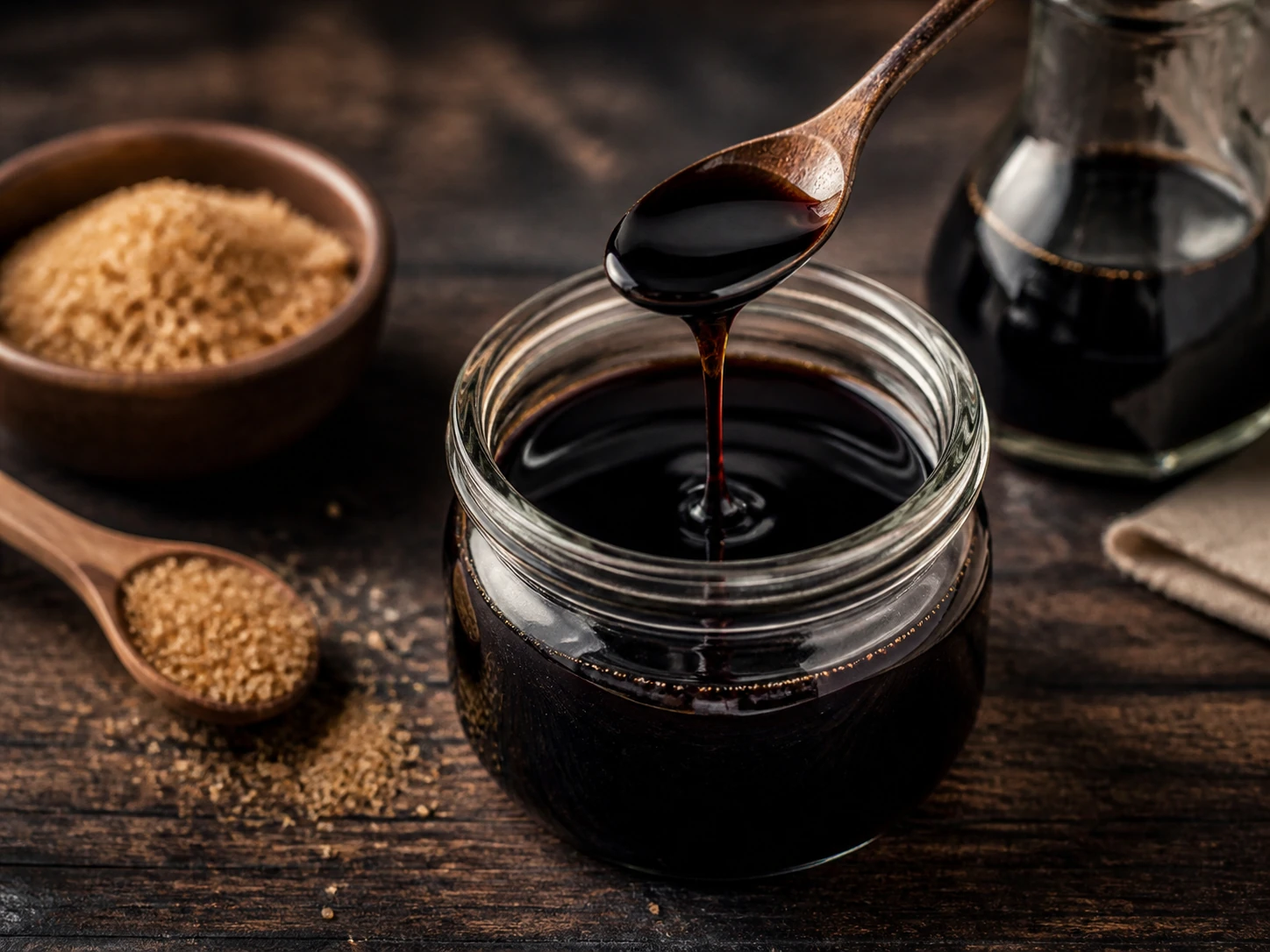
Why this formula works
A wide pan evaporates water evenly; a modest 8% sugar addition rounds sharp vinegar without hiding it. Stopping while the glaze still looks slightly thin matters because it thickens markedly as it cools.
Honest timing
| Active preparation | 3 min |
| Hydration / proof / preheat | 15 min |
| Cooking / baking | 22 min |
| Elapsed total | 40 min |
Ingredients
- dark balsamic vinegar, preferably 6% acidity250 g (8.8 oz)
- light brown sugar20 g (0.71 oz)
- fine sea salt0.5 g
Equipment
- small wide stainless-steel saucepan
- digital scale
- heatproof spatula
- cold saucer for the flow test
Exact method
- 1. Pour the vinegar into a cool pan; stir in sugar and salt until no dry crystals remain.
- 2. Bring just to a boil over medium heat, then immediately lower to a quiet simmer. Strong boiling drives off aroma and scorches the rim.
- 3. Simmer uncovered for 16 minutes without walking away. Swirl the pan every 3–4 minutes; do not scrape dried residue from the sides back in.
- 4. From minute 16, weigh the pan or watch the bubbles: they should become small and glossy. Target roughly 105–115 g finished glaze.
- 5. Drop ½ teaspoon on the cold saucer and wait 30 seconds. It should run slowly when tilted, not hold like jam.
- 6. Remove from the heat at once and pour through a fine sieve into a heatproof jar; residual heat otherwise keeps reducing it.
- 7. Cool uncovered for 15 minutes, then close. For pizza, add only after baking in thin lines so acidity stays bright.
How to know it is ready
- A spoonful forms a thin continuous ribbon.
- The cooled drop flows slowly but is not sticky like caramel.
- Aroma is fruity and acidic, never bitter or smoky.
Troubleshooting
- Too thick after cooling: warm gently with 5–10 g water.
- Too thin: return to a clean pan for 2-minute intervals.
- Bitter: the glaze scorched; dilution cannot remove burnt flavor.
- Crystals: sugar was left on the pan wall; strain and warm slowly.
How to adapt the base recipe
- For strawberries or dessert pizza, replace 5 g sugar with honey.
- For savory pizza, steep one small rosemary sprig for the first 10 minutes, then remove.
- Use 5–8 g per 30 cm pizza; more quickly dominates cheese and tomato.
Storage and food safety
Refrigerate in a clean closed jar for up to 4 weeks. This recipe is not a tested room-temperature canning formula.
Allergens
No EU/UK major allergen is intentionally included in the base formula. Depending on the selected product, may also contain: Sulphites.
Always verify every label and cross-contact risk; brand formulations can change.