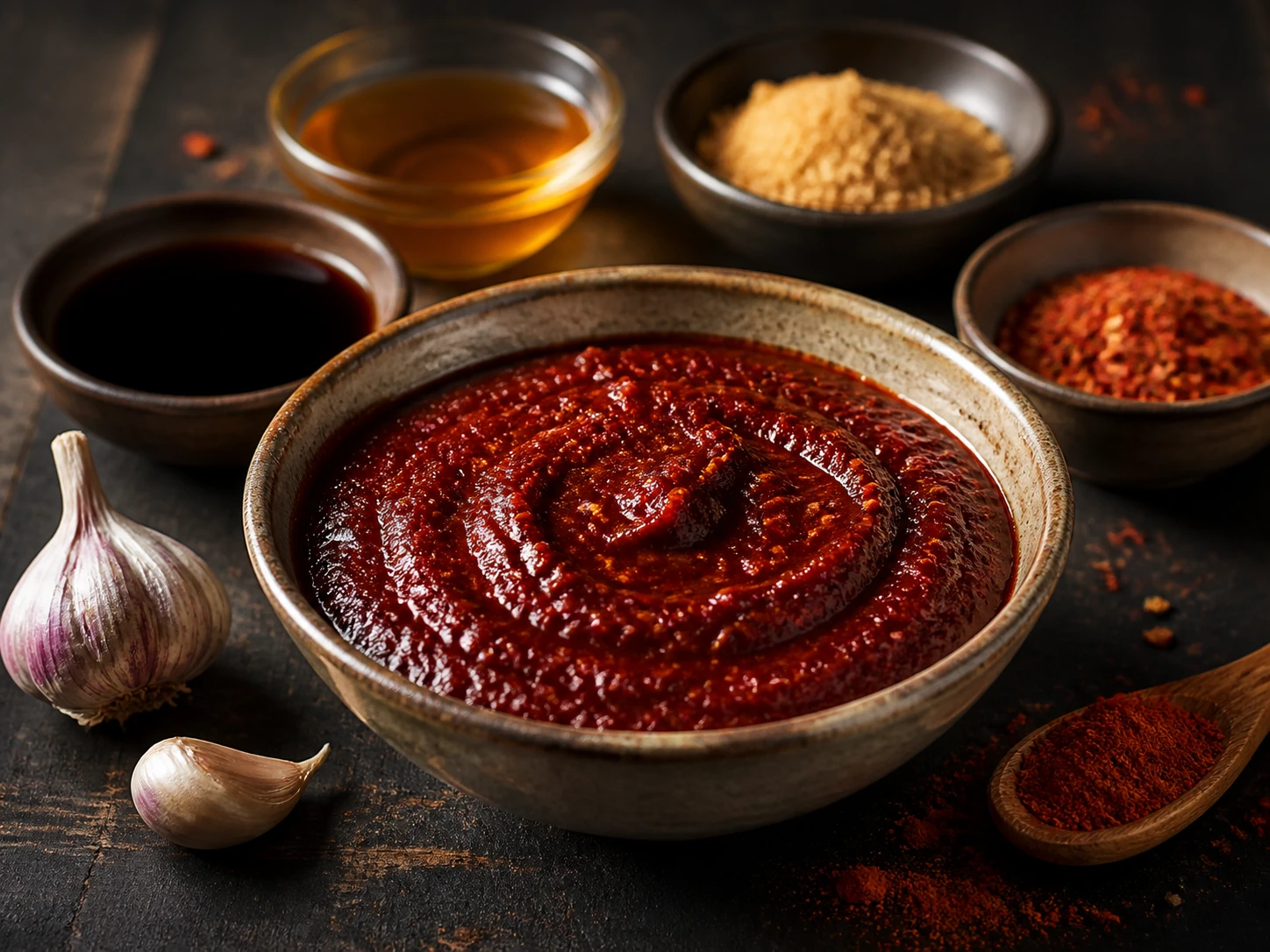
Why this formula works
Cook tomato paste with water for 3 minutes, remove from heat, then whisk in honey, soy, vinegar, chili, paprika and garlic; it is gochujang-style, not traditional fermented gochujang. The measured formula is designed around the final use, while the sensory checkpoint—After a 30-minute rest, the flakes are hydrated and the paste holds soft peaks while remaining spreadable.—is more reliable than the clock alone.
Honest timing
| Active preparation | 10 min |
| Hydration / proof / preheat | 30 min |
| Cooking / baking | 5 min |
| Elapsed total | 45 min |
Ingredients
- double-concentrated tomato paste80 g (2.82 oz)
- honey or brown sugar40 g (1.41 oz)
- soy sauce35 g (1.23 oz)
- apple cider vinegar20 g (0.71 oz)
- gochugaru or mild chili flakes12 g (0.42 oz)
- sweet paprika4 g (0.14 oz)
- finely grated garlic5 g (0.18 oz)
- water30 g (1.06 oz)
Equipment
- small saucepan
- whisk
- fine grater
- clean jar
Exact method
- 1. Weigh every ingredient before starting and complete all chopping, grating or temperature preparation; this recipe moves too quickly for measuring midway.
- 2. Set up the base exactly as follows: Cook tomato paste with water for 3 minutes, remove from heat, then whisk in honey, soy, vinegar, chili, paprika and garlic; it is gochujang-style, not traditional fermented gochujang.
- 3. Add the seasonings in the stated quantities and scrape the bowl or pan thoroughly, so no concentrated pockets remain.
- 4. Control the process by temperature and texture: After a 30-minute rest, the flakes are hydrated and the paste holds soft peaks while remaining spreadable.
- 5. Taste a small cooled sample. Judge salt, acid, sweetness and heat in that order; warmth can hide both salt and chili.
- 6. Scrape into a clean container and complete the stated resting or cooling time. Stir once more before judging final consistency.
- 7. Use it deliberately: mix 20–30 g with 50 g tomato sauce for one pizza or use 10 g in a finishing glaze.
How to know it is ready
- After a 30-minute rest, the flakes are hydrated and the paste holds soft peaks while remaining spreadable.
- A cooled spoonful is homogeneous, without watery seepage or a greasy ring.
- The primary ingredient remains recognizable after seasoning.
- The stated pizza dose gives flavor without making the base soggy.
Troubleshooting
- Too thin: first complete the rest; then correct in small measured additions rather than guessing.
- Too thick: loosen with the recipe's liquid 5 g at a time.
- Unbalanced: cool a sample before adding more salt, acid, sugar or chili.
- Separated: stop heating, transfer to a cool bowl and re-emulsify gradually.
How to adapt the base recipe
- mix 20–30 g with 50 g tomato sauce for one pizza or use 10 g in a finishing glaze.
- Scale by weight, not by spoons; keep every ingredient in the same ratio.
- Change only one of heat, acid or sweetness at a time and record the adjustment.
Storage and food safety
Refrigerate in a clean jar for up to 7 days or freeze portions for 2 months. It is not fermented or shelf-stable.
Allergens
Soy Depending on the selected product, may also contain: Gluten (wheat), Sulphites.
Always verify every label and cross-contact risk; brand formulations can change.