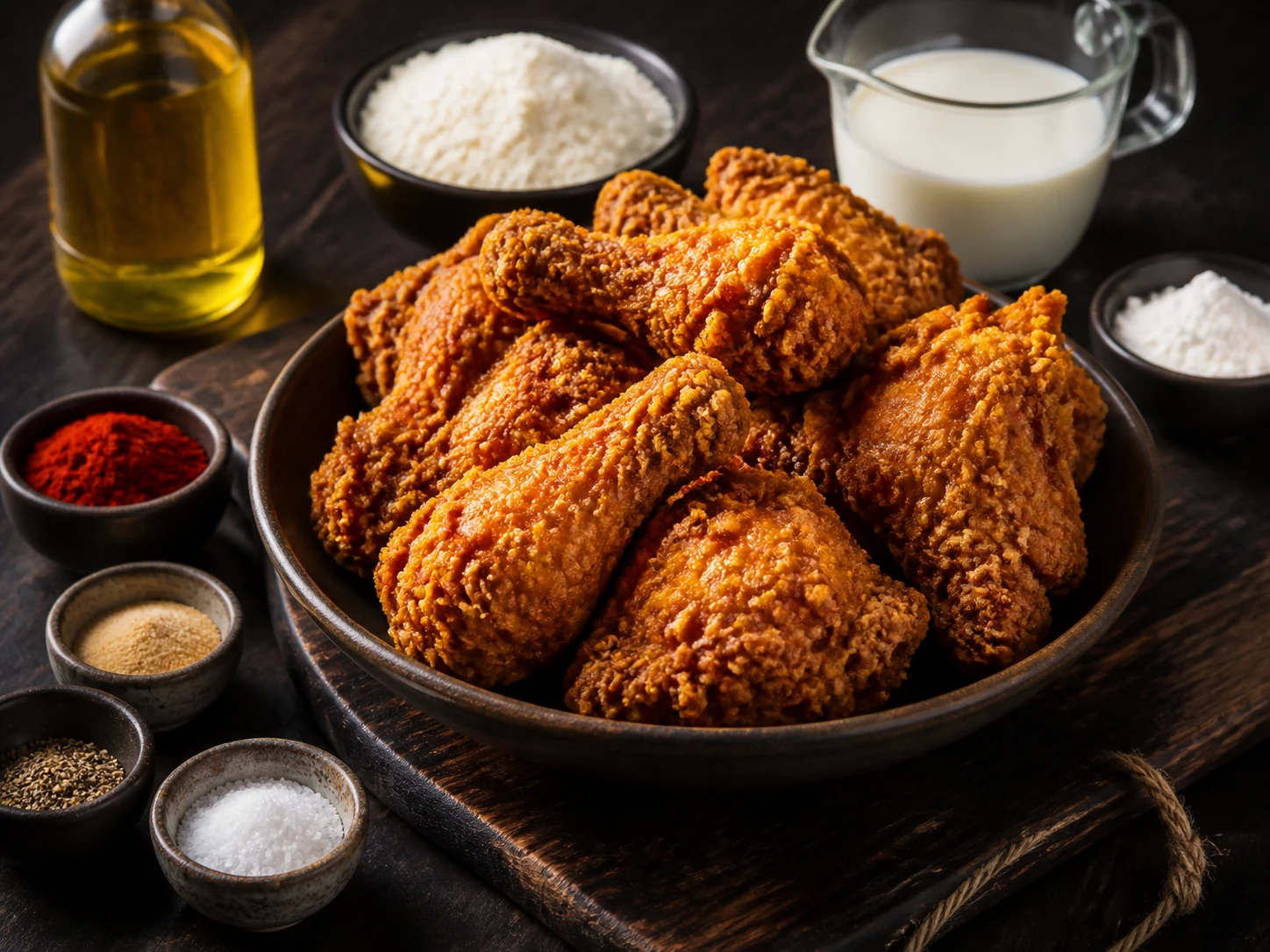
Why this formula works
Marinate chicken in buttermilk with half the salt for 4 hours refrigerated; dredge in flour, starch and spices, flick in marinade for crags, dredge again and fry at 170–175°C / 338–347°F. The decisive endpoint is every thick piece reaches 74°C / 165°F and the crust is rigid golden-brown without dark spice spots; using that physical sign prevents both under-processing and a dry, overworked result.
Honest timing
| Active preparation | 30 min |
| Hydration / proof / preheat | 4 h |
| Cooking / baking | 25 min |
| Elapsed total | 4 h 55 min |
Ingredients
- boneless chicken thigh pieces, 4 cm1000 g (35.3 oz)
- buttermilk400 g (14.1 oz)
- fine salt, divided12 g (0.42 oz)
- plain wheat flour250 g (8.8 oz)
- cornstarch50 g (1.76 oz)
- sweet paprika6 g (0.21 oz)
- garlic powder3 g (0.11 oz)
- black pepper2 g (0.07 oz)
- rapeseed oil for frying; not all is absorbed1000 g (35.3 oz)
Equipment
- deep heavy pot
- clip thermometer
- instant-read thermometer
- wire rack and tray
Exact method
- 1. Weigh every ingredient and prepare the equipment before starting. Keep raw animal products physically separate from ready-to-eat ingredients.
- 2. Build the preparation with this exact technique: Marinate chicken in buttermilk with half the salt for 4 hours refrigerated; dredge in flour, starch and spices, flick in marinade for crags, dredge again and fry at 170–175°C / 338–347°F.
- 3. Work in the stated batch size. Crowding a pan, processor or towel changes moisture removal and therefore the timing.
- 4. Judge the endpoint directly: every thick piece reaches 74°C / 165°F and the crust is rigid golden-brown without dark spice spots
- 5. Stop the heat or processing immediately at that point and move the food to a clean plate, rack or bowl so residual heat cannot overshoot it.
- 6. Taste a cooled sample and correct only one variable at a time. For raw-meat preparations, taste only a separately cooked test portion.
- 7. Apply it to pizza as follows: rest on a rack, chop just before topping and use 100–140 g per pizza; add wet Buffalo sauce after baking.
How to know it is ready
- every thick piece reaches 74°C / 165°F and the crust is rigid golden-brown without dark spice spots
- Texture is even from edge to center, without wet pockets or scorched fragments.
- A cooled sample keeps the intended structure instead of leaking water or oil.
- The stated pizza portion integrates with the crust rather than overwhelming it.
Troubleshooting
- Wet or soft result: batch size was too large or moisture removal stopped early.
- Dry or tough result: heat or processing continued past the physical endpoint.
- Uneven seasoning: mix by weight and cook a small test portion before changing the full batch.
- Weak flavor: improve browning, draining or spice blooming before simply adding more salt.
How to adapt the base recipe
- rest on a rack, chop just before topping and use 100–140 g per pizza; add wet Buffalo sauce after baking.
- Scale linearly by weight, but process in the original batch size for the same moisture control.
- For a wetter pizza style, increase the topping only after confirming that the base and oven can carry the extra moisture.
Storage and food safety
Refrigerate within 2 hours for up to 4 days. Reheat to 74°C / 165°F on a rack in a hot oven; do not refry used oil indefinitely.
Allergens
Gluten (wheat), Milk
Always verify every label and cross-contact risk; brand formulations can change.