Why this formula works
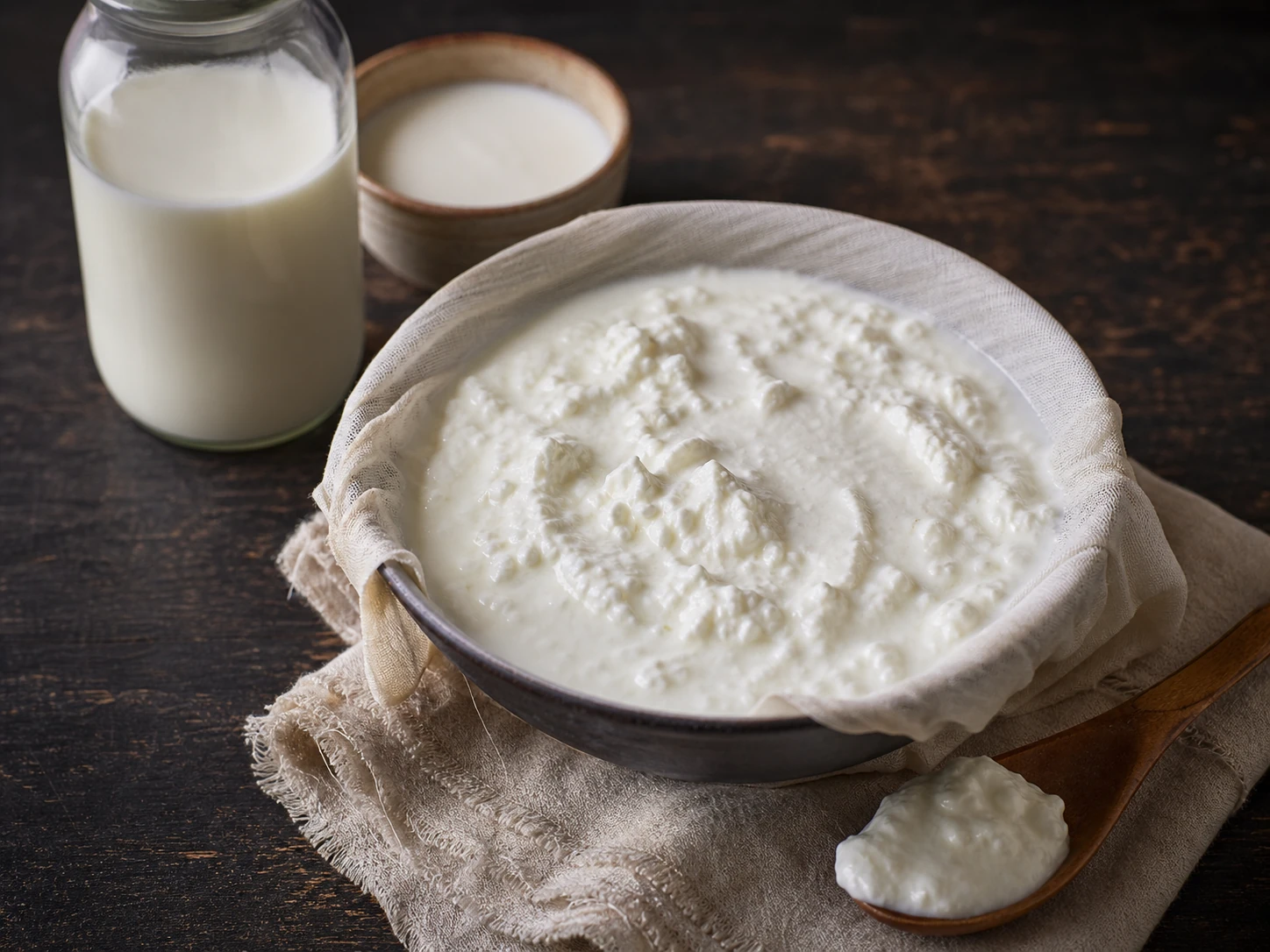
Sanitize equipment, combine milk and live-culture buttermilk, hold covered at 21–24°C / 70–75°F for 10–12 hours, then warm the set curd very gently to 35–38°C / 95–100°F and drain. The decisive endpoint is the curd smells cleanly tart, separates pale whey and drains to a smooth mound; any colored growth, gas or rotten odor means discard; using that physical sign prevents both under-processing and a dry, overworked result.
Honest timing
| Active preparation | 15 min |
| Hydration / proof / preheat | 12 h |
| Cooking / baking | 25 min |
| Elapsed total | 12 h 40 min |
Ingredients
- pasteurized whole milk1000 g (35.3 oz)
- cultured buttermilk with live cultures100 g (3.5 oz)
Equipment
- sanitized pot and lid
- digital thermometer
- fine cheesecloth
- colander and bowl
Exact method
- 1. Weigh every ingredient and prepare the equipment before starting. Keep raw animal products physically separate from ready-to-eat ingredients.
- 2. Build the preparation with this exact technique: Sanitize equipment, combine milk and live-culture buttermilk, hold covered at 21–24°C / 70–75°F for 10–12 hours, then warm the set curd very gently to 35–38°C / 95–100°F and drain.
- 3. Work in the stated batch size. Crowding a pan, processor or towel changes moisture removal and therefore the timing.
- 4. Judge the endpoint directly: the curd smells cleanly tart, separates pale whey and drains to a smooth mound; any colored growth, gas or rotten odor means discard
- 5. Stop the heat or processing immediately at that point and move the food to a clean plate, rack or bowl so residual heat cannot overshoot it.
- 6. Taste a cooled sample and correct only one variable at a time. For raw-meat preparations, taste only a separately cooked test portion.
- 7. Apply it to pizza as follows: drain 2–4 hours for pizza and use 60–100 g per 30 cm base, seasoned according to the final recipe.
How to know it is ready
- the curd smells cleanly tart, separates pale whey and drains to a smooth mound; any colored growth, gas or rotten odor means discard
- Texture is even from edge to center, without wet pockets or scorched fragments.
- A cooled sample keeps the intended structure instead of leaking water or oil.
- The stated pizza portion integrates with the crust rather than overwhelming it.
Troubleshooting
- Wet or soft result: batch size was too large or moisture removal stopped early.
- Dry or tough result: heat or processing continued past the physical endpoint.
- Uneven seasoning: mix by weight and cook a small test portion before changing the full batch.
- Weak flavor: improve browning, draining or spice blooming before simply adding more salt.
How to adapt the base recipe
- drain 2–4 hours for pizza and use 60–100 g per 30 cm base, seasoned according to the final recipe.
- Scale linearly by weight, but process in the original batch size for the same moisture control.
- For a wetter pizza style, increase the topping only after confirming that the base and oven can carry the extra moisture.
Storage and food safety
Use pasteurized dairy only. Refrigerate immediately after draining and use within 4 days; keep below 4°C / 40°F.
Allergens
Milk
Always verify every label and cross-contact risk; brand formulations can change.