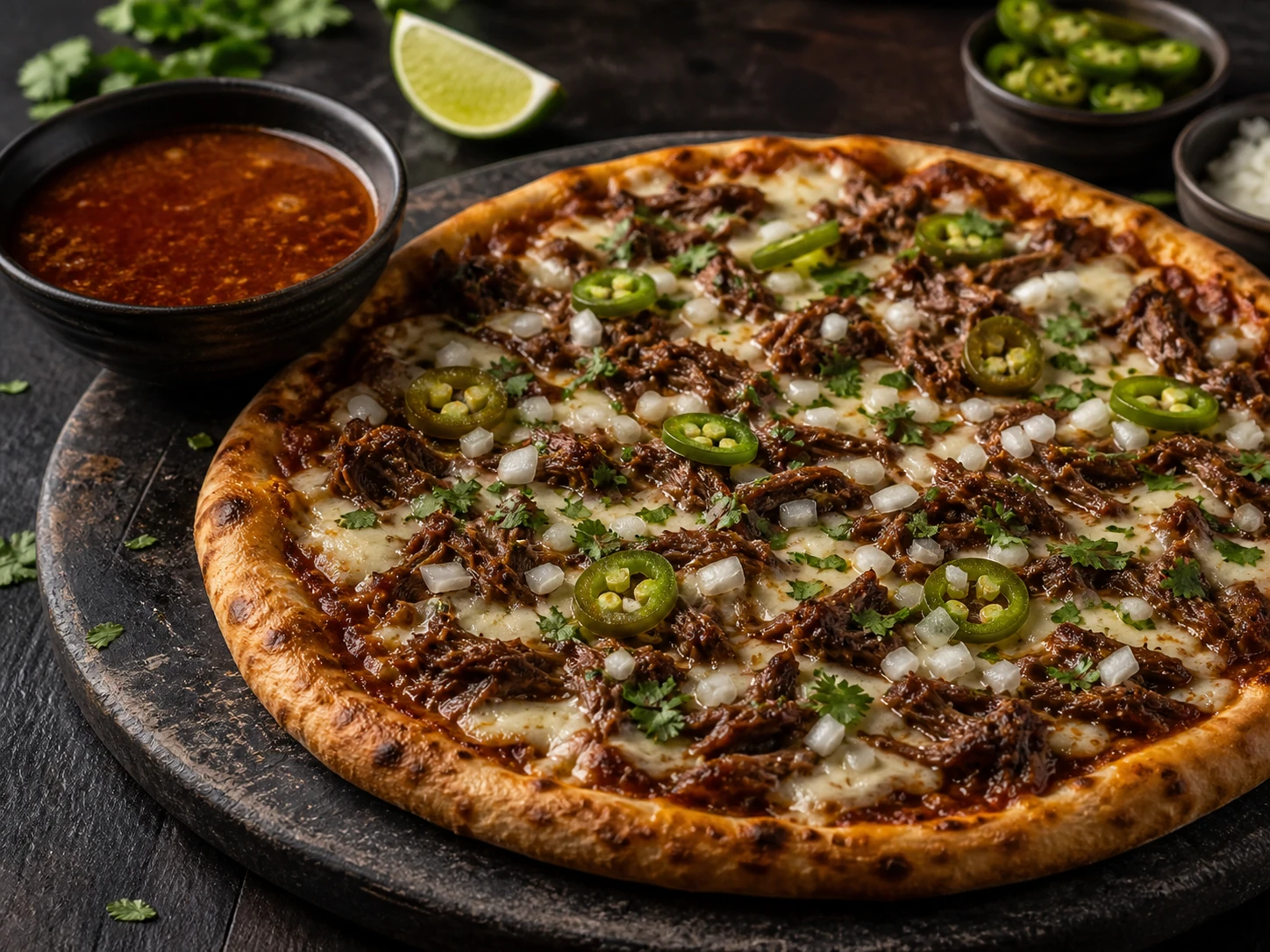
Why this formula works
This pizza is meant to be juicy, not dry, so it uses 110 g concentrated chile sauce and 160 g beef. Structure comes from reducing the sauce until spoonable, draining the meat and keeping 250 g thinner consommé in a separate bowl. A slightly larger 280 g dough ball carries the load; onion, cilantro, lime and jalapeño stay fresh after the bake.
Honest timing
| Active preparation | 25 min |
| Hydration / proof / preheat | 1 h |
| Cooking / baking | 12 min |
| Elapsed total | 1 h 37 min |
Ingredients
- mature room-temperature pizza dough ball280 g (9.9 oz)
- thick reduced birria consommé sauce containing celery110 g (3.9 oz)
- low-moisture Oaxaca-style melting cheese or mozzarella, coarsely grated130 g (4.6 oz)
- cooked shredded birria-style beef, moist but well drained160 g (5.6 oz)
- white onion, cut into 4 mm dice30 g (1.06 oz)
- fresh cilantro leaves and tender stems, chopped12 g (0.42 oz)
- fresh lime, cut into wedges30 g (1.06 oz)
- fresh jalapeño, thinly sliced25 g (0.88 oz)
- defatted birria consommé containing celery, for dipping250 g (8.8 oz)
Equipment
- small saucepan
- instant-read thermometer
- fine sieve or fat separator
- pizza steel or stone
- pizza peel
- digital scale
- heatproof dipping bowl
Exact method
- 1. Preheat a steel or stone on the lower-middle rack at maximum heat for 60 minutes. Put a rack near the oven for the finished pizza.
- 2. Simmer the birria sauce in a small saucepan for 4–6 minutes until it coats a spoon and a dragged line stays open for one second. Weigh 110 g after reduction.
- 3. Warm the shredded beef gently with 20 g of the measured sauce. If using refrigerated leftovers, bring the meat to 74°C / 165°F. Drain until it is glossy but does not drip continuously.
- 4. Heat the separate consommé to steaming, skim or separate excess fat, and hold it covered. Prepare onion, cilantro, lime wedges and jalapeño for the cold finish.
- 5. Open the 280 g dough ball to 30 cm, leaving a defined 1.5–2 cm rim. Move to a lightly dusted peel and confirm that it slides.
- 6. Spread the remaining 90 g thick sauce to within 1.5 cm of the rim. Add cheese in an even layer, then distribute warm beef in small loose clusters rather than one heavy center pile.
- 7. Bake at 250–300°C / 482–572°F for 5–8 minutes, rotating once, until the underside is deeply browned and the cheese bubbles through the beef.
- 8. Rest on a rack for 60 seconds. Add onion, cilantro and jalapeño evenly; squeeze half the lime over the pizza and reserve the rest for the dip.
- 9. Pour exactly 250 g hot consommé into a heatproof bowl. Cut the pizza into six narrow slices and serve immediately, dipping only the bite you are about to eat.
How to know it is ready
- The underside is deeply browned and does not fold under the loaded center.
- Beef is steaming and juicy but no red liquid floods the cheese.
- Fresh onion remains crisp and cilantro stays green.
- Consommé is hot, fluid and savory enough to coat one bite without turning it greasy.
Troubleshooting
- Soggy middle: reduce sauce until spoonable and drain beef; never pour dipping consommé onto the uncut pizza.
- Greasy dip: separate surface fat while hot, but retain a thin aromatic sheen.
- Dry beef: warm gently with 20 g sauce and stop once safely hot.
- Topping slides off during dipping: cut narrower slices, rest 60 seconds and dip only the tip.
How to adapt the base recipe
- For an even saucier 30 cm pizza, increase reduced sauce to 130 g only if it is thick enough to mound on a spoon.
- For less heat, remove jalapeño seeds and use mild dried chiles in the birria component; keep lime and onion.
- For 35 cm, use a 330–350 g dough ball, 145 g reduced sauce, 175 g cheese, 220 g drained beef and 350 g consommé on the side.
Storage and food safety
Keep leftover pizza, beef and consommé in separate shallow containers. Refrigerate within 2 hours for up to 3 days. Reheat meat and consommé to 74°C / 165°F; crisp the pizza base separately and add fresh onion, cilantro and lime afterward.
Allergens
Celery, Gluten (wheat), Milk
Always verify every label and cross-contact risk; brand formulations can change.