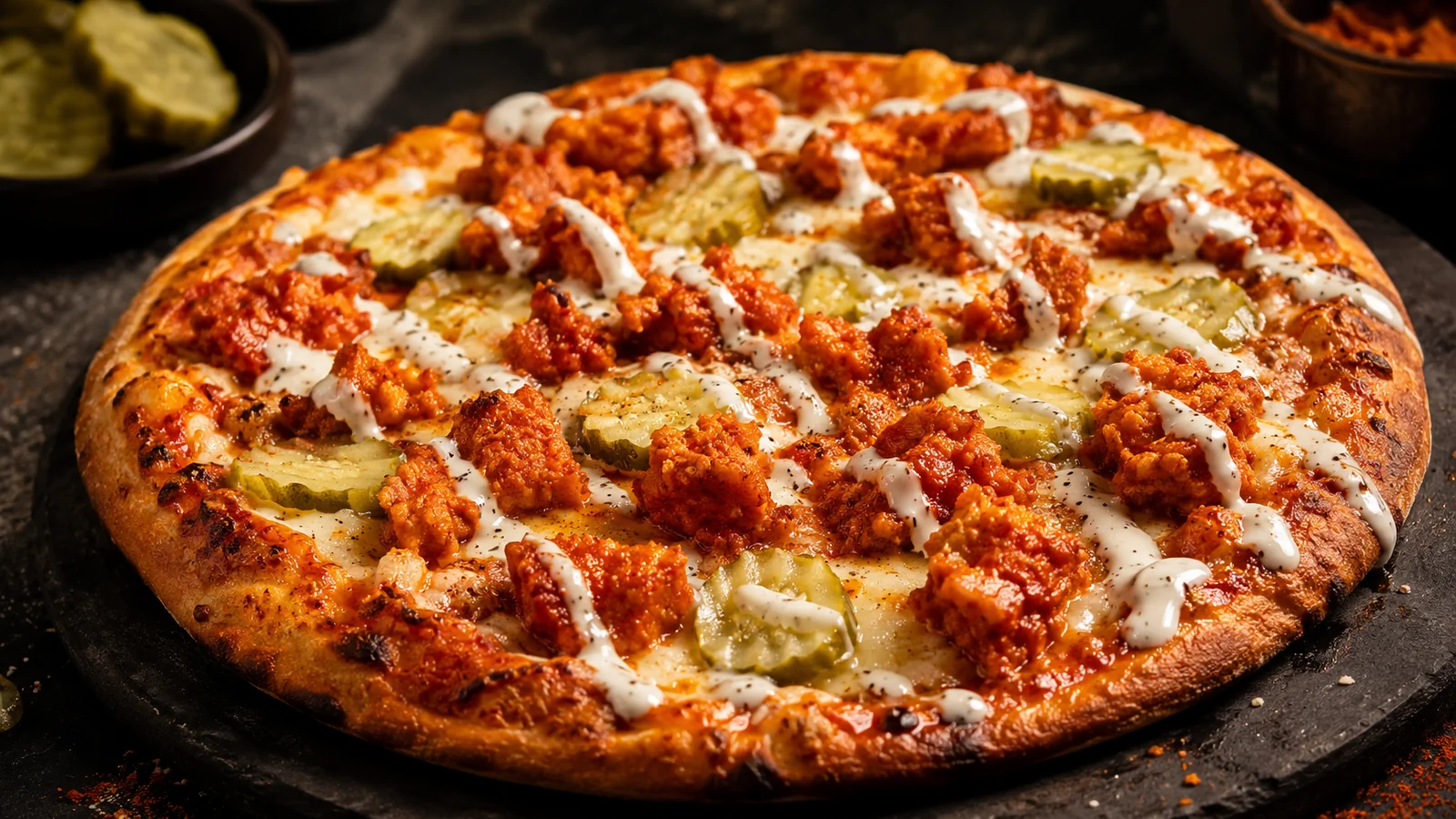
Why this formula works
Hot butter is applied after the chicken is safely fried, so the cayenne blooms without spending a long time in the pizza oven. Cold drained pickles provide acid and crunch; the pizza gets enough tomato and cheese to stay juicy without burying the crust.
Honest timing
| Active preparation | 35 min |
| Hydration / proof / preheat | 45 min |
| Cooking / baking | 25 min |
| Elapsed total | 1 h 45 min |
Ingredients
- mature home-oven pizza dough ball250 g (8.8 oz)
- boneless skinless chicken thigh, cut into 2–3 cm pieces160 g (5.6 oz)
- buttermilk50 g (1.76 oz)
- plain wheat flour35 g (1.23 oz)
- cornstarch20 g (0.71 oz)
- fine sea salt, divided3 g (0.11 oz)
- neutral high-heat oil for shallow frying250 g (8.8 oz)
- thick tomato sauce65 g (2.29 oz)
- low-moisture mozzarella, grated90 g (3.17 oz)
- unsalted butter, melted20 g (0.71 oz)
- cayenne pepper, adjust after the first test batch3 g (0.11 oz)
- smoked paprika2 g (0.07 oz)
- soft brown sugar8 g (0.28 oz)
- garlic powder1 g
- dill pickle slices, thoroughly drained40 g (1.41 oz)
- ranch dressing, optional25 g (0.88 oz)
- flat-leaf parsley, optional5 g (0.18 oz)
Equipment
- pizza stone or steel and peel
- instant-read food thermometer
- heavy skillet
- wire rack over a tray
- heatproof bowl and clean pastry brush
Exact method
- 1. Preheat a stone or steel at maximum oven heat for 45 minutes. Set a rack beside the stove and separate all tools that touch raw poultry.
- 2. Mix chicken, buttermilk and 1 g salt. Rest for 15 minutes while the oven heats.
- 3. Whisk flour, cornstarch and 1 g salt. Press the drained chicken into the coating, rest 5 minutes and coat once more for an irregular crisp crust.
- 4. Heat frying oil to 175°C / 347°F. Fry without crowding for 4–6 minutes, turning, until deep gold and 74°C / 165°F in every thick piece. Drain on the rack using clean tongs.
- 5. Whisk melted butter with cayenne, smoked paprika, brown sugar, garlic powder and the last 1 g salt. Brush a thin layer onto the hot cooked chicken; reserve the rest in a clean bowl.
- 6. Open the dough to 28–30 cm, check that it slides, then spread tomato sauce and mozzarella evenly.
- 7. Bake for 4–6 minutes on the fully heated steel. When the base is almost browned, add the cooked hot chicken and return for only 60–90 seconds.
- 8. Pull the pizza, brush the chicken with the remaining clean hot butter and add thoroughly drained cold pickles. Add optional ranch in a thin zigzag and parsley only after the heat is off.
- 9. Rest for 1 minute. Taste one piece before adding extra cayenne; heat builds as the butter spreads across the tongue.
How to know it is ready
- Every chicken piece reached 74°C / 165°F before topping.
- Cayenne smells toasted and aromatic, not blackened.
- Pickles stay cold-crisp and the base remains firm under the center.
Troubleshooting
- Harsh raw cayenne: whisk it into genuinely hot melted butter and let it bloom for 30 seconds.
- Burnt spice: do not bake the butter coating for the full pizza time.
- Soft chicken: use a rack and add it only at the end.
- Watery pizza: blot pickle slices and use ranch sparingly.
How to adapt the base recipe
- For medium heat, use 1.5 g cayenne; for hot, start at 3 g and increase only after tasting.
- Bought cooked fried chicken may be used at 120 g; reheat thoroughly before the finishing butter.
- Optional ranch introduces egg and milk; keep it off the base so it does not split in the oven.
Storage and food safety
Cool leftovers within 2 hours and refrigerate for up to 2 days. Reheat until piping hot in an oven or air fryer; add fresh pickles only after reheating.
Allergens
Gluten (wheat), Milk Depending on the selected product, may also contain: Egg, Mustard, Sulphites.
Always verify every label and cross-contact risk; brand formulations can change.