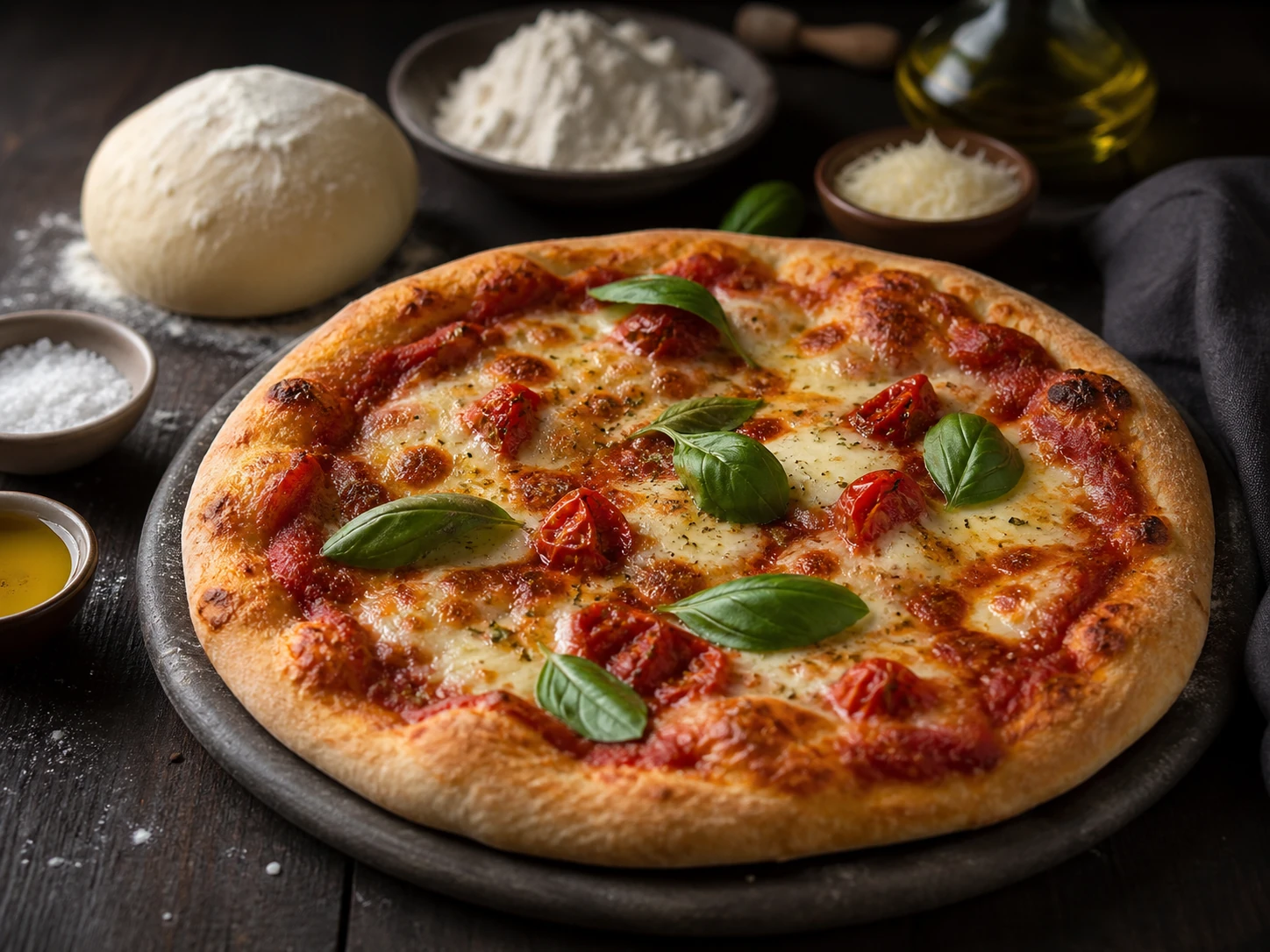
Why this formula works
Skyr contributes milk protein, acidity and moisture, but it cannot replace gluten development or yeast fermentation. Strong flour supplies the structure, baking powder supplies immediate lift, Parmesan deepens browning, and a short rest hydrates the dough. Par-baking is essential because the thick dairy dough sets more slowly than a lean pizza dough.
Honest timing
| Active preparation | 15 min |
| Hydration / proof / preheat | 20 min |
| Cooking / baking | 27 min |
| Elapsed total | 1 h 2 min |
Ingredients
- strong bread flour, 12–13% protein200 g (7.1 oz)
- plain thick skyr, cold180 g (6.3 oz)
- cold water; hold back until mixing20 g (0.71 oz)
- Parmigiano Reggiano, finely grated20 g (0.71 oz)
- extra-virgin olive oil12 g (0.42 oz)
- double-acting baking powder8 g (0.28 oz)
- fine sea salt5 g (0.18 oz)
- apple cider vinegar5 g (0.18 oz)
Equipment
- digital scale
- mixing bowl
- sturdy spoon and bench scraper
- two sheets of baking parchment
- 30 cm / 12 in pizza screen or flat tray
- cooling rack
Exact method
- 1. Whisk bread flour, Parmesan, baking powder and salt thoroughly. Break up every Parmesan clump so the leavener is distributed evenly.
- 2. Stir skyr, olive oil and vinegar smooth. Add this to the dry mixture and fold with a sturdy spoon until only a few dry streaks remain.
- 3. Add the reserved water only as needed and knead in the bowl for 60–90 seconds. The dough should be soft and slightly tacky but hold together; do not chase a dry wheat-dough feel with extra flour.
- 4. Cover and rest 20 minutes. The flour hydrates and the dough becomes less sticky; this is a hydration rest, not a yeast proof.
- 5. Shape between lightly floured parchment to a 30 cm round about 5 mm thick, leaving the outer centimeter slightly thicker. Peel off the top sheet and dock only the center.
- 6. Transfer on parchment to the selected preheated surface. Par-bake according to the setup below until the top is dry, pale gold and firm enough to lift in one piece.
- 7. Remove the parchment, turn the base and bake the second side for 3–4 minutes. This step dries the dairy-rich center before sauce is added.
- 8. Add no more than 80 g thick sauce and 140 g well-drained topping. Finish with the matching setup below, then rest 2 minutes on a rack before cutting.
How to know it is ready
- Rested raw dough is tacky but releases from lightly floured parchment.
- Par-baked base lifts without bending wetly in the center.
- Finished underside is evenly browned and dry.
- Crumb is tender and bread-like, not gummy from skyr.
Troubleshooting
- Sticky paste: skyr was unusually loose; rest first, then add at most 10 g flour if it still cannot hold shape.
- Dry cracks: all water was omitted or too much bench flour was used.
- Gummy center: base was topped before the turn and second-side bake.
- Bitter chemical note: baking powder was heaped or poorly dispersed.
How to adapt the base recipe
- For two thinner 24 cm / 9.5 in bases, divide equally and shorten each par-bake by about 2 minutes.
- Greek yogurt can replace skyr gram-for-gram only when similarly thick; drain loose yogurt first.
- For more protein, use lean cooked toppings rather than adding whey powder, which needs a separately balanced formula.
Storage and food safety
Because it contains fresh skyr, do not hold raw dough warm. Refrigerate immediately for no more than 24 hours. A cooled par-baked base keeps 2 days refrigerated or 2 months frozen.
Allergens
Gluten (wheat), Milk
Always verify every label and cross-contact risk; brand formulations can change.
Skyr pizza dough at a glance
This is a fast, no-yeast pizza base—not a fermented Neapolitan dough. Thick skyr supplies moisture and milk protein, while bread flour provides enough gluten to hold a 30 cm base. The par-bake is essential: it sets the center before wet toppings go on.
| Question | Practical answer |
|---|---|
| Skyr-to-flour ratio | 180 g thick skyr to 200 g bread flour |
| Does it need yeast? | No; 8 g double-acting baking powder provides lift |
| Can it be rolled? | Yes, between lightly floured parchment; do not stretch it like fermented dough |
| Why par-bake? | It prevents a damp, compressed center under sauce and cheese |
| Best use | One 30 cm high-protein pizza when an hour is available |
For a higher-protein finished pizza
Keep the dough formula balanced and add lean toppings instead of whey powder. Chicken, tuna or reduced-fat mozzarella raise protein without drying the base or changing how much water the flour can hold.