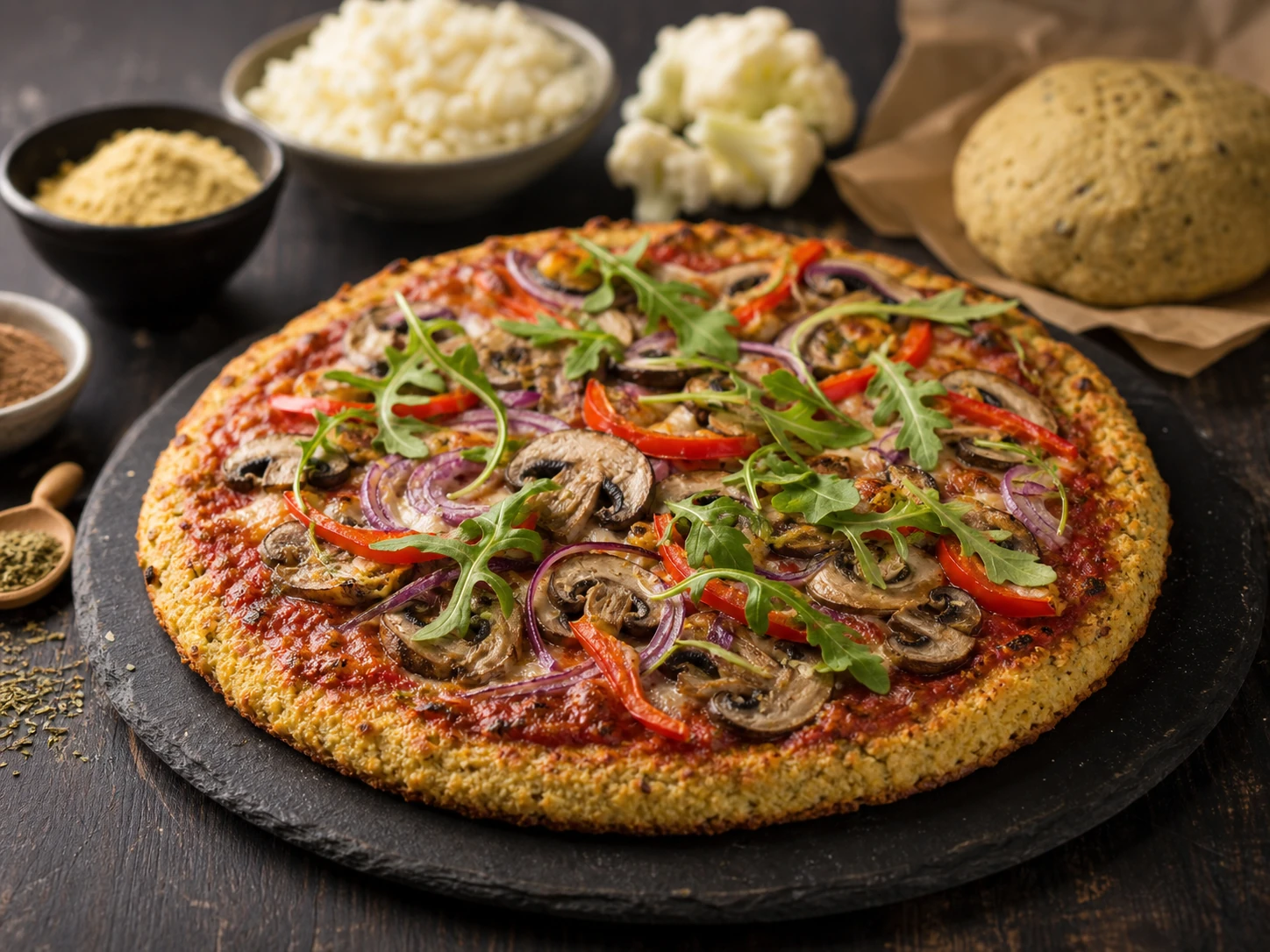
Why this formula works
Cauliflower crust fails when its water is guessed. Cooking releases moisture, then squeezing 600 g raw rice down to a target of about 200 g makes the formula repeatable. Flax gel and psyllium replace egg, chickpea flour supplies dry structure, and nutritional yeast plus garlic, oregano and smoked paprika create a savory base rather than a bland vegetable mat.
Honest timing
| Active preparation | 30 min |
| Hydration / proof / preheat | 15 min |
| Cooking / baking | 45 min |
| Elapsed total | 1 h 30 min |
Ingredients
- raw cauliflower rice, from about one medium head600 g (21.2 oz)
- finely milled chickpea flour70 g (2.47 oz)
- finely ground golden flaxseed30 g (1.06 oz)
- warm water, 35–40°C / 95–104°F90 g (3.17 oz)
- finely ground psyllium husk powder10 g (0.35 oz)
- nutritional yeast flakes20 g (0.71 oz)
- extra-virgin olive oil12 g (0.42 oz)
- fine sea salt, divided5 g (0.18 oz)
- garlic powder2 g (0.07 oz)
- dried oregano, rubbed fine2 g (0.07 oz)
- smoked paprika1 g
Equipment
- digital scale
- food processor or grater
- wide covered skillet or microwave-safe bowl
- clean strong kitchen towel or nut-milk bag
- large bowl
- two sheets of parchment
- 30 cm / 12 in pizza screen or tray
- cooling rack
Exact method
- 1. Cook the cauliflower rice with 2 g of the salt and no added water: covered in a wide skillet over medium heat for 8–10 minutes, or in a covered microwave-safe bowl for 6–8 minutes, stirring once.
- 2. Spread to cool until safe to handle. Wrap in a strong clean towel and squeeze repeatedly. Weigh the dry pulp: target 190–210 g. If heavier, squeeze again; do not compensate with extra flour.
- 3. Whisk ground flax with warm water and rest 10 minutes until thick and glossy.
- 4. Separately whisk chickpea flour, psyllium, nutritional yeast, remaining 3 g salt, garlic, oregano and smoked paprika until completely even.
- 5. Rub squeezed cauliflower apart with your fingers. Add flax gel, dry mixture and olive oil; knead by hand until no dry pockets remain. Rest 5 minutes for final hydration.
- 6. Press between parchment to a compact 30 cm round, 5–6 mm thick with a slightly thicker outer centimeter. Compress cracks firmly; remove the top paper.
- 7. Par-bake with the matching setup below until the top is dry, the edge is deep golden and the base can be turned as one sheet.
- 8. Turn onto a screen or fresh parchment, peel off the first paper and bake the second side 5–7 minutes until dry and lightly crisp.
- 9. Add no more than 70 g thick sauce and 110 g pre-cooked, drained vegan toppings. Finish until hot and rack-rest 5 minutes before slicing.
How to know it is ready
- Squeezed cauliflower weighs 190–210 g before binders are added.
- Par-baked base turns in one piece without a wet crease.
- Second side is dry before sauce.
- Rested slice is firm enough to lift but remains tender, not cracker-hard.
Troubleshooting
- Wet, weak center: squeezed cauliflower exceeded 210 g or topping was too moist.
- Crumbly edge: pulp was below 190 g, binders were underweighed or mixture was not compressed.
- Gummy layer: psyllium clumped because dry ingredients were not whisked first.
- Bland result: keep the measured nutritional yeast, garlic, oregano, paprika and salt rather than seasoning only the topping.
How to adapt the base recipe
- Frozen cauliflower rice works only when weighed at 600 g before cooking and still squeezed to the same 190–210 g target.
- For a 26 cm / 10 in thicker base, use the same formula and extend both par-bake stages until their visual endpoints.
- For strict gluten-free cooking, verify chickpea flour, nutritional yeast and seasonings and control all shared tools, towels and oven surfaces.
Storage and food safety
Cool the par-baked crust completely. Refrigerate airtight for 2 days or freeze flat with parchment for 2 months. Recrisp the bare base from chilled or thawed before topping.
Allergens
No EU/UK major allergen is intentionally included in the base formula.
Always verify every label and cross-contact risk; brand formulations can change.