Why this formula works
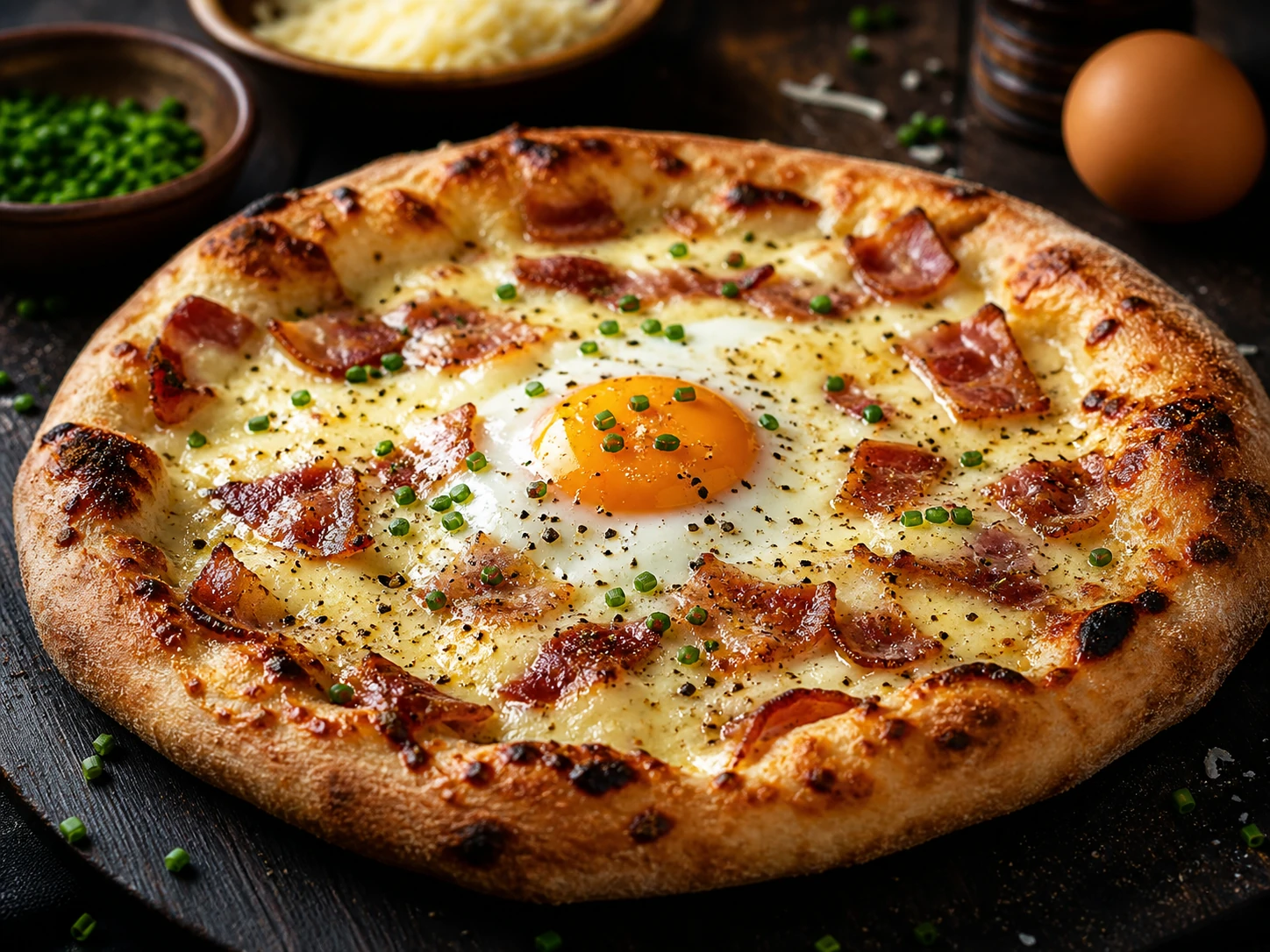
This borrows carbonara's cured pork, egg, hard cheese and pepper without pretending cream belongs in traditional pasta carbonara. Crème fraîche is a deliberate pizza base: it stays stable while pancetta is rendered separately. The egg goes on after the crust has set, and pasteurization supports the pictured soft-yolk endpoint; ordinary eggs must be cooked until both white and yolk are firm.
Honest timing
| Active preparation | 25 min |
| Hydration / proof / preheat | 1 h |
| Cooking / baking | 16 min |
| Elapsed total | 1 h 41 min |
Ingredients
- mature room-temperature pizza dough ball280 g (9.9 oz)
- crème fraîche100 g (3.5 oz)
- low-moisture mozzarella, coarsely grated110 g (3.9 oz)
- pancetta or unsmoked streaky bacon, cut into 1 cm pieces130 g (4.6 oz)
- large pasteurized shell egg, refrigerated1
- Parmigiano Reggiano, finely grated and divided50 g (1.76 oz)
- fresh chives, finely sliced15 g (0.53 oz)
- coarsely cracked black pepper, divided2.5 g (0.09 oz)
- fine sea salt1 g
Equipment
- cold skillet
- slotted spoon
- small bowl
- pizza steel or heavy inverted sheet
- pizza peel
- digital scale
- rack
Exact method
- 1. Preheat using the egg-pizza table below. Put pancetta in a cold skillet, set over medium heat and render 7–9 minutes until crisp at the edges. Drain on paper and cool.
- 2. Mix crème fraîche with 30 g Parmesan, 1.5 g pepper and the salt. Grate mozzarella and keep the pasteurized egg refrigerated.
- 3. Open the 280 g dough to 30 cm with a 1.5–2 cm rim. Move to a lightly dusted peel and confirm it slides.
- 4. Spread the seasoned crème fraîche, add mozzarella and distribute pancetta, leaving a shallow 9 cm well in the center.
- 5. Bake for the first stage in the matching setup below until the rim rises and the center has set; on steel this is about 4–5 minutes.
- 6. Crack the pasteurized egg into a cup and slide it into the center well. Add 10 g Parmesan around, not on, the yolk and finish until the white is opaque and set; on steel about 2–3 minutes.
- 7. Rest 60 seconds on a rack. Add remaining 10 g Parmesan, chives and remaining 1 g pepper.
- 8. Slice through the set white but around the yolk first, then spread yolk over portions at the table. With an ordinary unpasteurized egg, continue baking until yolk and white are firm.
How to know it is ready
- Pancetta is crisp-edged without a grease pool.
- Egg white is fully opaque and set.
- With a pasteurized egg, yolk may remain soft and glossy; ordinary egg yolk must be firm.
- The white base is creamy but does not run from the slice.
Troubleshooting
- Raw egg white: the center was not pre-set or the egg was added too early.
- Hard pictured yolk: shorten only the second stage, never the base pre-bake.
- Greasy center: render and drain pancetta before topping.
- Flat flavor: use the full pepper dose and reserve Parmesan and chives for after baking.
How to adapt the base recipe
- For two eggs, use a 35 cm, 340 g base and make two separate wells; do not crowd two eggs into this 30 cm center.
- Without a pasteurized egg, bake until white and yolk are firm.
- For guanciale, use 120 g and reduce added salt to zero.
Storage and food safety
Serve immediately. Refrigerate within 2 hours for up to 1 day. Reheat until the egg and center are steaming; a previously soft yolk will become firm and should not be kept runny during reheating.
Allergens
Egg, Gluten (wheat), Milk Depending on the selected product, may also contain: Sulphites.
Always verify every label and cross-contact risk; brand formulations can change.