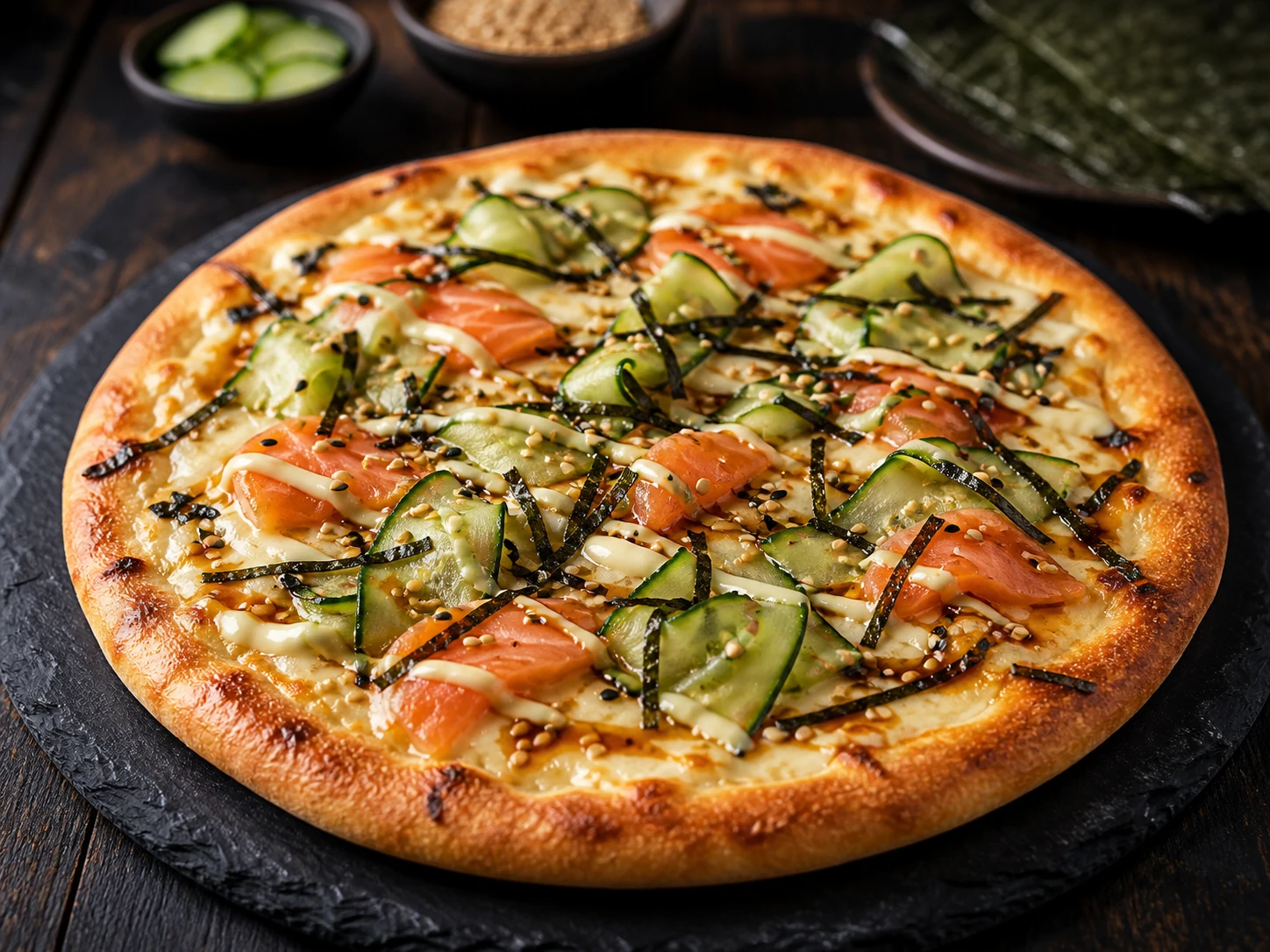
Why this formula works
This is sushi-inspired, not sushi and not a raw-fish recipe. The pizza separates hot dairy base from cold salmon, cucumber and nori. Cream cheese and mozzarella set into a firm layer; cucumber is de-seeded and dried; wasabi mayo stays in narrow lines. Tamari, rice vinegar, honey and lime form a measured sweet-sour-salty glaze without flooding the crust.
Honest timing
| Active preparation | 25 min |
| Hydration / proof / preheat | 1 h |
| Cooking / baking | 8 min |
| Elapsed total | 1 h 33 min |
Ingredients
- mature room-temperature pizza dough ball280 g (9.9 oz)
- full-fat cream cheese110 g (3.9 oz)
- low-moisture mozzarella, coarsely grated100 g (3.5 oz)
- cold-smoked salmon, kept refrigerated180 g (6.3 oz)
- seedless cucumber, shaved into ribbons120 g (4.2 oz)
- toasted nori sheet, cut into fine strips5 g (0.18 oz)
- mixed toasted white and black sesame seeds20 g (0.71 oz)
- thick wasabi mayonnaise containing egg and mustard80 g (2.82 oz)
- gluten-free tamari soy sauce25 g (0.88 oz)
- mild liquid honey15 g (0.53 oz)
- unseasoned rice vinegar15 g (0.53 oz)
- fresh lime juice, divided25 g (0.88 oz)
Equipment
- pizza steel or stone
- pizza peel
- vegetable peeler
- clean towels
- small saucepan
- scissors
- digital scale
- rack
Exact method
- 1. Preheat using the exact oven table below. Keep cold-smoked salmon below 4°C / 40°F and return it to refrigeration after weighing.
- 2. Shave cucumber into ribbons, avoiding the watery seed core. Press between clean towels for 10 minutes. Cut nori into 2 mm strips.
- 3. Simmer tamari, honey and rice vinegar for 60–90 seconds until lightly syrupy. Cool, then stir in 10 g lime juice.
- 4. Open the 280 g dough to 30–32 cm with a 1.5–2 cm rim. Move to a lightly dusted peel and confirm it slides.
- 5. Spread cream cheese thinly and add mozzarella. Bake with the matching setup below until underside browns and white base is fully set.
- 6. Rest exactly 2 minutes on a rack. Add dry cucumber ribbons and fold all 180 g salmon loosely across the pizza.
- 7. Drizzle all 80 g wasabi mayonnaise in narrow lines and the cooled tamari glaze in smaller lines. Add nori, sesame and remaining 15 g lime juice.
- 8. Cut immediately with a clean wheel and serve before cucumber releases moisture.
How to know it is ready
- The hot white base is set and brown before cold topping arrives.
- Salmon remains glossy and supple, never baked pale.
- Cucumber ribbons hold shape without water.
- Nori stays dry-edged and wasabi mayonnaise remains distinct.
Troubleshooting
- Wet finish: avoid cucumber core and dry ribbons for the full 10 minutes.
- Tough salmon: it entered the oven; every gram belongs on the rested base.
- Overpowering wasabi: use 80 g evenly in narrow lines, not concentrated blobs.
- Soggy nori: add it last over cold toppings, never beneath sauce.
How to adapt the base recipe
- People who are pregnant, older, very young or immunocompromised should use a fully cooked version with hot-smoked salmon and heat it until steaming hot.
- For cooked shrimp, replace salmon with 200 g fully cooked chilled shrimp and classify crustacean instead of fish allergen.
- For less sweetness, reduce honey to 8 g and increase rice vinegar to 20 g.
Storage and food safety
Serve immediately. Refrigerate within 2 hours and eat within 1 day. Remove cold toppings before reheating the base; people at increased risk should use only the fully heated fish version.
Allergens
Egg, Fish, Gluten (wheat), Milk, Mustard, Sesame, Soy Depending on the selected product, may also contain: Sulphites.
Always verify every label and cross-contact risk; brand formulations can change.