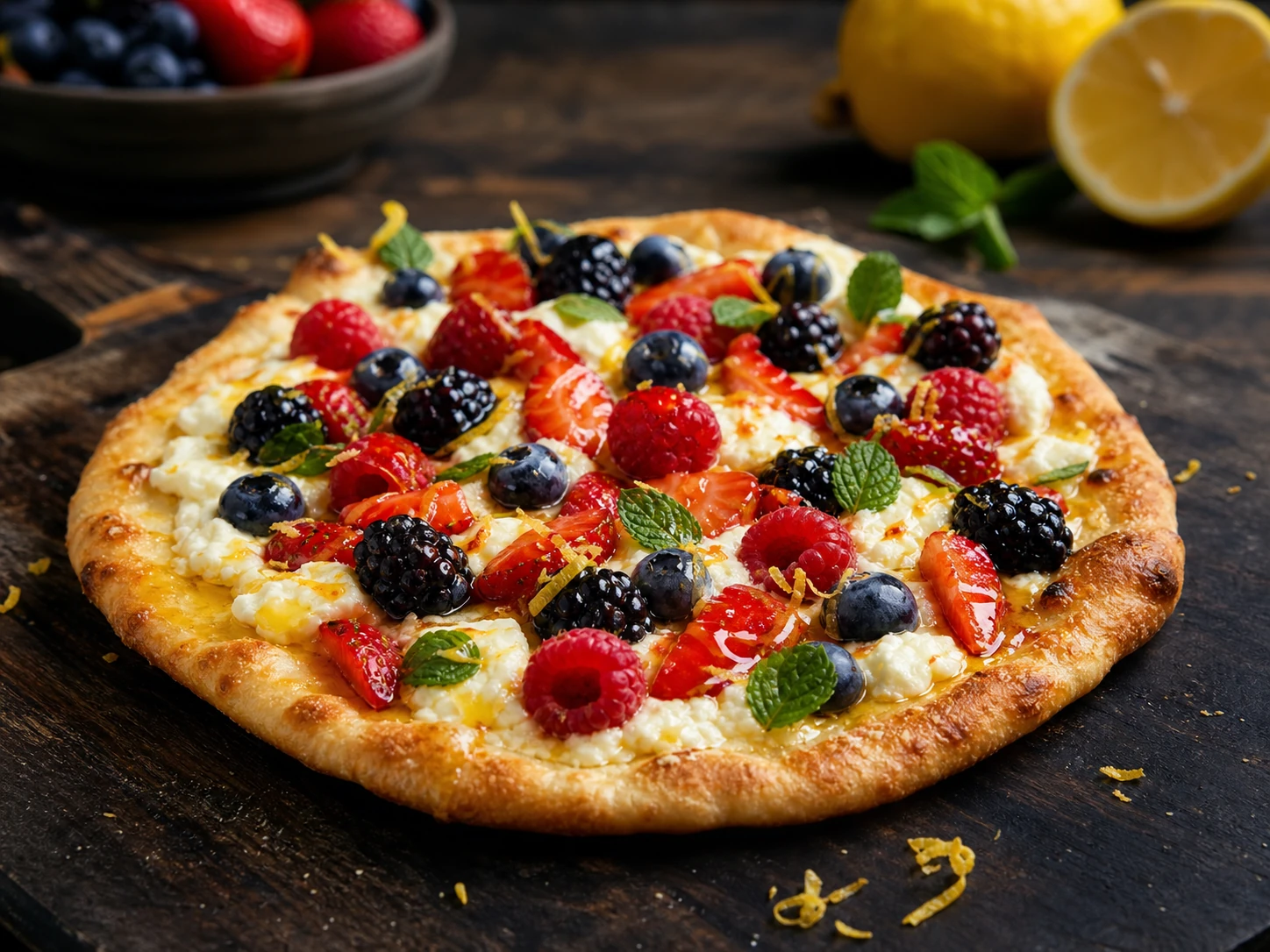
Why this formula works
The base bakes alone so berries never leak into raw dough. Drained ricotta is stabilized with mascarpone, then sharpened with zest and measured juice. A substantial 220 g berry layer remains fresh, but every berry is washed early and dried completely before touching the cream.
Honest timing
| Active preparation | 25 min |
| Hydration / proof / preheat | 45 min |
| Cooking / baking | 9 min |
| Elapsed total | 1 h 19 min |
Ingredients
- mature room-temperature pizza dough ball240 g (8.5 oz)
- unsalted butter, melted15 g (0.53 oz)
- fine sugar15 g (0.53 oz)
- whole-milk ricotta, drained 20 minutes180 g (6.3 oz)
- cold mascarpone50 g (1.76 oz)
- powdered sugar25 g (0.88 oz)
- finely grated unwaxed lemon zest4 g (0.14 oz)
- fresh lemon juice12 g (0.42 oz)
- vanilla extract2 g (0.07 oz)
- fine sea salt1 g
- mixed strawberries, raspberries, blueberries and blackberries220 g (7.8 oz)
- mild floral honey25 g (0.88 oz)
- small fresh mint leaves8 g (0.28 oz)
Equipment
- digital scale
- fine sieve
- salad spinner or clean towels
- electric whisk or food processor
- pizza peel
- baking steel or heavy inverted sheet
- cooling rack
Exact method
- 1. Drain ricotta in a sieve for 20 minutes while the selected pizza surface preheats according to the cold-finish dessert table.
- 2. Wash berries, hull and halve strawberries, then dry every surface completely. Refrigerate uncovered on a towel.
- 3. Whip drained ricotta, mascarpone, powdered sugar, lemon zest, lemon juice, vanilla and salt until smooth but still thick. Refrigerate.
- 4. Open dough to 28–30 cm, transfer to the peel and check sliding. Brush with butter and sprinkle sugar evenly inside the rim.
- 5. Bake the bare base with the matching setup until the underside is brown and center crisp. Rotate once, then rack-rest 5 minutes.
- 6. Spread whipped lemon ricotta over the warm, no-longer-steaming base, leaving a 1 cm border.
- 7. Arrange all berries in one abundant but even layer. Drizzle honey in thin lines and add mint leaves.
- 8. Cut and serve immediately; standing time releases berry juice and softens the cream layer.
How to know it is ready
- Bare base is crisp before cold cream is applied.
- Ricotta cream holds soft peaks rather than running.
- Berries show no wash water on their surfaces.
- Slice lifts cleanly for immediate service.
Troubleshooting
- Loose cream: ricotta was not drained or too much lemon juice was guessed.
- Wet base: berries were damp or cream was spread on a steaming crust.
- Torn fruit: dull knife crushed berries; use a sharp pizza wheel or knife.
- Flat lemon flavor: zest was omitted; juice alone gives acidity, not enough aroma.
How to adapt the base recipe
- Use any berry mix at 220 g, but cut large fruit to bite size.
- For 35 cm, use 300 g dough, 300 g berries and 300 g combined ricotta cream.
- For less sweetness, reduce honey to 15 g but keep powdered sugar for cream structure.
Storage and food safety
Refrigerate within 2 hours and use within 1 day. For best texture, store base, cream and berries separately and assemble only the amount being served.
Allergens
Gluten (wheat), Milk
Always verify every label and cross-contact risk; brand formulations can change.