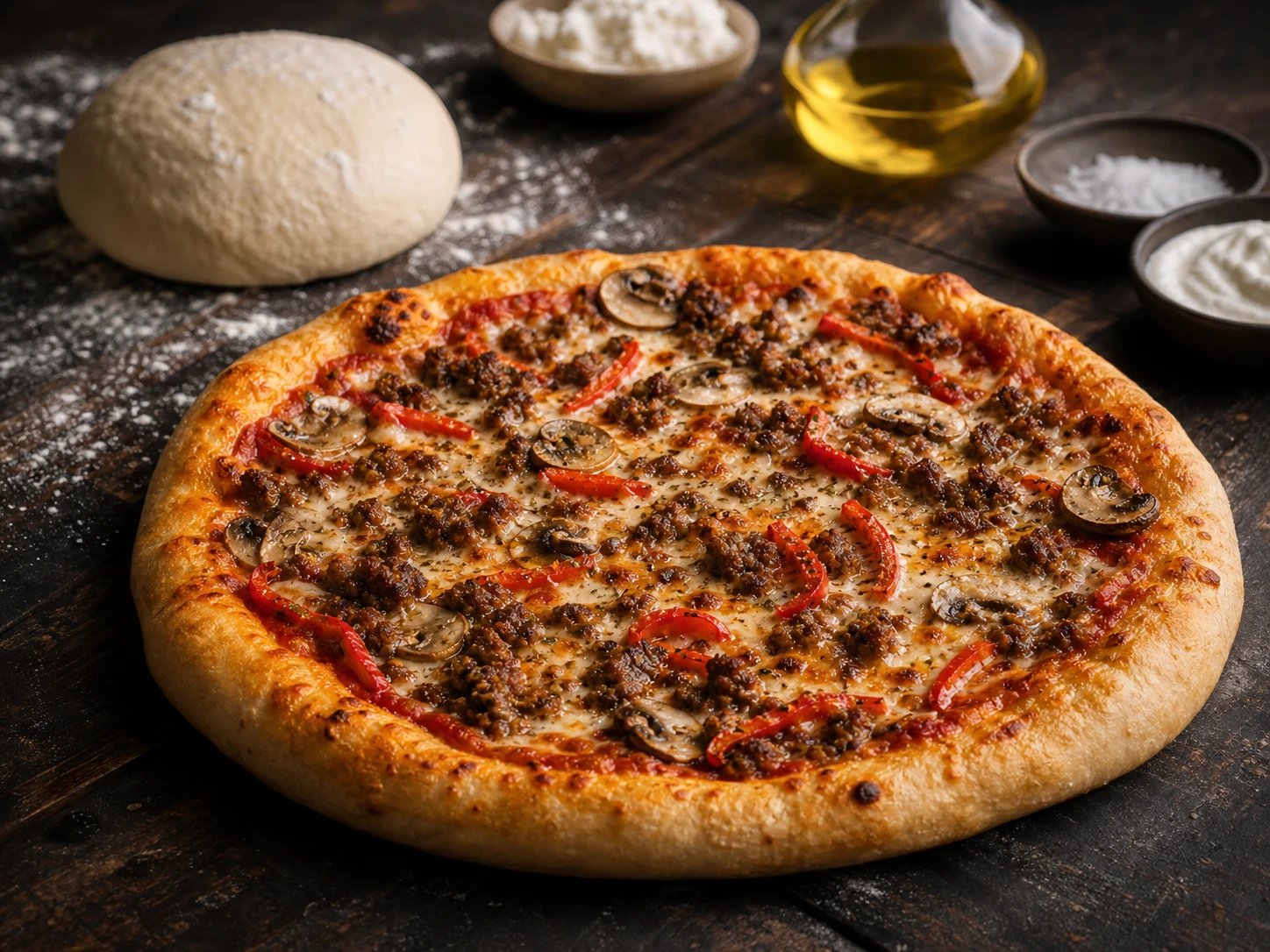
Why this formula works
Whey absorbs water and browns quickly, so more is not automatically better. Fifty grams enrich 400 g bread flour without replacing enough gluten to destroy stretch. Yogurt supplies additional protein, water and acidity; oil protects tenderness. A measured final dough temperature and full two-stage proof matter more than forcing a stiff mixture with extra flour.
Honest timing
| Active preparation | 20 min |
| Hydration / proof / preheat | 2 h 30 min |
| Cooking / baking | 12 min |
| Elapsed total | 3 h 2 min |
Ingredients
- strong bread flour, 12.5–13.5% protein400 g (14.1 oz)
- unflavored whey protein isolate50 g (1.76 oz)
- plain full-fat Greek yogurt200 g (7.1 oz)
- cool water, 20–22°C / 68–72°F210 g (7.4 oz)
- instant dry yeast5 g (0.18 oz)
- fine sea salt10 g (0.35 oz)
- extra-virgin olive oil20 g (0.71 oz)
Equipment
- digital scale
- stand mixer with dough hook or large bowl
- instant-read thermometer
- covered dough box
- bench scraper
- pizza steel or heavy inverted sheet
Exact method
- 1. Whisk bread flour and whey isolate until no protein pockets remain. In a second bowl, whisk yogurt, water and yeast smooth.
- 2. Add yogurt mixture to flour and mix until no dry flour remains. Cover and rest 15 minutes so whey and gluten hydrate.
- 3. Add salt and oil. Knead 7–9 minutes until smooth and elastic with a final dough temperature of 24–26°C / 75–79°F. It should feel soft and tacky, not dry.
- 4. Cover and bulk-ferment at 24–26°C / 75–79°F for 90 minutes. Fold once after 30 minutes; stop bulk when volume is about 60% larger, not necessarily doubled.
- 5. Divide into three portions of about 295 g. Shape tightly without tearing and place seam-side down in a covered dough box.
- 6. Proof 45 minutes at room temperature. A finger press should return slowly; if it snaps back immediately, rest another 15 minutes.
- 7. Preheat the chosen steel, fully preheated inverted sheet or stone oven according to the table below for its full time.
- 8. Open one ball by hand to 28–30 cm, preserving a 1.5 cm rim. Use light toppings because whey-rich dough browns before a very wet center dries.
- 9. Bake with the matching setup below and rotate as directed. Pull when underside is brown and center reaches a dry, flexible set; cool 60 seconds on a rack.
How to know it is ready
- Raw dough stretches to 28–30 cm without tearing or snapping hard.
- Crust browns evenly but does not scorch from whey.
- Center remains flexible rather than rubbery.
- Rim has fine even bubbles instead of a huge hollow shell.
Troubleshooting
- Dry tearing dough: do not add bench flour; yogurt or whey measurement was likely off.
- Fast dark top, pale base: lower the oven rack and reduce sugary toppings.
- Rubbery crumb: whey was overused or dough overbaked.
- Dense rim: allow full ball proof and open gently.
How to adapt the base recipe
- For more protein, change the topping rather than pushing whey above 60 g in this dough.
- For skyr, replace yogurt gram-for-gram and add 10–20 g water only if the mixed dough is genuinely stiff.
- For overnight fermentation, reduce yeast to 2 g, refrigerate after 30 minutes and temper balls before opening.
Storage and food safety
Refrigerate dough balls after shaping for up to 24 hours and bring toward room temperature before opening. Because yogurt is perishable, do not leave this dough warm beyond the stated proof.
Allergens
Gluten (wheat), Milk
Always verify every label and cross-contact risk; brand formulations can change.