Why this formula works
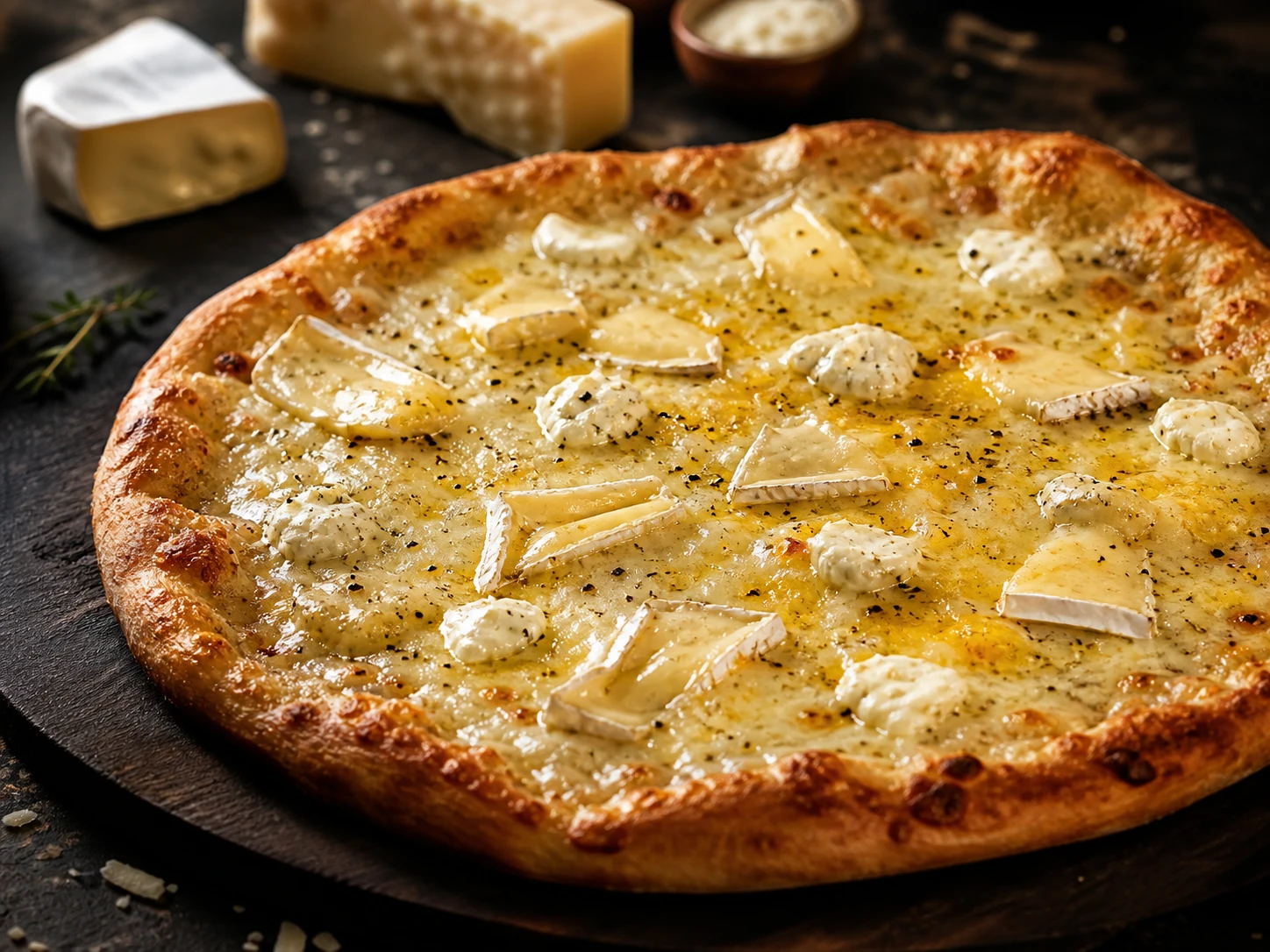
Three hundred and thirty grams of cheese is genuinely indulgent, but each cheese has a job. Mozzarella stretches, provolone and Fontina flow, Gruyère and cheddar deepen flavor, Pecorino seasons, while Brie and cream cheese remain visible creamy accents. A 280 g dough ball and only 80 g thick béchamel provide enough structure without making this heavy pizza dry.
Honest timing
| Active preparation | 25 min |
| Hydration / proof / preheat | 1 h |
| Cooking / baking | 10 min |
| Elapsed total | 1 h 35 min |
Ingredients
- mature room-temperature pizza dough ball280 g (9.9 oz)
- cold, thick béchamel80 g (2.82 oz)
- low-moisture mozzarella, coarsely grated70 g (2.47 oz)
- mild provolone, coarsely grated40 g (1.41 oz)
- Fontina, rind removed and coarsely grated40 g (1.41 oz)
- Gruyère, finely grated35 g (1.23 oz)
- mature cheddar, coarsely grated35 g (1.23 oz)
- Pecorino Romano, finely grated25 g (0.88 oz)
- Brie, chilled and sliced 4 mm thick50 g (1.76 oz)
- full-fat cream cheese, chilled35 g (1.23 oz)
- coarsely ground black pepper1 g
Equipment
- pizza steel or stone
- pizza peel
- digital scale
- coarse and fine graters
- two chilled bowls
- pizza wheel
Exact method
- 1. Preheat a steel or stone on the lower-middle rack at maximum heat for 60 minutes. Keep Brie and cream cheese refrigerated while preparing the other cheeses.
- 2. Coarsely grate mozzarella, provolone, Fontina and cheddar. Finely grate Gruyère and Pecorino. Spread any visibly damp cheese on a clean towel for 10 minutes.
- 3. Mix the six grated cheeses with half the black pepper. Do not compact the mixture; loose strands leave steam channels and melt more evenly.
- 4. Open the 280 g dough to 30 cm with a defined 1.5–2 cm rim. Move it to a lightly dusted peel and confirm it slides.
- 5. Spread 80 g cold béchamel in a thin layer to within 1.5 cm of the rim. It should hold ridges from the spoon rather than flow.
- 6. Scatter the grated-cheese blend evenly, keeping the center no thicker than the outer topping zone. Add Brie slices with gaps between them.
- 7. Place cream cheese in 10–12 small chilled dollops. Large spoonfuls stay cold while surrounding cheese overcooks.
- 8. Bake at 250–300°C / 482–572°F for 7–10 minutes, rotating once. If the top needs more color, use the broiler only after the underside is browned.
- 9. Rest on a rack for 2 minutes so the cheese matrix settles. Finish with remaining black pepper and cut into eight smaller slices.
How to know it is ready
- The underside is deeply browned and supports the heavy topping.
- Cheese is fully molten with small golden blisters, not a separated orange oil lake.
- Brie and cream cheese remain distinguishable from the grated blend.
- The center settles after two minutes but remains soft and stretchy.
Troubleshooting
- Grease pool: cheese was piled in the center or overheated after it had already melted.
- Pale, soft base: use the full preheat and a 280 g dough ball; do not add more sauce.
- Rubbery cheese: it baked too long; pull when the base is ready and only small blisters appear.
- Overly salty: weigh Pecorino and choose mild provolone; do not add salt automatically.
How to adapt the base recipe
- If one cheese is unavailable, replace it by function: Fontina with young Gouda, provolone with low-moisture mozzarella, or Gruyère with Comté. Keep total grated cheese unchanged.
- For a slightly lighter version, remove Brie and cream cheese and reduce the total topping by 85 g; it becomes a different, less creamy formula.
- For 35 cm, use a 340 g dough ball, 105 g béchamel and about 420 g total cheese, distributed just as evenly.
Storage and food safety
This pizza is best shared immediately. Refrigerate within 2 hours for up to 3 days. Reheat uncovered in a hot skillet or oven until the center is steaming; a microwave separates fat and softens the base.
Allergens
Gluten (wheat), Milk
Always verify every label and cross-contact risk; brand formulations can change.