Why this formula works
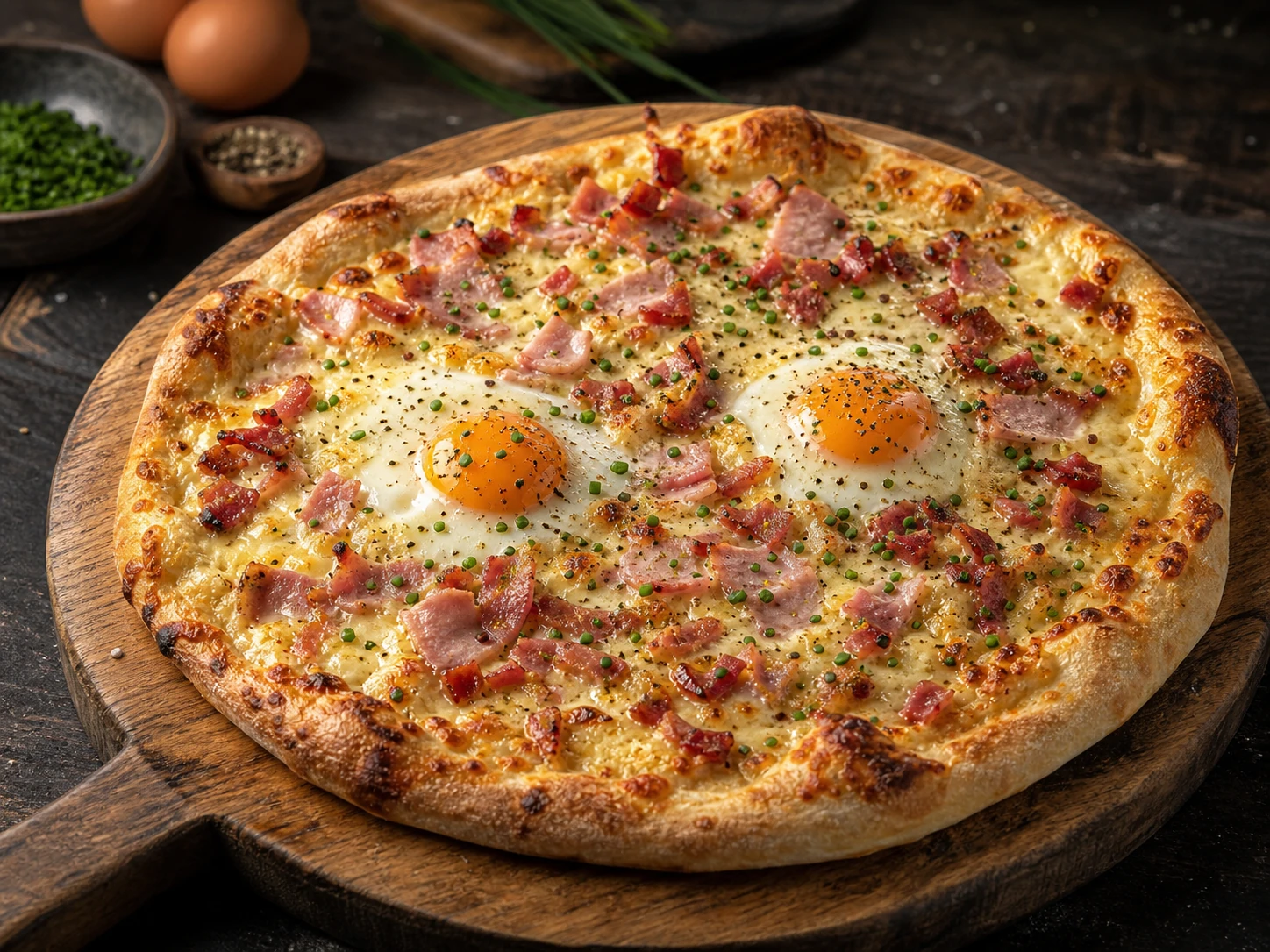
Bacon is rendered before topping, so 80 g brings crisp edges instead of flooding the cheese with raw fat. The 90 g cream base keeps the loaded pizza juicy, while a 280 g dough ball supports 100 g ham and two eggs. A staged bake gives the base a head start; pasteurized eggs permit the deliberately soft photographed yolk with lower risk than ordinary shell eggs.
Honest timing
| Active preparation | 25 min |
| Hydration / proof / preheat | 1 h |
| Cooking / baking | 16 min |
| Elapsed total | 1 h 41 min |
Ingredients
- mature room-temperature pizza dough ball280 g (9.9 oz)
- heavy cream, cold90 g (3.17 oz)
- low-moisture mozzarella, coarsely grated110 g (3.9 oz)
- cooked ham, sliced into 2 cm pieces100 g (3.5 oz)
- smoked streaky bacon, cut into 1 cm lardons80 g (2.82 oz)
- pasteurized large shell eggs2
- fresh chives, finely cut8 g (0.28 oz)
- coarsely ground black pepper1 g
Equipment
- pizza steel or stone
- pizza peel
- small skillet
- two small cups
- instant-read thermometer
- digital scale
- pizza wheel
Exact method
- 1. Preheat a steel or stone on the lower-middle rack at maximum heat for 60 minutes.
- 2. Put bacon in a cold skillet, set over medium heat and cook 5–6 minutes until roughly two-thirds rendered and lightly golden. Drain on paper; it will finish in the oven.
- 3. Stir cold cream with half the black pepper. Grate mozzarella, separate ham pieces and cut chives. Crack each egg into its own small cup so shell and freshness can be checked.
- 4. Open the 280 g dough ball to 30 cm, preserving a 1.5–2 cm rim. Move to a lightly dusted peel and verify that it slides.
- 5. Spread all 90 g seasoned cream to within 1.5 cm of the rim. Add mozzarella, ham and rendered bacon evenly, leaving two shallow 9 cm gaps for the eggs.
- 6. Bake at 250–300°C / 482–572°F for 3–4 minutes, rotating once, until the rim begins to set but the cheese remains pale.
- 7. Pull the rack partway out, press the two gaps again with a spoon and slide one egg into each. Return immediately and bake another 4–6 minutes.
- 8. For the photographed-style endpoint, use only the specified pasteurized eggs and pull when every trace of white is opaque and set while the yolks remain thick and glossy. For pregnant people, young children, older adults or anyone immunocompromised, continue until both yolk and white are firm and the egg areas reach 71°C / 160°F.
- 9. Rest on a rack for 60 seconds. Finish with chives and remaining black pepper, then cut around the yolks so they can be shared across slices.
How to know it is ready
- The underside is browned and supports both egg wells.
- Bacon edges are crisp and no large fat pool sits on the cheese.
- With pasteurized eggs, every trace of white is opaque and set while the pictured yolks remain thick and glossy.
- Ham stays moist with lightly browned edges rather than becoming hard.
Troubleshooting
- Raw white with dark crust: create wider egg wells, use room-temperature eggs and add them earlier next time.
- Hard egg before the base browns: strengthen bottom heat and delay adding the eggs by 1 minute.
- Greasy surface: render bacon first and drain it; do not cook raw lardons entirely on the pizza.
- Watery cream center: use heavy cream, low-moisture cheese and the full preheat.
How to adapt the base recipe
- For the fully cooked safety endpoint, continue until yolk and white are firm and verify 71°C / 160°F; this is the recommended version for higher-risk diners.
- For one egg, reduce cream to 80 g and keep the meat quantities unchanged.
- For 35 cm, use a 340 g dough ball, 120 g cream, 145 g mozzarella, 130 g ham, 105 g bacon and three pasteurized eggs.
Storage and food safety
Egg-and-meat pizza is best fresh. Refrigerate within 2 hours for up to 2 days. Reheat until the center and egg reach 74°C / 165°F; the yolk will become firm, which is safer than trying to preserve a soft leftover egg.
Allergens
Egg, Gluten (wheat), Milk Depending on the selected product, may also contain: Mustard, Sulphites.
Always verify every label and cross-contact risk; brand formulations can change.