Why this formula works
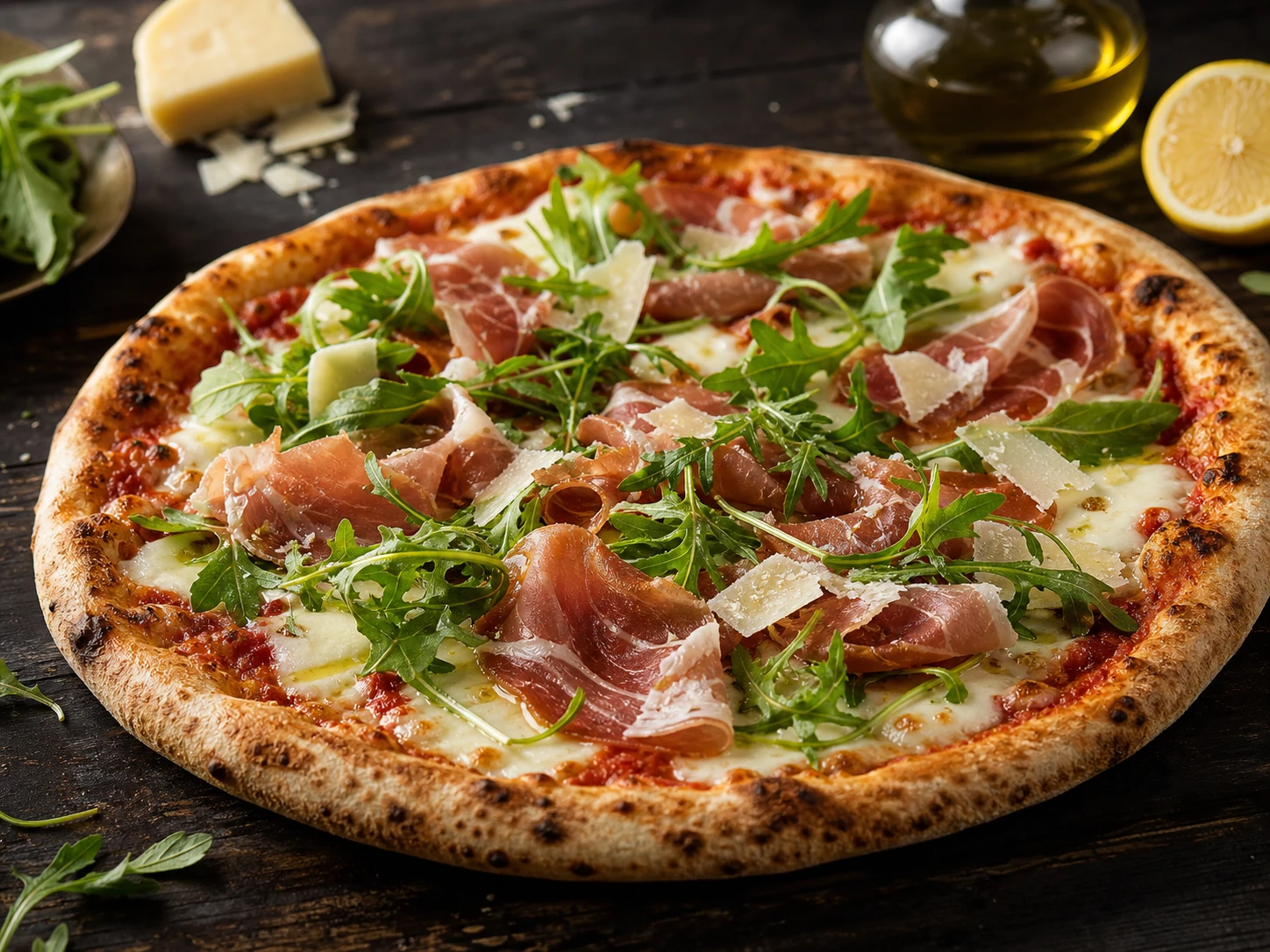
Only tomato and mozzarella enter the oven. Prosciutto warms on residual heat without turning leathery, while thoroughly dried rocket stays fresh rather than steaming. A tiny lemon-oil dressing coats the leaves; it is not poured onto the crust.
Honest timing
| Active preparation | 20 min |
| Hydration / proof / preheat | 1 h |
| Cooking / baking | 8 min |
| Elapsed total | 1 h 28 min |
Ingredients
- mature room-temperature pizza dough ball250 g (8.8 oz)
- thick pizza tomato sauce95 g (3.35 oz)
- well-drained fior di latte, torn small100 g (3.5 oz)
- Prosciutto di Parma, very thinly sliced70 g (2.47 oz)
- young rocket leaves, washed and completely dried35 g (1.23 oz)
- Parmigiano Reggiano, shaved25 g (0.88 oz)
- fresh lemon juice5 g (0.18 oz)
- extra-virgin olive oil10 g (0.35 oz)
Equipment
- pizza steel or stone
- pizza peel
- salad spinner or clean towel
- vegetable peeler
- pizza wheel
Exact method
- 1. Preheat a steel or stone on the lower-middle rack at maximum heat for 60 minutes.
- 2. Drain mozzarella and tear into 1.5 cm pieces. Wash rocket, spin or towel it completely dry and keep it cool.
- 3. Whisk lemon juice with 6 g olive oil. Toss with rocket only in the final minute before serving.
- 4. Open the dough to 28–30 cm, preserve the rim and move it to a peel that allows the base to slide.
- 5. Spread 95 g tomato to within 1.5 cm of the rim, add mozzarella evenly and drizzle the remaining 4 g oil over the exposed tomato.
- 6. Bake at 250–300°C / 482–572°F for 5–8 minutes, rotating once, until the bottom is browned and the cheese has melted.
- 7. Rest 60 seconds. Drape prosciutto in loose folds across the hot pizza; do not press it into a sealed layer.
- 8. Dress the rocket lightly, distribute it over the prosciutto, add Parmigiano shavings and cut immediately.
How to know it is ready
- The baked base is browned and stable before cold toppings are added.
- Prosciutto remains soft, translucent and loosely folded.
- Rocket is glossy but dry enough that no dressing collects on the pizza.
Troubleshooting
- Wilted watery rocket: leaves were not dried or were dressed too early.
- Tough prosciutto: it went into the oven; add it only after baking.
- Soggy center: drain mozzarella and keep dressing off the crust.
- Over-salty pizza: do not salt tomato automatically; prosciutto and Parmigiano already season it.
How to adapt the base recipe
- For a juicier base, increase tomato to 110–115 g while keeping the rocket dressing unchanged.
- Bresaola can replace prosciutto gram for gram, but it is leaner and should receive another 2 g oil.
- For 35 cm, use 130 g tomato, 125 g mozzarella, 90 g prosciutto and 45 g rocket.
Storage and food safety
Serve immediately. If needed, remove loose rocket before reheating. Refrigerate within 2 hours and use within 2 days because dressed leaves deteriorate quickly.
Allergens
Gluten (wheat), Milk
Always verify every label and cross-contact risk; brand formulations can change.
Technical references
When to add prosciutto and arugula
Add both after baking. Heat makes prosciutto dry and aggressively salty, while arugula turns limp. Bake only the tomato-and-mozzarella base, rest it for 60 seconds, then finish in layers.
| Stage | Ingredient | Reason |
|---|---|---|
| Before baking | 95 g tomato sauce, 100 g fior di latte | Builds the stable hot base |
| After a 60-second rest | 70 g prosciutto | Residual heat releases aroma without cooking it |
| Immediately before serving | 35 g dry arugula, 25 g Parmigiano | Keeps leaves fresh and cheese distinct |
| Final seasoning | 5 g lemon, 10 g olive oil | Adds measured acidity without soaking the crust |
Rocket and arugula are the same leaf; “rucola” is the Italian name. Dry it completely and dress it lightly before it touches the pizza.