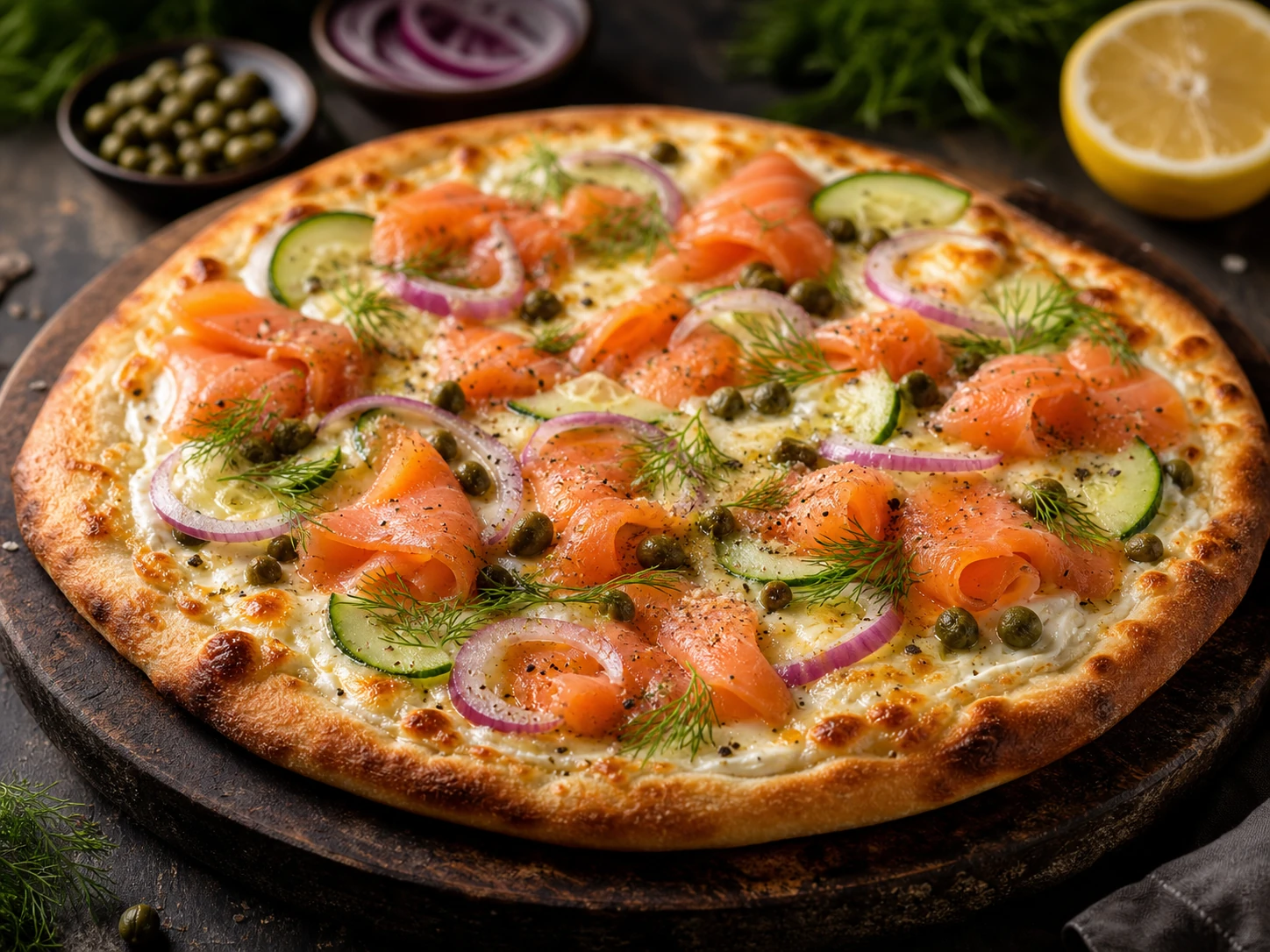
Why this formula works
The oven handles only the stable white base: 120 g cream cheese and 80 g low-moisture mozzarella. Salmon, cucumber, onion, capers, dill and lemon remain cold, preserving silky fish and crisp vegetables. One hundred and fifty grams salmon is generous enough to cover every slice without being cooked dry.
Honest timing
| Active preparation | 25 min |
| Hydration / proof / preheat | 1 h |
| Cooking / baking | 8 min |
| Elapsed total | 1 h 33 min |
Ingredients
- mature room-temperature pizza dough ball250 g (8.8 oz)
- full-fat pasteurized cream cheese, cold120 g (4.2 oz)
- low-moisture mozzarella, coarsely grated80 g (2.82 oz)
- refrigerated cold-smoked salmon, kept at 4°C / 40°F or below150 g (5.3 oz)
- red onion, sliced into 2 mm rings60 g (2.12 oz)
- capers in brine, drained and rinsed25 g (0.88 oz)
- fresh dill fronds12 g (0.42 oz)
- unwaxed lemon, 2 g zest plus 18 g juice20 g (0.71 oz)
- small firm cucumber, sliced 1–2 mm thick80 g (2.82 oz)
- coarsely ground black pepper1 g
Equipment
- pizza steel or stone
- pizza peel
- mandoline or sharp knife
- small bowl
- clean kitchen towels
- fine grater
- digital scale
- pizza wheel
Exact method
- 1. Preheat a steel or stone on the lower-middle rack at maximum heat for 60 minutes. Keep salmon refrigerated until the baked base has rested.
- 2. Soak onion rings in cold water for 10 minutes, drain and blot completely dry. Slice cucumber 1–2 mm thick, spread it on a towel and blot both sides.
- 3. Rinse and drain capers. Wash and dry dill. Measure 2 g lemon zest and 18 g juice. Separate salmon into broad loose folds without warming it.
- 4. Stir cream cheese with half the dill, lemon zest, 8 g lemon juice and half the black pepper. Grate mozzarella.
- 5. Open the dough to 28–30 cm, preserving a 1.5–2 cm rim. Move to a lightly dusted peel and confirm it slides.
- 6. Spread the seasoned cream cheese in a thin even layer and add mozzarella. Bake at 250–300°C / 482–572°F for 5–8 minutes, rotating once, until the underside browns.
- 7. Rest the hot white base on a rack for 2 minutes. Arrange cold cucumber and onion first, then drape all 150 g salmon in folds so heat can escape between pieces.
- 8. Add capers and remaining dill. Drizzle the remaining 10 g lemon juice over the salmon, finish with remaining pepper and serve immediately.
How to know it is ready
- The hot base is browned and firm before any cold topping is added.
- Salmon stays glossy, silky and coral-colored rather than pale and cooked.
- Cucumber remains crisp with no clear water around it.
- Cream cheese is hot and set beneath the cold topping, not a runny white puddle.
Troubleshooting
- Soggy finish: blot cucumber and onion, and rest the hot base on a rack before topping.
- Dry salmon: it was exposed to oven heat; every slice belongs on the rested base.
- Overly salty pizza: rinse capers and do not add automatic salt to cream cheese or salmon.
- Topping slides: use broad salmon folds, a thin cream-cheese layer and a two-minute rest.
How to adapt the base recipe
- For pregnant people, older adults, young children or anyone immunocompromised, do not use cold-smoked salmon as a cold topping. Use hot-smoked salmon in a cooked version and heat the fish area to 74°C / 165°F.
- For no cucumber, replace 80 g cucumber with 40 g thoroughly dried rocket after baking; the result becomes more peppery and less cooling.
- For 35 cm, use a 300–320 g dough ball, 155 g cream cheese, 105 g mozzarella, 200 g salmon, 80 g onion, 32 g capers and 105 g cucumber.
Storage and food safety
Serve immediately and return unused salmon to the refrigerator promptly. Refrigerate the finished pizza within 2 hours and use within 1 day. For leftovers, remove the cold topping where practical, reheat the base until steaming and add freshly chilled toppings; higher-risk diners should not eat the cold-smoked version.
Allergens
Fish, Gluten (wheat), Milk Depending on the selected product, may also contain: Sulphites.
Always verify every label and cross-contact risk; brand formulations can change.