Why this formula works
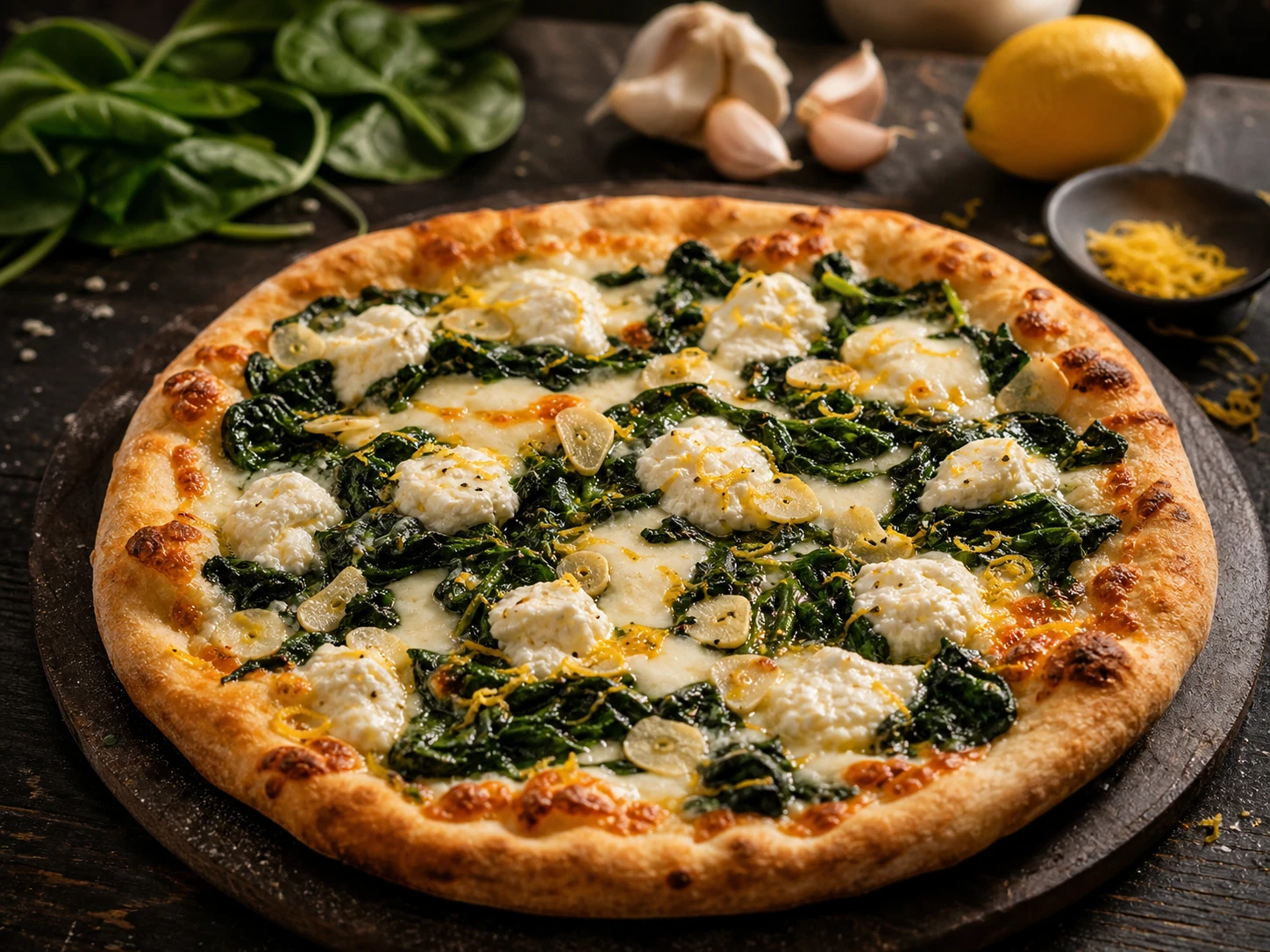
Fresh spinach loses most of its volume and releases substantial water. Wilting 180 g first, then cooling and pressing it to roughly 75–85 g cooked spinach gives real coverage without steaming the base. Drained ricotta stays in distinct creamy spoonfuls; lemon zest added after baking keeps the white pizza lively.
Honest timing
| Active preparation | 25 min |
| Hydration / proof / preheat | 1 h |
| Cooking / baking | 13 min |
| Elapsed total | 1 h 38 min |
Ingredients
- mature room-temperature pizza dough ball250 g (8.8 oz)
- fresh baby spinach, washed and spun dry180 g (6.3 oz)
- whole-milk ricotta, drained150 g (5.3 oz)
- low-moisture mozzarella, coarsely grated100 g (3.5 oz)
- garlic, sliced paper-thin10 g (0.35 oz)
- freshly grated nutmeg0.3 g
- finely grated unwaxed lemon zest2 g (0.07 oz)
- extra-virgin olive oil15 g (0.53 oz)
- fine sea salt3 g (0.11 oz)
- freshly ground black pepper1 g
Equipment
- wide skillet with lid
- fine sieve
- clean kitchen towel
- pizza steel or stone
- pizza peel
- fine grater
- pizza wheel
Exact method
- 1. Preheat a steel or stone on the lower-middle rack at maximum heat for 60 minutes. At the same time, drain ricotta in a fine sieve for at least 20 minutes.
- 2. Heat 8 g olive oil in a wide skillet. Add half the garlic for 20 seconds, then add spinach in two batches with 1 g salt. Cover for 30 seconds, uncover and toss until just wilted, 2–3 minutes total.
- 3. Spread spinach on a plate to cool. Wrap it in a clean towel and press firmly but not bone-dry; target roughly 75–85 g cooked spinach. Chop it into bite-size ribbons.
- 4. Mix the drained ricotta with nutmeg, black pepper and 1 g salt. Grate mozzarella and keep the lemon zest covered for the post-bake finish.
- 5. Open the dough to 28–30 cm, preserving a 1.5–2 cm rim. Transfer to a lightly dusted peel and confirm it slides.
- 6. Distribute mozzarella in a thin layer. Add spinach in loose tufts, then place ricotta in 10–12 small spoonfuls with gaps between them. Scatter the remaining raw garlic slices.
- 7. Drizzle 4 g olive oil over the topping. Bake at 250–300°C / 482–572°F for 5–8 minutes, rotating once, until the underside browns and the ricotta edges begin to color.
- 8. Rest on a rack for 60 seconds. Finish with lemon zest, remaining 3 g olive oil and remaining 1 g salt; cut while the spinach remains green and the ricotta creamy.
How to know it is ready
- The center lifts cleanly with no green liquid escaping.
- Ricotta is creamy inside with lightly colored edges, not dry and grainy.
- Spinach remains deep green rather than grey.
- Lemon is aromatic at the table without making the cheese taste sour.
Troubleshooting
- Wet pizza: cool and press the wilted spinach; raw spinach releases its water too late.
- Dry, chalky ricotta: use whole-milk ricotta and keep it in larger spoonfuls.
- Burnt garlic: slice paper-thin, keep half protected in the spinach and watch strong top heat.
- Flat flavor: add the measured lemon zest and final salt after baking rather than more cheese.
How to adapt the base recipe
- Frozen spinach works: thaw 220 g, squeeze to 75–85 g and skip the wilting stage.
- For stronger cheese, add 20 g finely grated Parmigiano and reduce the final salt by 0.5 g.
- For 35 cm, use a 300–320 g dough ball, 240 g raw spinach, 200 g ricotta and 130 g mozzarella.
Storage and food safety
Serve promptly. Refrigerate within 2 hours for up to 2 days. Reheat uncovered on a hot skillet or steel until the center is steaming; do not seal the hot pizza in a container because trapped steam softens the base.
Allergens
Gluten (wheat), Milk
Always verify every label and cross-contact risk; brand formulations can change.