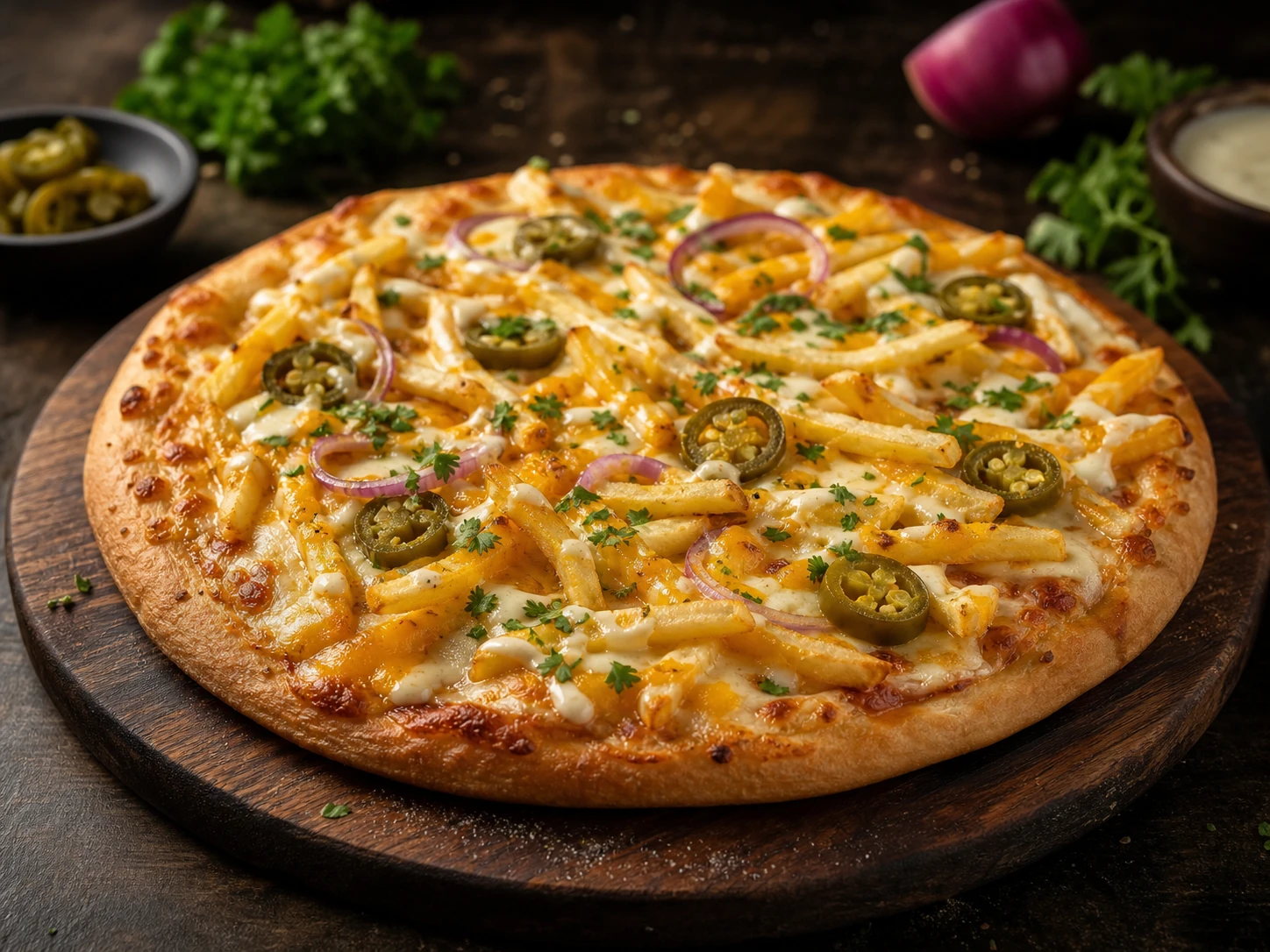
Why this formula works
Fries have to become almost fully crisp before they meet dough. A 320 g base and 100 g mozzarella form the structure; 180 g sauce and 130 g cheddar deliver the juicy loaded-fries character. The sauce must be thick enough to hold a spoon track, jalapeños and onion are dried, and the cold garlic sauce goes on only after baking so the fries retain crisp edges.
Honest timing
| Active preparation | 20 min |
| Hydration / proof / preheat | 1 h |
| Cooking / baking | 28 min |
| Elapsed total | 1 h 48 min |
Ingredients
- mature strong pizza dough ball320 g (11.3 oz)
- frozen straight-cut oven fries300 g (10.6 oz)
- very thick warm cheese sauce180 g (6.3 oz)
- low-moisture mozzarella, coarsely grated100 g (3.5 oz)
- mature cheddar, coarsely grated130 g (4.6 oz)
- pickled jalapeño rings, very well drained60 g (2.12 oz)
- red onion, cut into thin rings80 g (2.82 oz)
- thick yogurt-mayonnaise garlic sauce containing milk, egg and mustard100 g (3.5 oz)
- flat-leaf parsley, finely chopped15 g (0.53 oz)
- neutral high-heat oil15 g (0.53 oz)
- smoked paprika2 g (0.07 oz)
- ground cumin1 g
- fine sea salt3 g (0.11 oz)
Equipment
- large metal tray
- pizza steel or second heavy inverted sheet
- pizza peel
- fine sieve
- digital scale
- rack
- squeeze bottle or spoon
Exact method
- 1. Heat the oven to 230°C / 446°F. Toss frozen fries with oil, smoked paprika, cumin and 2 g salt. Spread in one layer on a hot tray and bake 18–22 minutes until deeply golden and almost crisp.
- 2. Remove fries to a rack so steam escapes. Raise the oven and preheat the chosen pizza surface for the full loaded-pizza time below; a steel needs a complete 60-minute saturation.
- 3. Drain jalapeños and blot dry. Soak onion rings in cold water for 10 minutes, drain and dry. Warm cheese sauce only until spreadable; it must remain very thick.
- 4. Open the 320 g dough to 32 cm with a 2 cm rim. Move to a lightly dusted peel and confirm it slides.
- 5. Spread all 180 g cheese sauce in a thin even layer and add mozzarella. Distribute crisp fries in a loose single layer, then add cheddar, jalapeños and onion.
- 6. Bake using the matching loaded setup below. On steel, allow 7–10 minutes and rotate once; pull when the base is deeply brown, cheddar bubbles and fry tips have re-crisped.
- 7. Rest 60 seconds on a rack. Drizzle all 100 g cold garlic sauce in thin lines, then add parsley and remaining 1 g salt.
- 8. Cut into eight narrow slices and serve immediately, before steam from the cheese softens the fries.
How to know it is ready
- Fries have crisp brown tips and fluffy centers.
- Cheese sauce stays beneath the fries without running from a lifted slice.
- The 32 cm center lifts despite the heavy topping.
- Cold garlic sauce forms bright lines instead of a hot oily film.
Troubleshooting
- Soft fries: pre-bake darker, cool on a rack and use a single topping layer.
- Wet pizza: thicken cheese sauce and dry jalapeños and onion.
- Raw center: use the loaded profile and keep fries away from one central pile.
- Bland starch: season fries before pre-baking and use both smoky paprika and cumin.
How to adapt the base recipe
- For meat-loaded fries, add 150 g fully cooked crisp bacon or doner meat and move to a 35 cm, 350 g base.
- For a tomato version, replace 60 g cheese sauce with 60 g thick tomato, not the entire cheese layer.
- For less heat, halve jalapeño but keep garlic sauce and spices unchanged.
Storage and food safety
Best immediately. Refrigerate within 2 hours for up to 2 days. Remove any loose cold sauce, reheat uncovered on a hot surface until fries re-crisp, then add fresh sauce and parsley.
Allergens
Egg, Gluten (wheat), Milk, Mustard Depending on the selected product, may also contain: Sulphites.
Always verify every label and cross-contact risk; brand formulations can change.