Timing for this recipe
Complete recipe including its own yeast dough and onion preparation. Proof at 24–26°C/75–79°F. During the 60–75 minute bulk proof, slice onions for five to seven minutes, soften for eight to ten minutes and cool for at least ten minutes; these overlap the proof. Start the oven after 45 minutes of bulk proofing and allow at least 35–40 minutes to preheat.
| Preheat alongside preparation | 35–40 min |
|---|---|
| Weigh ingredients for the dough | 3–5 min |
| Knead the 60% hydration dough | 8–10 min |
| Bulk proof; slice, soften and cool onions | 1 hr–1 hr 15 min |
| Per pizza, shape a 320 g base and 178 g lid | 5–7 min |
| Relax the covered unequal dough pieces | 20–30 min |
| Line the pan, enclose cheese and add onions | 7–10 min |
| Bake the stuffed fugazzeta in the home oven | 25–32 min |
| Let the cheese filling settle before slicing | 10 min |
| Approximate elapsed time | 2 hr 18 min–2 hr 59 min |
| From mature dough made to this recipe | 1 hr 10 min–1 hr 22 min |
These times include the work and rests described here. Temperature, equipment and ripeness can make things quicker or slower.
Heat the oven during the preparation or rest. If it still needs longer, add that extra time.
Additional schedule from mature homemade dough
From already relaxed dough pieces made to this exact fugazzeta formula: a 320 g/11.29 oz base and 178 g/6.28 oz lid per pizza. Onions start raw; slicing, softening, cooling, cold-oven preheating and baking are included.
The schedule shows the longer option. All times start with mature dough.
| Phase | Start from this point | Duration in the longer schedule |
|---|---|---|
| Preheat oven | 0 min | 40 min |
| Slice the full onion quantity | 0 min | 7 min |
| Soften the onions gently | 7 min | 10 min |
| Cool the onion topping on a wide plate | 17 min | 10 min |
| Line the pan, enclose cheese and add onions | 27 min | 10 min |
| Bake the stuffed fugazzeta in the home oven | 40 min | 32 min |
| Let the cheese filling settle before slicing | 1 hr 12 min | 10 min |
Cooking mode
Selected quantity: 1 stuffed pizza
Original yield: 1 stuffed pizza from 498 g / 17.57 oz dough, metal pan with a 28 cm / 11 in inside diameter · 4 standard servings
Choose a whole number. Each item keeps the size, weight and shape given in the recipe.
Nutrition is estimated per standard serving and for the whole selection.
US units show weights in ounces and liquids in US fluid ounces.
More info
Measuring spoons use 1 tsp = 5 ml and 1 tbsp = 15 ml here.
Estimated nutrition for your selection
| Nutrition | ¼ stuffed pizza | Selected quantity |
|---|---|---|
| Energy | 533 kcal | 2,133 kcal |
| Protein | 25.8 g | 103.1 g |
| Carbohydrate | 58.7 g | 234.8 g |
| Fat | 21.3 g | 85.3 g |
| Salt | 2.69 g | 10.76 g |
Ingredients
1 stuffed pizza · 1× original recipe
Original yield/size: 1 stuffed pizza from 498 g / 17.57 oz dough, metal pan with a 28 cm / 11 in inside diameter
The ingredient list shows the totals for this selection. Amounts per item stay the same.
- 300 g (10.58 oz) strong white bread flour, about 11–13% protein
- 180 g (6.35 oz) water for the dough
- 3 g (0.11 oz) instant dry yeast
- 8 g (0.28 oz) fine salt, divided: 6 g for dough and 2 g for onions
- 25 g (0.88 oz) olive oil, divided: 9 g for dough, 8 g for pan and 8 g for onions
- 300 g (10.58 oz) low-moisture mozzarella made with microbial rennet
- 300 g (10.58 oz) onion, weighed peeled
- 1 pinch dried oregano (about 0.5 g)
Equipment
- Oven
- round metal pan with a 28 cm / 11 in inside diameter and at least 3 cm / 1¼ in sides
- kitchen scale
- covered bowl
- dough scraper
- rolling pin
- wide frying pan
- cooling rack
- wide spatula
Method
Before shaping or topping, divide the ingredients between 1 stuffed pizza at their original size. Prepare each item as described. Do not multiply cooking times by the number of items. Extra batches still take extra time. Look for the doneness cues in the recipe.
- Knead the dough from scratch Mix flour and instant yeast. Add the water at about 28°C/82°F, the 6 g dough salt and 9 g oil. Knead for eight to ten minutes into a supple slightly tacky dough. Reserve the other 2 g salt and 16 g oil for onions and pan.
- Bulk proof and prepare onions in parallel Cover dough at 24–26°C/75–79°F for 60–75 minutes until noticeably airy and roughly one-and-a-half times its initial volume. Meanwhile slice the full 300 g onions thinly, allowing five to seven minutes. Soften with 8 g oil and the remaining 2 g salt over medium-low heat for eight to ten minutes. Spread on a wide plate and cool for at least ten minutes.
- Start the oven after 45 minutes of bulk proofing After 45 minutes of bulk proofing, start the oven at 220°C/428°F conventional or 200°C/392°F fan, Gas Mark 7. Allow at least 35–40 minutes before baking. The remaining bulk proof, dividing and final proof overlap this preheat. Keep the metal pan out of the oven for now.
- Divide deliberately unequal base and lid Weigh the dough. Portion 320 g/11.29 oz per pizza for the base. Portion 178 g/6.28 oz per pizza for the lid. If a little dough is lost to the bowl, divide the actual weight in the same 320:178 ratio. Round both loosely and rest covered for 20–30 minutes. Make one such pair for every additional pizza.
- Line the pan and add the cheese Use 8 g oil per pizza to coat the 28 cm/11 in pan and corners. Roll the larger 320 g/11.29 oz piece per pizza to about 32 cm/12½ in and line the pan with raised sides. Distribute 300 g/10.58 oz mozzarella per pizza, leaving about 2 cm/¾ in clear all around. Keep the filling level without packing it down.
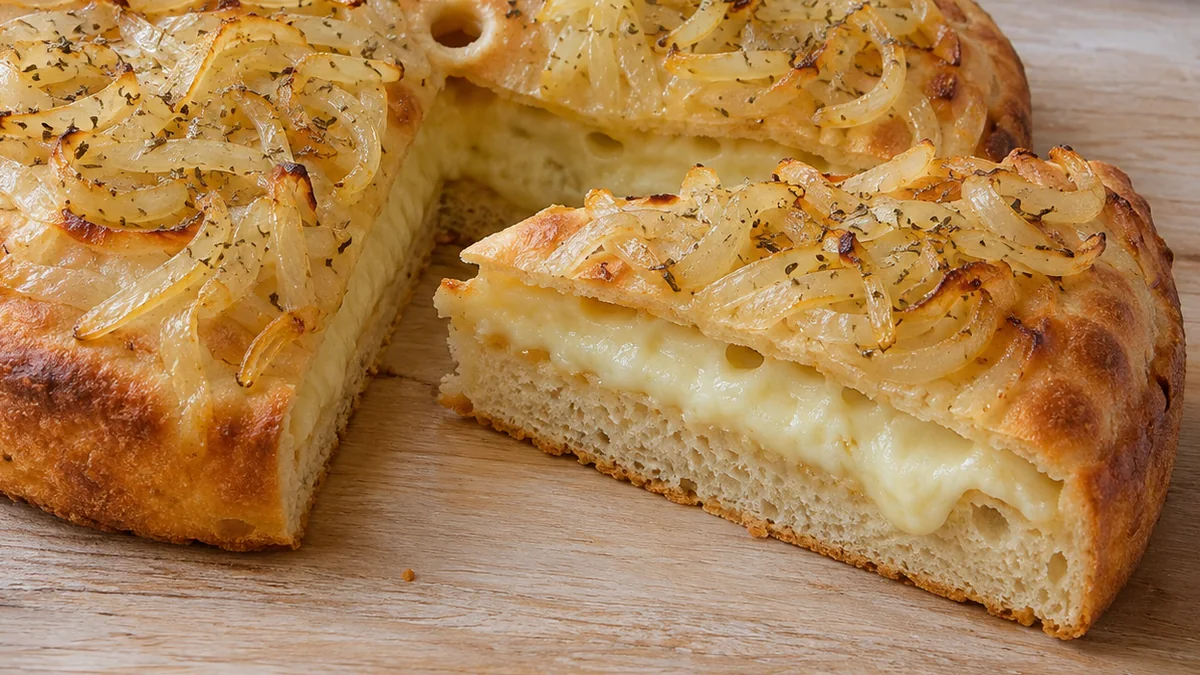
- Seal the thin lid and distribute onions Roll the 178 g/6.28 oz lid per pizza to about 28 cm/11 in and lay over the cheese. Press the clean borders together and fold inward once. Make a small central steam vent. Spread the cooled topping made from 300 g/10.58 oz raw onion per pizza over the lid and crumble on one pinch of oregano, keeping the vent clear.
- Bake through in the metal pan After at least 35–40 minutes of preheating, bake on the lower-middle rack for 25–32 minutes. From minute 25, lift with a wide spatula to inspect beneath the centre: it should be deeply golden and firm. The lid should be set and the edge fully baked. If onions darken early, cover loosely with foil and finish the base.
- Settle the filling and check the cut crumb Rest for ten minutes, then lift carefully from the pan onto a board with two wide spatulas. Cut into four portions. Cheese should be soft without pouring like water, and no wet raw-dough line should remain between filling and base. Take care with the first bite; melted cheese retains heat.
Estimated nutrition
What is included
- Includes the complete homemade dough, 300 g low-moisture mozzarella, raw peeled onions and all 25 g oil including pan oil. Weight loss during softening and baking is not presented as an exact cooked yield.
| Nutrient | ¼ stuffed pizza | 1 stuffed pizza from 498 g / 17.57 oz dough, metal pan with a 28 cm / 11 in inside diameter |
|---|---|---|
| Energy | 533 kcal | 2133 kcal |
| Protein | 25.8 g | 103.1 g |
| Carbohydrate | 58.7 g | 234.8 g |
| Fat | 21.3 g | 85.3 g |
| Salt | 2.69 g | 10.76 g |
Why the base and lid have different weights
The 60% hydration dough weighs 498 g in theory. For exactly one fugazzeta in a 28 cm/11 in metal pan, divide it into a 320 g/11.29 oz base and a 178 g/6.28 oz lid. The heavier base supports the cheese and sides; the thinner lid encloses the filling. Equal pieces would make the top unnecessarily thick.
Tender onions rather than onion jam
Thin onion slivers are softened gently and cooled before topping. This removes raw harshness and some moisture without making dark sweet onion jam. Only low-moisture mozzarella goes inside; fresh brined cheese would trap considerably more water beneath the lid.
A tight seam and a small steam vent
Leave a 2 cm/¾ in margin free of cheese and oil. Press the raised base edge firmly against the lid and fold it inward once. A small central vent releases steam pressure. Avoid a large hole that leaves filling exposed to drying.
If cheese escapes or the underside stays pale
A few escaped drops of cheese can occur. Large leaks suggest a greasy or overly thin seam; keep the border clean next time. Bake on the lower-middle rack and use a wide spatula to inspect under the centre. Shield early-browning onions loosely with foil and finish according to the base.
Make several whole fugazzetas rather than one thick stack
The ingredient list makes one complete pizza. For two, double the batch and use two equal pans: each still gets a 320 g/11.29 oz base, 178 g/6.28 oz lid, 300 g/10.58 oz mozzarella and the topping made from 300 g/10.58 oz raw onion. Do not put the doubled batch in one 28 cm/11 in pan. Sequential baking adds another bake; refrigerate the second assembled pan while it waits.
A restrained herb variation and safe leftovers
For a variation, scatter a little finely chopped parsley over the onions after baking. Ten minutes of resting helps the cheese settle but does not replace safe cooling of leftovers. Refrigerate remaining slices in shallow containers within two hours, eat within two days at 4°C/39°F or colder and reheat to 74°C/165°F in the centre.
US measuring cups: original batch values
More info: US measures
Approximate US volume equivalents for the original base batch: 300 g strong white bread flour, about 11–13% protein ≈ 2½ cups; 180 g water for the dough ≈ ¾ cup; 3 g instant dry yeast ≈ 1 tsp; 25 g olive oil, divided: 9 g for dough, 8 g for pan and 8 g for onions ≈ 1 tbsp plus 2½ tsp; 300 g low-moisture mozzarella made with microbial rennet ≈ 2⅔ cups shredded; 300 g onion, weighed peeled ≈ 2 cups thinly sliced. Gram weights define the recipe. For more pizzas scale the ingredient list by weight; these reference values describe only the original batch.
Related recipes and help with baking
Component recipes: Quick Same-Day Pizza Dough
Fermentation: Judge Maturity, Not Just Hours · Opening Pizza Dough: Relax Tension and Preserve the Rim · Oven Heat: Air Temperature versus Baking Surface
Comments are optional. By submitting a comment, you consent to public display of your text and any name you provide; you may withdraw this consent at any time for the future. The text is sent to OpenAI for abuse screening. Privacy and deletion.