Practical guide
Fresh to Dry Yeast Conversion: A Practical Table
As a guide, a 42 g cube of fresh yeast corresponds to 14 g instant dry yeast, and 21 g fresh yeast to 7 g dry yeast. Divide fresh yeast by three as an approximation, or multiply dry yeast by three for the reverse conversion. Follow the specific product instructions where they differ.
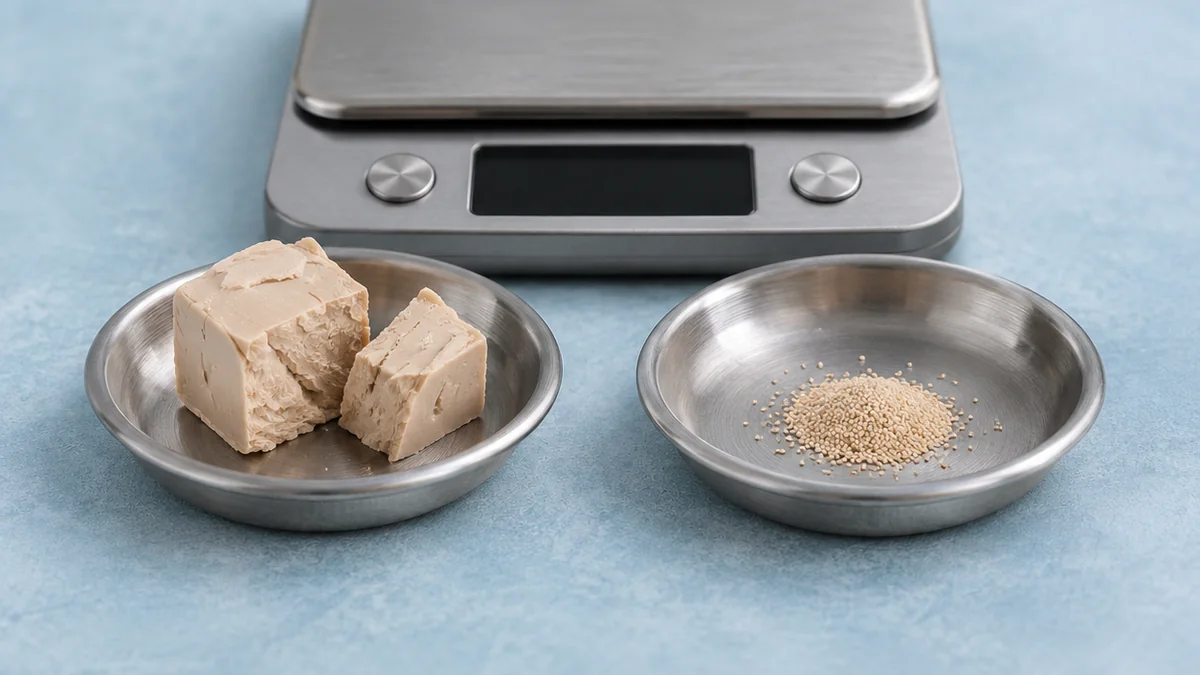
The table for cubes and small dough batches
| Fresh yeast | Instant dry yeast, approximate 1:3 | Context |
|---|---|---|
| 42 g | 14 g | A common German cube; not automatically your recipe’s dose. |
| 21 g | 7 g | Half a 42 g cube. |
| 12 g | 4 g | A conversion, not the correct dose for every 500 g flour batch. |
| 6 g | 2 g | Weigh small quantities rather than dividing a cube by eye. |
| 3 g | 1 g | Use a sufficiently accurate scale. |
| 1.5 g | 0.5 g | Use a precision scale or a freshly made dilution. |
| 0.6 g | 0.2 g | Do not round to a misleading zero on a coarse kitchen scale. |
Account for water in a tiny dry-yeast dose
For a calculated example, mix 1 g dry yeast thoroughly with 19 g of the recipe water. The 20 g mixture contains five percent yeast. A uniformly mixed 4 g portion supplies 0.2 g yeast and 3.8 g water. Subtract those 3.8 g from the water otherwise added.
Prepare the dilution immediately before mixing dough, stir again before taking a portion and do not store leftovers. It helps only if your scale can reliably weigh the initial gram. A watery yeast mixture left standing is not a shelf-stable substitute for new dry yeast.
Treat instant and active dry yeast according to the packet
Products are not all handled alike. Some active dry yeasts need dissolving in liquid, whereas instant yeast can be mixed with flour. The usual one-third rule does not replace those directions. On the first change, keep temperature, batch size and planned fermentation consistent and check maturity signs.
A packet portion is not a universal timetable
“One sachet per 500 g flour” describes a manufacturer’s usual application. An overnight pizza dough may need much less, while a quick soft dough uses more leavener and warmer conditions. Converting yeast form and designing a new fermentation timetable are separate jobs.
References and context
These references explain ingredients and physical principles. The small kitchen comparisons are reproducible suggestions, not a claim of laboratory testing. Follow product labels and appliance instructions.