Timing for this recipe
Includes poolish and final dough up to baking readiness. Toppings and baking are added in the chosen pizza recipe. The poolish assumes 20–22°C; do not use the unchanged timetable in a much warmer kitchen.
| Stir the poolish | 5–7 min |
|---|---|
| Mature the poolish at 20–22°C | 12 hr–16 hr |
| Mix the final dough | 5–7 min |
| Hydrate the flour | 15–20 min |
| Knead in salt and water | 7–9 min |
| Bulk fermentation at 23–24°C | 1 hr–1 hr 30 min |
| Divide and round three dough balls | 5–7 min |
| Relax and proof the dough balls | 1 hr 30 min–2 hr |
| Approximate elapsed time | 15 hr 7 min–20 hr 20 min |
These times include the work and rests described here. Temperature, equipment and ripeness can make things quicker or slower.
Cooking mode
Selected quantity: 3 dough balls
Original yield: 3 dough balls of about 279 g (9.8 oz), each for a 28–30 cm (11–12 in) pizza · 3 standard servings
Choose a whole number. Each item keeps the size, weight and shape given in the recipe.
Nutrition is estimated per standard serving and for the whole selection.
US units show weights in ounces and liquids in US fluid ounces.
More info
Measuring spoons use 1 tsp = 5 ml and 1 tbsp = 15 ml here.
Estimated nutrition for your selection
| Nutrition | 1 dough ball without toppings | Selected quantity |
|---|---|---|
| Energy | 565 kcal | 1,696 kcal |
| Protein | 21.7 g | 65.2 g |
| Carbohydrate | 113.3 g | 340 g |
| Fat | 1.7 g | 5 g |
| Salt | 4.02 g | 12.05 g |
Ingredients
Recalculate this dough recipe
This keeps the ingredient ratios of this recipe. It changes neither the recipe method nor your cooking progress.
Original yield: 3 dough balls of about 279 g (9.8 oz), each for a 28–30 cm (11–12 in) pizza
3 dough balls · 1× original recipe
Original yield/size: 3 dough balls of about 279 g (9.8 oz), each for a 28–30 cm (11–12 in) pizza
The ingredient list shows the totals for this selection. Amounts per item stay the same.
- 200 g (7.05 oz) strong white bread flour, for the poolish
- 200 g (7.05 oz) water, for the poolish
- 0.2 g (0.01 oz) instant dry yeast, for the poolish
- 300 g (10.58 oz) strong white bread flour, for the final dough
- 125 g (4.41 oz) water for the final dough, divided
- 12 g (0.42 oz) fine salt
- 0.5 g (0.02 oz) instant dry yeast, for the final dough
Equipment
- Kitchen scale
- precision scale
- tall clear covered container
- mixing bowl
- dough scraper
- three dough containers
Method
Before shaping or topping, divide the ingredients between 3 dough balls at their original size. Prepare each item as described. Do not multiply proofing times by the number of dough balls. Look for the dough condition described in the recipe.
- Stir a lump-free poolish Put 200 g water and 0.2 g instant yeast in the tall container. Stir in 200 g flour to make a thick, even batter. Mark the starting level and cover to prevent drying, leaving at least twice the starting volume as headroom.
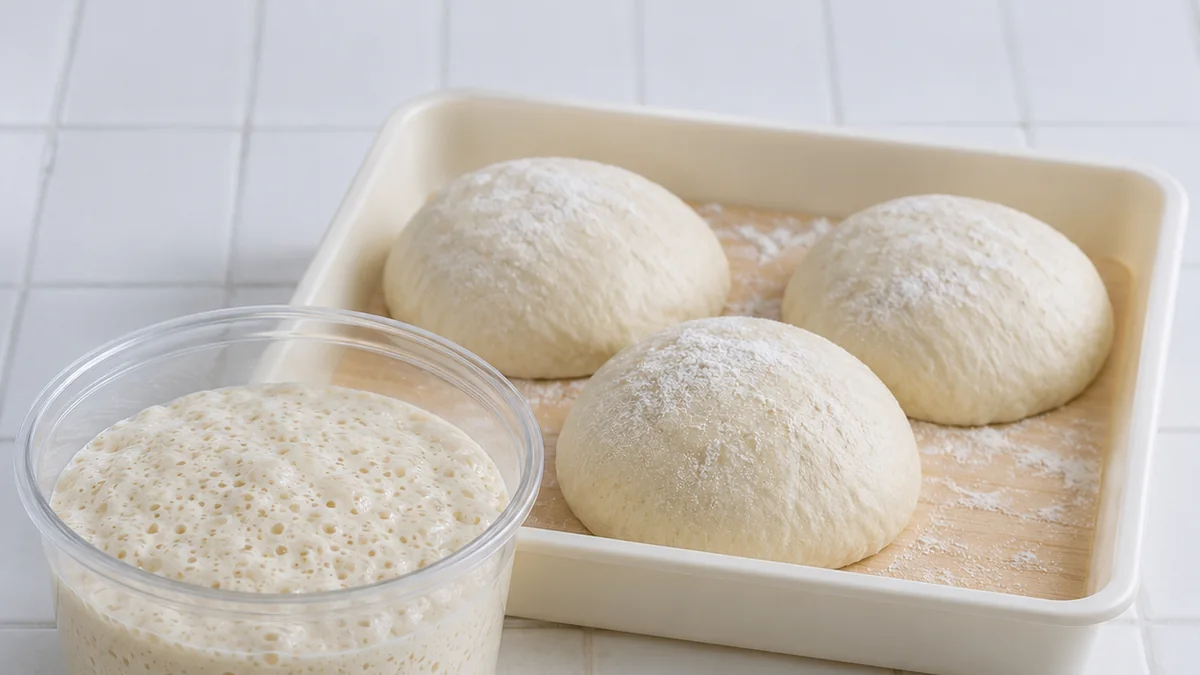
- Catch the poolish near its peak Mature for about 12–16 hours at 20–22°C (68–72°F). Look for substantial expansion and many small bubbles. The surface should still be gently domed or only just starting to level. A deeply collapsed preferment with a thin separated liquid layer is well past this target.
- Mix the final dough with part of the water Stir all the ripe poolish with 105 g of the final-dough water and 0.5 g instant yeast. Add 300 g flour and mix firmly until moistened throughout. Cover and leave for 15–20 minutes. Reserve the final 20 g water for kneading.
- Add the salt after hydration Knead in 12 g salt and gradually add the remaining 20 g water. Work by hand for 7–9 minutes until smoother and extensible. Some tackiness is normal; large flour additions change the calculated 65% hydration. Pause briefly if the dough gets very warm instead of heating it further by kneading faster.
- Give the dough a short bulk fermentation Cover and ferment for 60–90 minutes at 23–24°C (73–75°F). Fold once in the bowl after 25–30 minutes. Proceed when noticeably aerated and roughly half as large again. The ripe poolish accounts for part of the fermentation that would otherwise happen in the final dough.
- Divide with a scraper and round gently Divide into three equal pieces, about 279 g (9.8 oz) each. Use the scraper and slightly damp hands to create gentle surface tension. Avoid repeatedly packing flour into the seam and place in covered containers.
- Stretch after the final proof Proof for 90–120 minutes at 23–24°C. A ripe ball presses and stretches without snapping back strongly. If it immediately contracts, cover for a further 15–20 minutes and allow that extra time. Bake using the appropriate route under “Baking with this dough” and the linked topping recipe.
Estimated nutrition
What is included
- Calculated for one of three raw dough balls. Toppings, extra dusting flour and a different flour product can change the eventual values.
| Nutrient | 1 dough ball without toppings | 3 dough balls of about 279 g (9.8 oz), each for a 28–30 cm (11–12 in) pizza |
|---|---|---|
| Energy | 565 kcal | 1696 kcal |
| Protein | 21.7 g | 65.2 g |
| Carbohydrate | 113.3 g | 340 g |
| Fat | 1.7 g | 5 g |
| Salt | 4.02 g | 12.05 g |
Why poolish mixes differently
Equal flour and water make poolish stirrable. It preferments 40% of the total flour, and all that water counts towards the final dough. The liquid preferment disperses readily; the following hydration rest helps avoid adding unnecessary flour just because the freshly mixed dough feels tacky.
A 100% preferment is not a 100% final dough
Poolish contains 200 g flour and 200 g water. The final mix adds 300 g flour and 125 g water. The entire dough therefore contains 500 g flour and 325 g water: 65% hydration. Keep that distinction when scaling the recipe in a calculator.
Catch the poolish before deep collapse
Bubbles alone are not enough: compare with the marked starting level and examine the surface. Substantial expansion with the top just changing from domed to level is a useful target. A completely collapsed poolish behaves differently and is not the target condition for this process.
Baking with this dough
For a home-oven stone or steel, use 250°C conventional (480°F, approximately Gas Mark 9) or 230°C fan (445°F), preheated for 45–60 minutes. Start with 7–10 minutes per lightly topped pizza. In a pizza oven, stabilise the measured floor at 400–430°C (750–805°F) and start with 90–150 seconds, turning regularly. The underside should colour beneath the centre and the rim should be cooked inside. Topping and baking are additional to making the dough.
If the dough snaps back when stretching
First rest it covered for another 15–20 minutes rather than using increasing force and dusting flour. An underproofed or cold ball needs time; a very slack ball does not improve simply by standing longer. Judge extensibility together with fermentation.
Swap yeast or change the flour
Fresh yeast can be used at roughly three times the weight: 0.6 g for the poolish and 1.5 g in the final mix. The small mass change slightly changes the theoretical ball weight; nutrition remains based on the listed dry-yeast formula. Do not increase the water immediately when using weaker flour. Strong white wheat flour around 12–13% protein is easier to assess initially than an unfamiliar pizza flour.
Storage and clean handling
For this schedule, mix the ripe poolish straight into the final dough. Use the mature dough balls the same day. If interrupted, refrigerate covered at no more than 5°C/41°F before overproofing and bake within 24 hours, allowing extra warming time. Do not taste poolish with unwashed fingers. Flour and dough are raw foods and must be fully baked.
Use a small yeast dilution
If 0.2 g is too small for your scale, stir 1 g instant yeast into 19 g water immediately before use. Weigh 4 g thoroughly mixed liquid for the poolish, adding only 196.2 g further water. Make a fresh mixture for the final-dough yeast; use 10 g and subtract 9.5 g from the 125 g final water. This calculation does not replace clean handling or temperature control.
Measure reliably
More info: US measures
The 200 g poolish flour is about 1⅔ loosely spooned US cups, and the 300 g final flour about 2½ cups. Poolish water is about ¾ cup plus 1½ tablespoons. These are approximate; grams keep the 100% preferment and 65% total hydration consistent.
Related recipes and help with baking
Fermentation: Judge Maturity, Not Just Hours · Opening Pizza Dough: Relax Tension and Preserve the Rim · Hydration: Calculate Water Correctly
Comments are optional. By submitting a comment, you consent to public display of your text and any name you provide; you may withdraw this consent at any time for the future. The text is sent to OpenAI for abuse screening. Privacy and deletion.