Timing for this recipe
From mixing the biga to three mature dough balls. Preparing toppings and baking the pizzas are not included. Timings assume the stated temperatures; proceed earlier or later according to dough maturity.
| Mix the stiff preferment | 6–8 min |
|---|---|
| Mature the biga at 18–20°C | 16 hr–18 hr |
| Loosen the biga in water | 5–7 min |
| Hydrate the final dough | 15–20 min |
| Knead in salt and the remaining water | 8–10 min |
| Bulk fermentation at 23–24°C | 1 hr 30 min–2 hr |
| Shape three dough balls | 5–7 min |
| Proof the covered dough balls | 1 hr 30 min–2 hr 30 min |
| Approximate elapsed time | 19 hr 39 min–23 hr 22 min |
These times include the work and rests described here. Temperature, equipment and ripeness can make things quicker or slower.
Cooking mode
Selected quantity: 3 dough balls
Original yield: 3 dough balls of about 279 g (9.8 oz), each for a 28–30 cm (11–12 in) pizza · 3 standard servings
Choose a whole number. Each item keeps the size, weight and shape given in the recipe.
Nutrition is estimated per standard serving and for the whole selection.
US units show weights in ounces and liquids in US fluid ounces.
More info
Measuring spoons use 1 tsp = 5 ml and 1 tbsp = 15 ml here.
Estimated nutrition for your selection
| Nutrition | 1 dough ball without toppings | Selected quantity |
|---|---|---|
| Energy | 565 kcal | 1,696 kcal |
| Protein | 21.8 g | 65.3 g |
| Carbohydrate | 113.3 g | 340 g |
| Fat | 1.7 g | 5 g |
| Salt | 4.02 g | 12.05 g |
Ingredients
Recalculate this dough recipe
This keeps the ingredient ratios of this recipe. It changes neither the recipe method nor your cooking progress.
Original yield: 3 dough balls of about 279 g (9.8 oz), each for a 28–30 cm (11–12 in) pizza
3 dough balls · 1× original recipe
Original yield/size: 3 dough balls of about 279 g (9.8 oz), each for a 28–30 cm (11–12 in) pizza
The ingredient list shows the totals for this selection. Amounts per item stay the same.
- 250 g (8.82 oz) strong white bread flour, for the biga
- 125 g (4.41 oz) water, for the biga
- 0.3 g (0.01 oz) instant dry yeast, for the biga
- 250 g (8.82 oz) strong white bread flour, for the final dough
- 200 g (7.05 oz) water for the final dough, divided
- 12 g (0.42 oz) fine salt
- 0.5 g (0.02 oz) instant dry yeast, for the final dough
Equipment
- Digital kitchen scale
- precision yeast scale
- covered mixing bowl
- dough scraper
- thermometer
- three covered dough containers
Method
Before shaping or topping, divide the ingredients between 3 dough balls at their original size. Prepare each item as described. Do not multiply proofing times by the number of dough balls. Look for the dough condition described in the recipe.
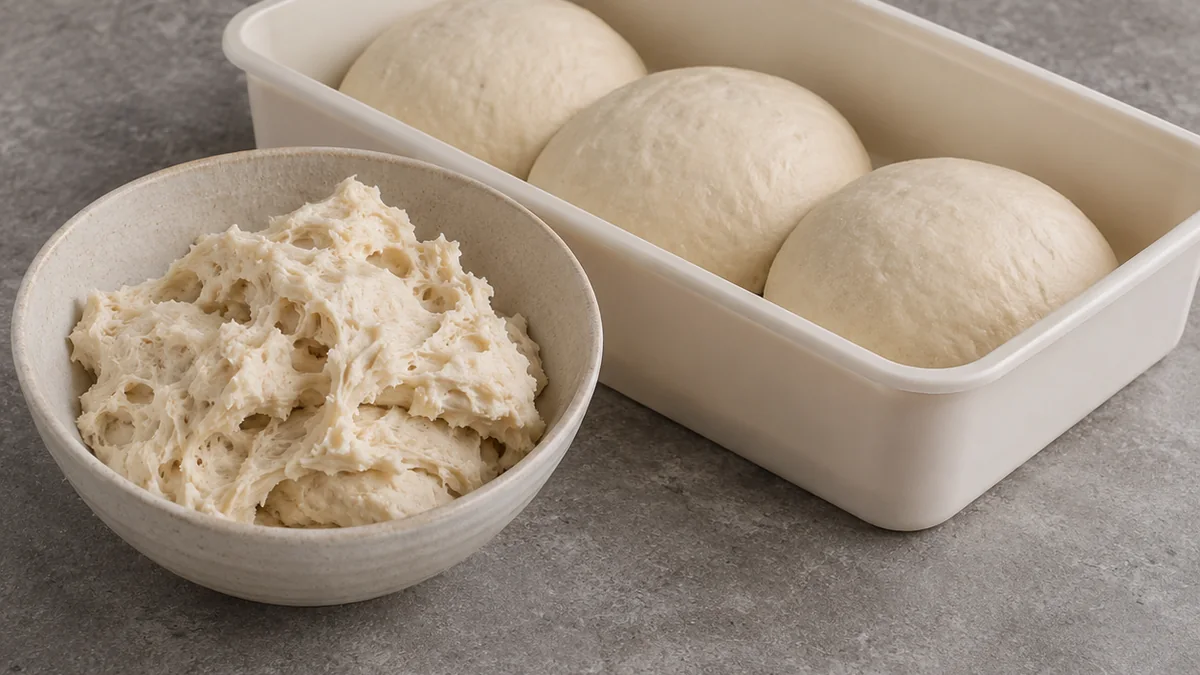
- Mix a rough biga Stir 0.3 g instant yeast into the 125 g water. Add 250 g flour and work together with your fingertips for 2–3 minutes until no dry flour pockets remain. The preferment should form firm irregular clumps, not a fully kneaded smooth ball. Put in a roomy container and cover.
- Judge the cool preferment by its condition Leave for 16–18 hours at 18–20°C (64–68°F). Ripe biga is expanded, threaded with small pores inside and smells gently yeasty. If it is already collapsed or smells sharply acidic, do not keep waiting for the clock. Find a reliably cooler place in a warm kitchen; this long schedule is not intended for 26°C/79°F.
- Break down the biga and mix the final dough Tear all the biga into small pieces. Mix with 180 g of the 200 g final-dough water and 0.5 g instant yeast, squeezing the pieces through your fingers. Work in the remaining 250 g flour. Cover and hydrate for 15–20 minutes, keeping back the last 20 g water.
- Knead in salt and water gradually Add 12 g salt and knead for 8–10 minutes, incorporating the remaining 20 g water a little at a time. Wait until each addition has been absorbed. The dough should finish elastic and slightly tacky rather than flowing like batter. Aim for a dough temperature around 23–24°C (73–75°F).
- Bulk ferment with one fold Cover and bulk ferment for 90–120 minutes at 23–24°C. After about 30 minutes, fold the four sides towards the centre. Look for roughly half as much volume again and a gently domed surface; do not insist on a full doubling.
- Divide into three equal dough balls Weigh the dough and divide into three equal pieces, approximately 279 g (9.8 oz) each. Round each with as little extra flour as possible. Close the seam without tearing the skin and place apart in covered containers.
- Check the final proof and choose the baking route Proof covered for 90–150 minutes at 23–24°C. A ready dough ball is soft and visibly aerated, and a gentle indentation returns slowly. Only then stretch and top according to your chosen pizza recipe. For a home oven, use the last hour of this proof to heat a stone or steel.
Estimated nutrition
What is included
- Nutrition is for one of three raw dough balls, without toppings or extra dusting flour. Baking later evaporates water, so no cooked per-100-g value is asserted.
| Nutrient | 1 dough ball without toppings | 3 dough balls of about 279 g (9.8 oz), each for a 28–30 cm (11–12 in) pizza |
|---|---|---|
| Energy | 565 kcal | 1696 kcal |
| Protein | 21.8 g | 65.3 g |
| Carbohydrate | 113.3 g | 340 g |
| Fat | 1.7 g | 5 g |
| Salt | 4.02 g | 12.05 g |
Why use a stiff preferment?
Half the flour and 125 g of the total 325 g water go into the biga. It first matures as a stiff preferment; the final mix brings the whole dough to a manageable 65% hydration. Tearing it small and adding water gradually helps avoid dry biga lumps. A small fresh addition of yeast in the final mix makes the following stages easier to plan, without guaranteeing maturity.
Keep the water balance clear
The preferment and final mix each contain 250 g flour, giving 500 g total. Its 125 g plus 200 g water gives 325 g: 325 ÷ 500 × 100 = 65%. The biga itself has 50% hydration. There is no hidden liquid; extra kneading water deliberately changes the recipe.
Baking with this dough
In a home oven, heat a stone or steel for 45–60 minutes at 250°C conventional (480°F, approximately Gas Mark 9) or 230°C fan (445°F). Start with about 7–10 minutes for one lightly topped pizza. A pizza oven with a measured 400–430°C (750–805°F) floor is the second route, around 90–150 seconds per pizza. Air temperature is not floor temperature. Three pizzas baked in sequence need additional baking and floor-recovery time. Dough timings exclude toppings and baking.
Recognise the right maturity
The biga becomes porous while remaining connected inside. Finished dough balls feel soft but retain some tension. Giant isolated bubbles or exactly doubled height are not required targets. Use temperature, expansion and extensibility together to decide when to move on.
If biga lumps remain
Squeeze firm pieces apart in the first water addition before adding all the final flour. Soft shreds disappear with kneading; hard dry centres first need water and the hydration rest. Pause if the dough gets hot instead of heating it further with vigorous kneading.
Change the dough without losing the preferment balance
Keep the original flour quantity and 65% hydration for a first attempt. Different flour binds water differently; a flour’s type alone does not establish its strength. For a small wholemeal addition next time, replace 25 g of the final-mix flour with wholemeal wheat. A little extra water may then be needed; do not automatically add as much water as the flour replaced.
Storage and food safety
Preferably bake mature balls the same day. If interrupted, cover and refrigerate the shaped balls promptly at no more than 5°C/41°F before clear overproofing, and use within 24 hours. Subsequent warming extends the schedule and is outside this base plan. Do not taste raw flour or dough; clean hands, bowl and work surfaces afterwards.
Measure tiny yeast quantities
A precision scale is useful for 0.3 and 0.5 g yeast. Alternatively, immediately before mixing, stir 1 g instant yeast thoroughly into 19 g water: 6 g mixture contains 0.3 g yeast and 5.7 g water. Make a fresh mixture for the final dough; 10 g contains 0.5 g yeast and 9.5 g water. Subtract this dilution water from the 125 or 200 g recipe water respectively. Do not store the mixture for later use.
Measure reliably
More info: US measures
500 g flour is roughly 4¼ loosely spooned US cups, while 325 g water is about 1⅜ US cups. These are approximate orientation measures; weigh each preferment addition and the tiny yeast quantities.
Related recipes and help with baking
Fermentation: Judge Maturity, Not Just Hours · Opening Pizza Dough: Relax Tension and Preserve the Rim · Hydration: Calculate Water Correctly
Comments are optional. By submitting a comment, you consent to public display of your text and any name you provide; you may withdraw this consent at any time for the future. The text is sent to OpenAI for abuse screening. Privacy and deletion.