Timing for this recipe
Includes building the levain from existing active starter, mixing the final dough and cold fermentation. Creating a new starter from scratch takes several days and is outside this plan. Add toppings and baking in the pizza recipe. Sourdough can need longer than the planning windows shown.
| Mix the levain | 5–7 min |
|---|---|
| Ripen the levain at 24–26°C | 6 hr–10 hr |
| Mix the final dough | 5–7 min |
| Hydrate the covered dough | 20–25 min |
| Knead in salt and water | 5–8 min |
| Warm bulk fermentation with folds | 4 hr–6 hr |
| Cold bulk fermentation at no more than 5°C | 18 hr–24 hr |
| Divide and round the cold dough | 6–8 min |
| Proof the dough balls at 23–24°C | 3 hr–5 hr |
| Approximate elapsed time | 31 hr 41 min–45 hr 55 min |
These times include the work and rests described here. Temperature, equipment and ripeness can make things quicker or slower.
Cooking mode
Selected quantity: 3 dough balls
Original yield: 3 dough balls of about 279 g (9.8 oz), each for a 28–30 cm (11–12 in) pizza · 3 standard servings
Choose a whole number. Each item keeps the size, weight and shape given in the recipe.
Nutrition is estimated per standard serving and for the whole selection.
US units show weights in ounces and liquids in US fluid ounces.
More info
Measuring spoons use 1 tsp = 5 ml and 1 tbsp = 15 ml here.
Estimated nutrition for your selection
| Nutrition | 1 dough ball without toppings | Selected quantity |
|---|---|---|
| Energy | 565 kcal | 1,695 kcal |
| Protein | 21.7 g | 65 g |
| Carbohydrate | 113.3 g | 340 g |
| Fat | 1.7 g | 5 g |
| Salt | 4.02 g | 12.05 g |
Ingredients
Recalculate this dough recipe
This keeps the ingredient ratios of this recipe. It changes neither the recipe method nor your cooking progress.
Original yield: 3 dough balls of about 279 g (9.8 oz), each for a 28–30 cm (11–12 in) pizza
3 dough balls · 1× original recipe
Original yield/size: 3 dough balls of about 279 g (9.8 oz), each for a 28–30 cm (11–12 in) pizza
The ingredient list shows the totals for this selection. Amounts per item stay the same.
- 10 g (0.35 oz) active wheat sourdough starter at 100% hydration
- 45 g (1.59 oz) strong white bread flour, for the levain
- 45 g (1.59 oz) water, for the levain
- 450 g (15.87 oz) strong white bread flour, for the final dough
- 275 g (9.7 oz) water for the final dough, divided
- 12 g (0.42 oz) fine salt
Equipment
- Kitchen scale
- small covered jar
- mixing bowl
- thermometer
- large covered dough container
- three dough boxes
Method
Before shaping or topping, divide the ingredients between 3 dough balls at their original size. Prepare each item as described. Do not multiply proofing times by the number of dough balls. Look for the dough condition described in the recipe.
- Build a small levain Mix 10 g active starter with 45 g water and 45 g flour in a clean jar. Mark the level, cover loosely and ripen at 24–26°C (75–79°F) for about 6–10 hours. Use when well expanded and bubbly throughout, before the top has deeply sunk. Stabilise a sluggish seed starter with regular refreshments first.
- Use all the ripe levain Stir the resulting 100 g levain into 255 g of the final-dough water. Mix in 450 g flour until no dry patches remain. Cover and hydrate for 20–25 minutes. Use the full levain build; this recipe leaves no uncounted levain remainder.
- Add the salt and remaining water Add 12 g salt and knead in the remaining 20 g water. Work in the bowl with wet hands for 5–8 minutes until cohesive and extensible. Aim for a dough temperature around 24–26°C, without putting the container on a hot radiator.
- Fold during the warm bulk fermentation Cover and bulk ferment for 4–6 hours at 24–26°C. Fold the four sides towards the centre after 30, 60 and 90 minutes. Then leave undisturbed until roughly half as large again, with bubbles at the edges and a gentle wobble. The folds happen within bulk fermentation and are not added to its duration.
- Control the cold fermentation Refrigerate the covered dough for 18–24 hours at no more than 5°C/41°F, ideally around 4°C/39°F. Refrigerate before it is overproofed. A refrigerator at 8°C/46°F ferments dough substantially faster; this window does not transfer unchanged.
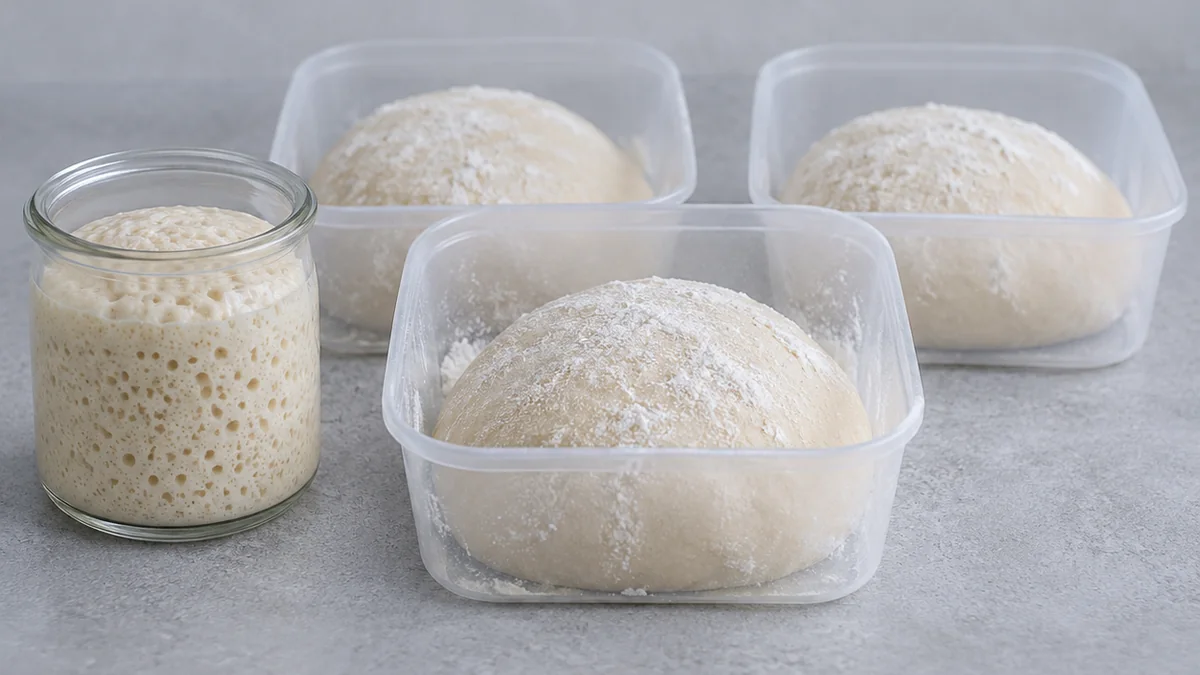
- Divide the cold dough into three Turn out the cold dough and divide into three equal pieces, approximately 279 g (9.8 oz) each. Round gently, guiding a sticky surface with the scraper instead of kneading in lots of flour. Place in covered dough boxes.
- Finish the proof by condition as well as time Let warm and proof for about 3–5 hours at 23–24°C (73–75°F). The balls should soften, spread a little and feel aerated inside. Wait longer if still dense and tight. If they flatten, become very sticky and lose all strength, shorten the warm fermentation next time.
- Continue with a suitable pizza recipe For a home oven, heat the stone or steel during the last hour of proofing. Stretch a ripe ball from the centre to 28–30 cm, leaving the rim unrolled. Top lightly only after stretching. The baking profiles and linked topping quantities are additional to making the dough.
Estimated nutrition
What is included
- The seed starter is modelled as 50% reference flour and 50% water. Fermentation changes are not asserted as exact nutrient losses without laboratory analysis. The entire levain build is used.
| Nutrient | 1 dough ball without toppings | 3 dough balls of about 279 g (9.8 oz), each for a 28–30 cm (11–12 in) pizza |
|---|---|---|
| Energy | 565 kcal | 1695 kcal |
| Protein | 21.7 g | 65 g |
| Carbohydrate | 113.3 g | 340 g |
| Fat | 1.7 g | 5 g |
| Salt | 4.02 g | 12.05 g |
Why include a separate levain build?
Ten grams of active seed starter is refreshed with flour and water to make 100 g levain. The final dough therefore begins with a visibly active culture. Warm bulk fermentation first develops gas and dough structure; refrigeration then slows further fermentation. A refrigerator replaces neither active starter nor the initial warm bulk.
Count the starter in the flour and water totals
The seed starter must contain equal flour and water by weight. Its 10 g then contributes 5 g of each. With 45 g refresh flour and 450 g final flour, the total is 500 g. Water totals 5 + 45 + 275 = 325 g. Hydration is therefore 65%, not simply 275 divided by 450.
If the levain does not rise
A sour smell alone does not establish enough leavening power. If the levain barely expands in its planned window, do not continue the final dough merely to meet a deadline. Refresh the seed starter regularly and begin another attempt with a visibly growing culture. Any extra refreshments add time to the actual project.
Distinguish bulk, refrigeration and final proof
End the first warm stage at roughly 50% expansion, before collapse. The 18–24 hours in the refrigerator is a separate maturation stage. After cold dividing, allow time for the balls to soften and become extensible. A colder kitchen or different starter can shift the endpoint, so visible maturity matters more than an exact clock time.
Bake sourdough in your own oven
Bake this lean dough without sugar or oil, lightly topped, on fully heated stone or steel at 250°C conventional (480°F, approximately Gas Mark 9) or 230°C fan (445°F), starting with 8–11 minutes per pizza. For a pizza oven, measure a 400–430°C (750–805°F) floor and start with around 90–150 seconds, turning often. Do not equate the appliance’s air-temperature display with its floor temperature. The rim must not retain a sticky raw layer.
Adjust flavour or add some wholemeal
For a milder flavour, use regularly refreshed wheat starter and mix the levain near its active peak. A heavily degraded, very sour culture is less suited to this schedule. To add wholemeal, initially replace just 25 g of the final flour. Water absorption and fermentation can change; the timetable is not an unchanging guarantee.
Storage: cold fermentation is already included
This recipe already includes 18–24 hours of refrigeration. Bake after the final warm proof on the planned day rather than automatically adding several more refrigerator days. Move the final dough promptly into a working refrigerator and keep it separate from raw animal foods. Discard visibly mouldy or unusually coloured cultures, and do not taste raw flour or dough.
Measure reliably
More info: US measures
For orientation, the 450 g final flour is about 3¾ loosely spooned US cups and 275 g water about 1 cup plus 2½ tablespoons. Weigh the levain ingredients and the final additions; variable starter volume is not a reliable cup measure.
Related recipes and help with baking
Fermentation: Judge Maturity, Not Just Hours · Opening Pizza Dough: Relax Tension and Preserve the Rim · Hydration: Calculate Water Correctly
Comments are optional. By submitting a comment, you consent to public display of your text and any name you provide; you may withdraw this consent at any time for the future. The text is sent to OpenAI for abuse screening. Privacy and deletion.