Practical guide
Flour and Yeast in Germany: Types 405, 550 and 00
German flour types describe mineral content, and Italian types likewise relate to extraction or ash limits. Neither guarantees dough strength. For pizza, also check the particular flour’s suitability and a timetable appropriate to its yeast quantity.
What to look for on the bag
| Label | Meaning | Does not automatically guarantee |
|---|---|---|
| Type 405 or 550 | German mineral-content classification | Long fermentation or high water absorption. |
| Tipo 00 | Italian low-ash type | That this specific flour is exclusively for pizza or particularly strong. |
| Protein percentage | Protein quantity as an indication | The same gluten quality across products. |
| W value, where provided | A measured dough-strength property under set test conditions | A correct water or yeast quantity calculated from that number alone. |
Make a practical choice for the next dough
A suitable Type 550 wheat flour is widely available for a straightforward home-oven dough. Follow the recipe rather than excluding Type 405 categorically. A moderate hydration and short schedule demand different handling from a 48-hour fermentation or very wet pan dough.
When changing flour, reserve a little of the recipe water and reassess after the hydration rest. Record the amount actually used. A cup is less reliable than grams because filling and compression can change the flour weight enough to shift hydration.
Fresh cubes, dry yeast and tiny doses
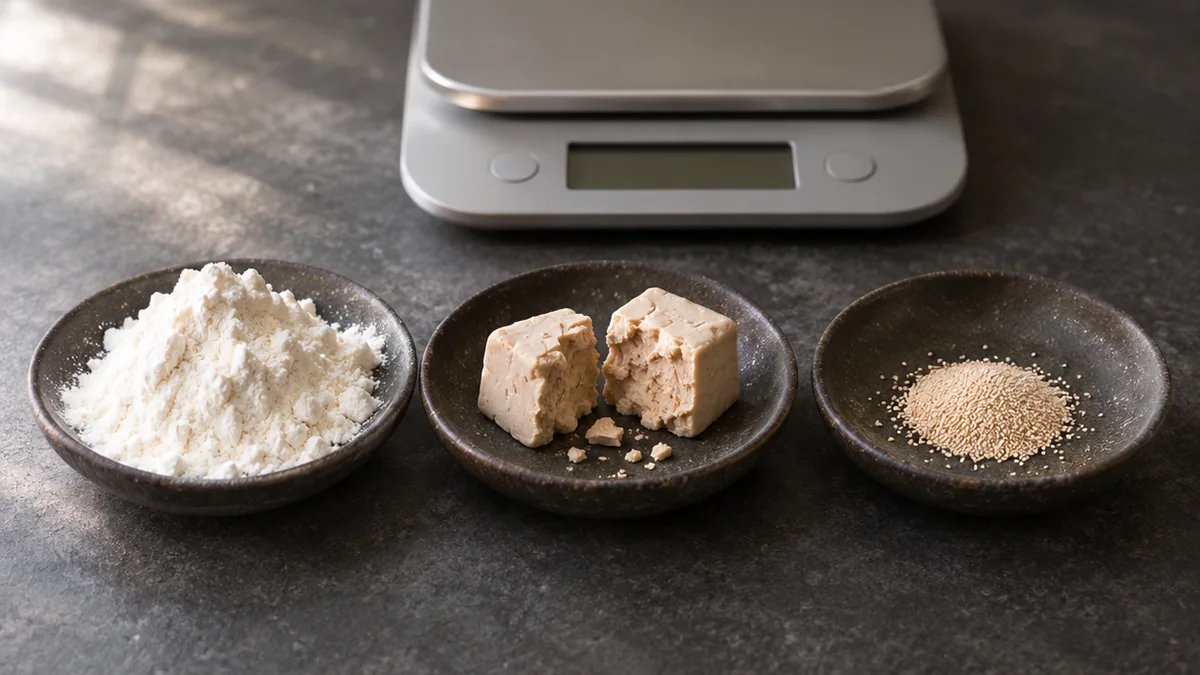
A common German fresh-yeast cube weighs 42 g. A usual conversion is fresh yeast divided by three for instant dry yeast: 21 g becomes 7 g, and 6 g becomes 2 g. This converts yeast form; it does not instruct you to add half a cube to every pizza dough. Long schedules often use much less.
Yeast and baking powder are different leaveners. Follow product directions for fresh or active dry yeast. For doses below your scale’s resolution, do not guess with a large spoon; use a precision scale or a freshly prepared dilution whose water is included in the recipe.
Bulk fermentation and final proof in plain language
Bulk fermentation is the first rise of the whole dough. After dividing and rounding, individual dough balls have their final proof. Temperature and yeast quantity affect both. A schedule should state whether a rest takes place at room temperature or in the refrigerator; “overnight” alone is not a temperature instruction.
Allergens and raw flour
Wheat, spelt, durum semolina and wheat Tipo 00 contain gluten. Changing type does not make the dough gluten-free. Do not taste raw flour or dough; a flour bag is not a ready-to-eat food.
References and context
These references explain ingredients and physical principles. The small kitchen comparisons are reproducible suggestions, not a claim of laboratory testing. Follow product labels and appliance instructions.