Timing for this recipe
Includes dough, toppings and baking for one pizza. The oven preheats from the weighing stage. Prepare the tomatoes during the first proof. At a room temperature of only 20°C, fermentation can take longer; 60–90 minutes is not a promise for a cold kitchen.
| Preheat alongside preparation | 35–40 min |
|---|---|
| Weigh ingredients and switch on the oven | 4–6 min |
| Knead the dough | 6–8 min |
| Warm bulk fermentation at 26–28°C | 25–35 min |
| Round the dough | 3–4 min |
| Relax the dough | 8–10 min |
| Stretch and top lightly | 5–7 min |
| Bake in the home oven | 10–13 min |
| Rest briefly on a rack | 2 min |
| Approximate elapsed time | 1 hr 3 min–1 hr 25 min |
These times include the work and rests described here. Temperature, equipment and ripeness can make things quicker or slower.
Heat the oven during the preparation or rest. If it still needs longer, add that extra time.
Cooking mode
Selected quantity: 1 pizza
Original yield: 1 pizza, about 30–32 cm (12–12½ in) · 2 standard servings
Choose a whole number. Each item keeps the size, weight and shape given in the recipe.
Nutrition is estimated per standard serving and for the whole selection.
US units show weights in ounces and liquids in US fluid ounces.
More info
Measuring spoons use 1 tsp = 5 ml and 1 tbsp = 15 ml here.
Estimated nutrition for your selection
| Nutrition | ½ pizza | Selected quantity |
|---|---|---|
| Energy | 476 kcal | 953 kcal |
| Protein | 20.7 g | 41.5 g |
| Carbohydrate | 68.3 g | 136.6 g |
| Fat | 12.1 g | 24.2 g |
| Salt | 2.41 g | 4.81 g |
Ingredients
1 pizza · 1× original recipe
Original yield/size: 1 pizza, about 30–32 cm (12–12½ in)
The ingredient list shows the totals for this selection. Amounts per item stay the same.
- 180 g (6.35 oz) white wheat flour (German Type 550)
- 115 g (4.06 oz) water at about 30°C/86°F
- 4 g (0.14 oz) instant dry yeast
- 3 g (0.11 oz) sugar
- 4 g (0.14 oz) fine salt, divided: 3 g in the dough and 1 g for the tomato
- 6 g (0.21 oz) olive oil, for the dough
- 90 g (3.17 oz) unsalted crushed canned tomatoes, thick with no free liquid
- 85 g (3 oz) low-moisture mozzarella made with microbial rennet, coarsely grated
- 3 g (0.11 oz) fresh basil leaves
Equipment
- Kitchen scale
- covered mixing bowl
- small sieve
- dough scraper
- large uncoated metal baking tray
- suitable baking parchment
Method
Before shaping or topping, divide the ingredients between 1 pizza at their original size. Prepare each item as described. Do not multiply cooking times by the number of items. Extra batches still take extra time. Look for the doneness cues in the recipe.
- Start heating the oven and tray early Put a heavy uncoated tray upside down on the lower-middle rack. Immediately heat to 250°C conventional (480°F; approximately Gas Mark 9) or 230°C fan (445°F). Allow the tray at least 35–40 minutes to heat. Use parchment only if rated for that temperature; otherwise bake on a lightly floured tray.
- Knead a soft dough Mix flour, instant yeast and sugar. Add the water, 3 g of the salt and 6 g olive oil. Knead for 6–8 minutes until supple and slightly tacky. Use pleasantly warm water rather than hot water, aiming for dough around 26–28°C (79–82°F).
- Proof warm while preparing the topping Cover and proof for 25–35 minutes in a spot around 26–28°C, until clearly expanded. Meanwhile, drain the tomatoes briefly if needed, weigh 90 g thick pulp and stir in the remaining 1 g salt. Grate the mozzarella. Do not put the dough on a hot hob or in the switched-on oven.
- Relax before stretching Divide the full dough quantity evenly among the selected number of pizzas and loosely round the pieces. Rest covered for 8–10 minutes. Press and stretch each dough ball separately to 30–32 cm (12–12½ in) on suitable parchment or a sparingly floured surface. Keep each centre about 3–4 mm (⅛ in) thick with a slightly thicker rim. For multiple pizzas, share the toppings and repeat the oven stage; extra batches need extra time.
- Top with a thin tomato layer Per pizza, spread 90 g prepared tomato just inside the rim and scatter 85 g mozzarella with small gaps. Hold back the basil. Transfer promptly to the hot tray, using dry oven gloves to handle the very hot equipment.
- Bake until the base and crumb are cooked Bake for 10–13 minutes, checking the underside with a spatula from minute 10. It should be firm and golden, with no wet dense dough line in a cut edge. If the cheese browns first, move the pizza one rack lower and continue judging the base.
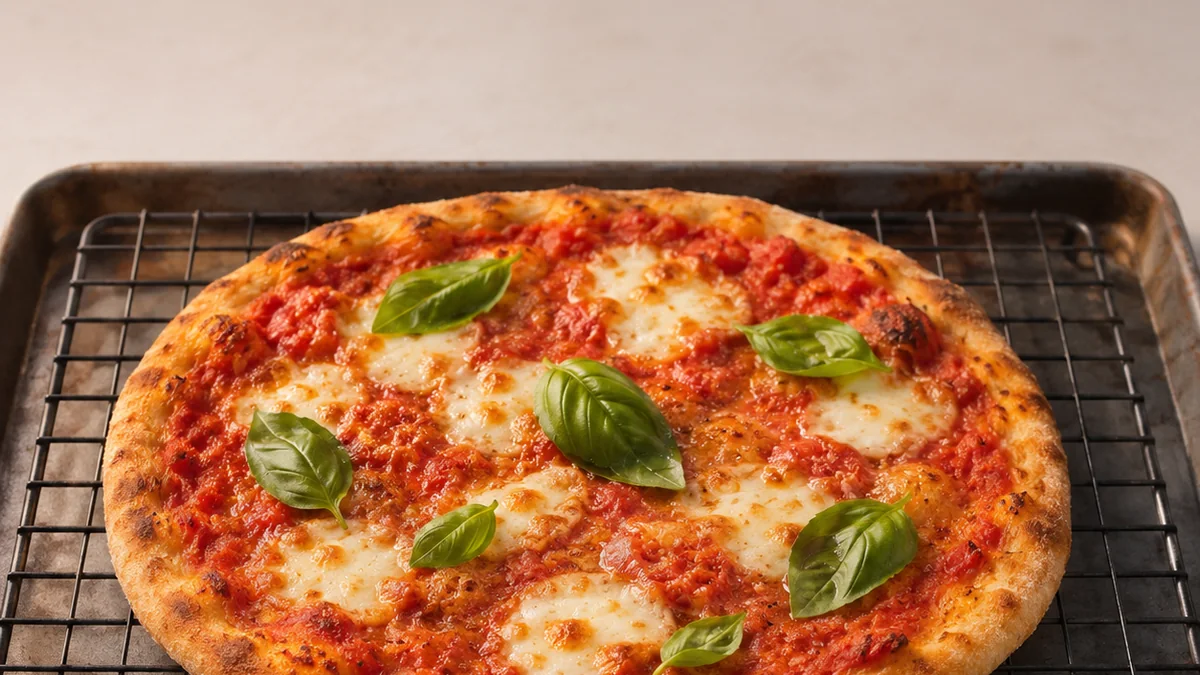
- Finish with basil Rest on a rack for 2 minutes to release steam. Tear over the basil, then slice. This short warm fermentation gives a mild everyday crumb; its flavour is different from a long overnight preferment.
Estimated nutrition
What is included
- Nutrition is for half of the topped pizza, calculated from the listed raw ingredients. No extra spread or additional prepared sauce is assumed.
| Nutrient | ½ pizza | 1 pizza, about 30–32 cm (12–12½ in) |
|---|---|---|
| Energy | 476 kcal | 953 kcal |
| Protein | 20.7 g | 41.5 g |
| Carbohydrate | 68.3 g | 136.6 g |
| Fat | 12.1 g | 24.2 g |
| Salt | 2.41 g | 4.81 g |
Why this short process works
More yeast, comfortably warm dough and a small amount of sugar shorten the wait. Moderate 63.9% hydration makes it manageable without a long hydration rest. An early-heated tray and a thin tomato layer help the base cook before the cheese dries. The aim is a useful quick everyday pizza, with a different flavour from long fermentation.
What the 60–90 minutes includes
The base plan totals 63–85 minutes and includes weighing, kneading, warm proofing, relaxing, toppings and baking. Preheating begins when weighing starts. Dough around 26–28°C (79–82°F) matters to this timing; a cold kitchen needs longer. A second pizza baked afterwards adds another baking cycle.
Scale dough and toppings consistently
The dough contains 180 g flour and 115 g water, approximately 63.9% hydration. Of the 4 g total salt, 3 g goes in the dough and 1 g in the tomato. Changing only the topping leaves the dough formula unchanged. This page’s nutrition already includes tomato, mozzarella and basil; it is not for a plain crust.
If the quick dough remains tight
Keep the brief relaxation after the first proof. Strong snapping back means another covered 5–10 minute rest is useful. Sprinkling extra yeast into already kneaded dough does not solve it. A thermometer helps distinguish a cool process from genuinely weak yeast.
Conventional, fan and pizza ovens
This quick dough contains sugar and oil and is designed here for a home oven: 250°C conventional (480°F), or 230°C fan (445°F), watching for earlier colouring with fan heat. This is approximately Gas Mark 9. It is not specified for an unchanged 450°C/840°F bake. Choose the lean biga, poolish or Neapolitan dough and its own schedule for a very hot pizza oven.
Two useful variations
For heat, add a little chilli oil after baking rather than scorching the basil in the oven. For dairy-free pizza, choose an explicitly vegan cheese alternative suitable for melting; water release, salt and nutrition will differ. Do not add raw meat or thick raw vegetables and expect the same short baking time.
Cool and reheat leftovers
Refrigerate leftover pizza within 2 hours and eat within 2 days when stored at no more than 5°C/41°F. Reheat until hot throughout in a skillet over gentle heat or in a preheated oven. Do not repurpose this high-yeast dough as a multi-day cold-fermented formula. Do not taste raw flour or dough.
Measure reliably
More info: US measures
180 g flour is about 1½ loosely spooned US cups; 115 g water is about ½ US cup; 6 g olive oil is about 1⅓ US teaspoons. Cups are approximate, and weighing keeps the dough consistent.
Related recipes and help with baking
Component recipes: Crispy Chili Oil without Burnt Flakes
Fermentation: Judge Maturity, Not Just Hours · Oven Heat: Air Temperature versus Baking Surface · Opening Pizza Dough: Relax Tension and Preserve the Rim
Comments are optional. By submitting a comment, you consent to public display of your text and any name you provide; you may withdraw this consent at any time for the future. The text is sent to OpenAI for abuse screening. Privacy and deletion.