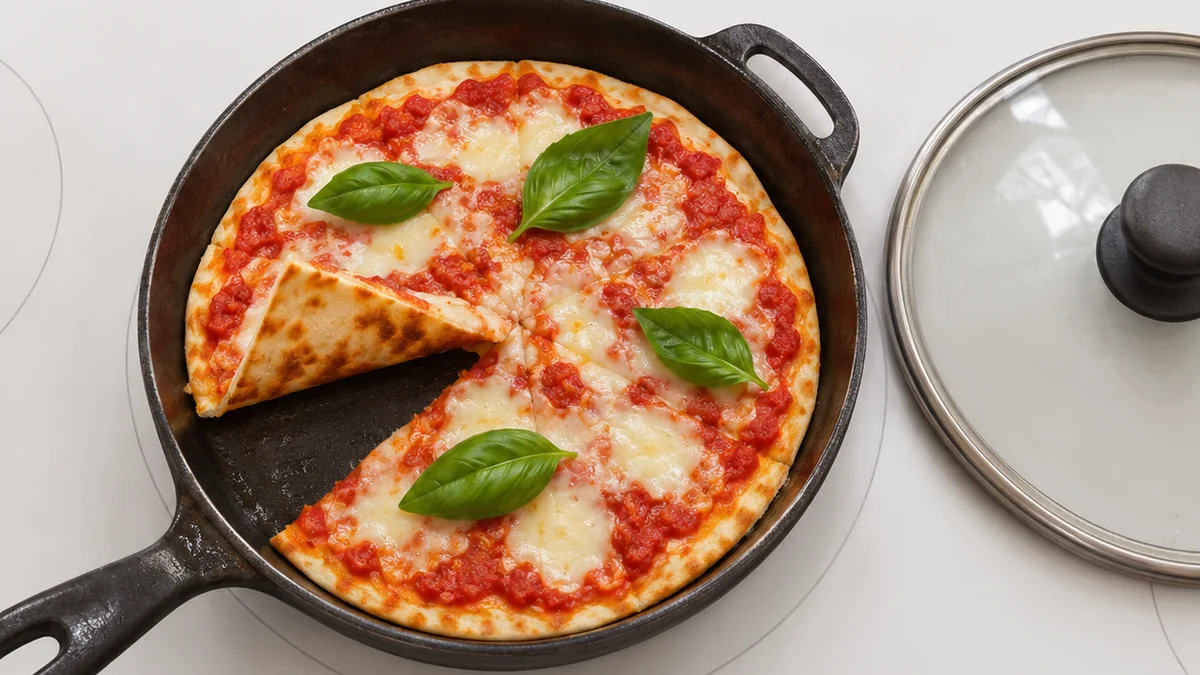
Timing for this recipe
A complete meal using one skillet for one pizza, including dough and toppings. Prepare the topping during the five-minute dough rest. No oven or yeast fermentation is required.
| Weigh the ingredients | 4–6 min |
|---|---|
| Mix the yogurt dough | 3–4 min |
| Rest briefly while preparing the topping | 5 min |
| Shape a thin base and heat the skillet | 3–4 min |
| Cook the first side without toppings | 4–5 min |
| Turn and top lightly | 1–2 min |
| Finish covered over gentle heat | 6–8 min |
| Release steam briefly | 1 min |
| Approximate elapsed time | 27–35 min |
These times include the work and rests described here. Temperature, equipment and ripeness can make things quicker or slower.
Cooking mode
Selected quantity: 1 pizza
Original yield: 1 pizza, about 25–26 cm (10 in) · 2 standard servings
Choose a whole number. Each item keeps the size, weight and shape given in the recipe.
Nutrition is estimated per standard serving and for the whole selection.
US units show weights in ounces and liquids in US fluid ounces.
More info
Measuring spoons use 1 tsp = 5 ml and 1 tbsp = 15 ml here.
Estimated nutrition for your selection
| Nutrition | ½ skillet pizza | Selected quantity |
|---|---|---|
| Energy | 439 kcal | 877 kcal |
| Protein | 21 g | 42 g |
| Carbohydrate | 57.2 g | 114.5 g |
| Fat | 13 g | 25.9 g |
| Salt | 2.67 g | 5.34 g |
Ingredients
1 pizza · 1× original recipe
Original yield/size: 1 pizza, about 25–26 cm (10 in)
The ingredient list shows the totals for this selection. Amounts per item stay the same.
- 150 g (5.29 oz) white wheat flour (German Type 550)
- 100 g (3.53 oz) plain Greek yogurt with 5% fat
- 15 g (0.53 oz) water
- 4 g (0.14 oz) baking powder
- 3 g (0.11 oz) fine salt, divided: 2 g in the dough and 1 g for the topping
- 6 g (0.21 oz) olive oil, divided: 3 g in the dough and 3 g for the pan
- 60 g (2.12 oz) unsalted crushed canned tomatoes, thick with no free liquid
- 70 g (2.47 oz) low-moisture mozzarella made with microbial rennet, finely grated
- 2 g (0.07 oz) fresh basil leaves
Equipment
- Heavy skillet with a usable flat base at least 26 cm (10¼ in) across and a fitting lid
- mixing bowl
- kitchen scale
- small rolling pin
- wide spatula
Method
Before shaping or topping, divide the ingredients between 1 pizza at their original size. Prepare each item as described. Do not multiply cooking times by the number of items. Extra batches still take extra time. Look for the doneness cues in the recipe.
- Distribute the baking powder evenly Thoroughly mix flour, baking powder and 2 g salt in a bowl. Add yogurt, 15 g water and 3 g olive oil. Bring together with a spoon, then briefly by hand into a soft dough. Knead for only 1–2 minutes; it does not need full yeast-dough development.
- Rest for five minutes and prepare the tomato Cover the dough for 5 minutes. Meanwhile, drain free liquid from the tomatoes and weigh 60 g thick pulp. Stir in the remaining 1 g salt. Finely grate the mozzarella so it melts quickly under the lid.
- Shape an evenly thin round Divide all the dough evenly among the selected number of pizzas. Roll or press each dough ball into a 25–26 cm (10 in) round on a lightly floured surface. Keep each centre evenly about 4–5 mm (around ⅙ in) thick without a thick raised rim. Each base must sit flat on the skillet bottom. Release sticking dough with a scraper. Cook further pizzas in separate skillet batches, allowing extra time.
- Set the first side before adding wet toppings Heat the heavy skillet over medium heat for 2–3 minutes. Per skillet batch, brush the pan with 3 g oil. Add one base and cook uncovered for about 4–5 minutes. Look for small golden patches and a base firm enough to lift in one piece. Reduce the heat if dark patches appear early.
- Turn and top the cooked side Turn the base and reduce the heat to low-medium. Per pizza, spread 60 g tomato thinly over the now uppermost cooked side and add 70 g finely grated mozzarella. Work promptly so the second side does not brown unnoticed.
- Finish covered and control condensation Cover and cook gently for a further 6–8 minutes. Check after 3 minutes and wipe condensation from the lid. The cheese should be melted, the underside golden and the middle free of a wet raw dough line. If necessary, dry uncovered over low heat for another 1–2 minutes, adding that time to the plan.
- Add basil at the end Lift onto a rack or board, release steam for 1 minute and finish with torn basil. A skillet does not give the same browned upper crust as an oven; judge the crisp underside and fully cooked centre instead.
Estimated nutrition
What is included
- Calculated per half pizza including all 6 g oil. Actual fat can be lower if some oil remains in the skillet.
| Nutrient | ½ skillet pizza | 1 pizza, about 25–26 cm (10 in) |
|---|---|---|
| Energy | 439 kcal | 877 kcal |
| Protein | 21 g | 42 g |
| Carbohydrate | 57.2 g | 114.5 g |
| Fat | 13 g | 25.9 g |
| Salt | 2.67 g | 5.34 g |
Why cook one side before topping?
Yogurt and baking powder make a quick base without yeast fermentation. A skillet has no top heat, so the first side cooks before being turned into the topping side. Finely grated cheese melts quickly under a lid while moderate heat cooks the centre. Excess tomato water would undermine that sequence.
A skillet is all you need
The base plan takes about 27–35 minutes for one pizza. No oven preheating or precooked bread is required. Several pizzas cooked sequentially in one skillet need additional cooking cycles; 30 minutes does not automatically cover four batches.
Yogurt is not interchangeable with plain water
Greek yogurt contributes water, fat, milk protein and acidity, so this dough is not assigned a misleading conventional hydration percentage. Runny drinking yogurt makes the same formula too wet; very thick skyr may need more water. Start with the specified plain yogurt rather than treating all dairy products as equivalent by weight.
If the base browns while the centre stays raw
The heat is too high or the dough too thick. Lower it immediately and continue covered rather than scorching the base further. Next time, shape evenly to 25–26 cm and use a heavy skillet. A thin old pan distributes heat less evenly, so frequent checks matter more than one fixed dial setting.
Melted cheese but a soft base?
Uncover at the end, wipe condensation and dry briefly over low heat. Do not leave the finished pizza on a damp skillet base. A rack lets steam escape more effectively. A pale upper rim is normal for this stovetop method and should not be compensated for by burning the underside.
Mushrooms or a vegan adaptation
Cook mushrooms separately first and evaporate their liquid, allowing extra time. A plant-based version needs an explicitly unsweetened thick yogurt alternative and a suitable vegan melting topping. Products behave differently: start with a small base, adjust water cautiously and expect different nutrition. The listed base recipe contains dairy and is not vegan.
Store without soaking the yogurt crust
Best eaten immediately. Refrigerate leftovers within 2 hours, keep covered at no more than 5°C/41°F and use within 2 days. Reheat in a skillet over gentle heat, covering briefly only if needed to heat the cheese. Mix this baking-powder dough fresh rather than treating it as a multi-day yeast-dough supply. Flour remains a raw food even without eggs.
Measure reliably
More info: US measures
150 g flour is about 1¼ loosely spooned US cups, 100 g thick yogurt about ⅖ cup and 15 g water about 1 US tablespoon. Four grams of baking powder is roughly 1 teaspoon, but check the pack; weighing is the reliable basis.
Related recipes and help with baking
Oven Heat: Air Temperature versus Baking Surface · Hydration: Calculate Water Correctly
Comments are optional. By submitting a comment, you consent to public display of your text and any name you provide; you may withdraw this consent at any time for the future. The text is sent to OpenAI for abuse screening. Privacy and deletion.