Timing for this recipe
Full method with a 48-hour cold ferment at 4°C/39°F or colder followed by 2–3 hours of final proofing at 23–24°C/73–75°F. Heat the stone or steel for 45–60 minutes during the last hour and prepare toppings. The plan includes two pinse with separate parbaking and finishing stages for each.
| Preheat alongside preparation | 45 min–1 hr |
|---|---|
| Mix flours with the first water | 6–8 min |
| Hydrate the flour blend | 20 min |
| Work in salt, oil and remaining water | 8–10 min |
| Warm bulk fermentation with two folds | 1 hr |
| 48-hour cold fermentation at 4°C or colder | 48 hr |
| Divide into two equal pieces | 5–7 min |
| Warm and proof the balls; heat oven towards the end | 2 hr–3 hr |
| Open the first oval pinsa | 7–9 min |
| Parbake the first plain base | 6–8 min |
| Top the first pinsa | 2–3 min |
| Finish baking the first pinsa | 5–7 min |
| Rest the first pinsa | 2 min |
| Open the second pinsa and recover the surface | 4–5 min |
| Parbake the second plain base | 6–8 min |
| Top the second pinsa | 2–3 min |
| Finish baking the second pinsa | 5–7 min |
| Rest the second pinsa | 2 min |
| Approximate elapsed time | 52 hr 20 min–53 hr 39 min |
| From mature dough made to this recipe | 1 hr 19 min–1 hr 45 min |
These times include the work and rests described here. Temperature, equipment and ripeness can make things quicker or slower.
Heat the oven during the preparation or rest. If it still needs longer, add that extra time.
Additional schedule from mature homemade dough
From mature, warmed dough made to this exact recipe. From a cold home oven, including preheating and all stated bakes.
The schedule shows the longer option. All times start with mature dough.
| Phase | Start from this point | Duration in the longer schedule |
|---|---|---|
| Preheat oven | 0 min | 1 hr |
| Open the first oval pinsa | 0 min | 9 min |
| Parbake the first plain base | 1 hr | 8 min |
| Top the first pinsa | 1 hr 8 min | 3 min |
| Finish baking the first pinsa | 1 hr 11 min | 7 min |
| Rest the first pinsa | 1 hr 18 min | 2 min |
| Open the second pinsa and recover the surface | 1 hr 20 min | 5 min |
| Parbake the second plain base | 1 hr 25 min | 8 min |
| Top the second pinsa | 1 hr 33 min | 3 min |
| Finish baking the second pinsa | 1 hr 36 min | 7 min |
| Rest the second pinsa | 1 hr 43 min | 2 min |
Cooking mode
Selected quantity: 2 pinse
Original yield: 2 oval pinse, each about 20 × 30 cm / 8 × 12 in · 4 standard servings
Choose a whole number. Each item keeps the size, weight and shape given in the recipe.
Nutrition is estimated per standard serving and for the whole selection.
US units show weights in ounces and liquids in US fluid ounces.
More info
Measuring spoons use 1 tsp = 5 ml and 1 tbsp = 15 ml here.
Estimated nutrition for your selection
| Nutrition | ½ pinsa | Selected quantity |
|---|---|---|
| Energy | 477 kcal | 1,906 kcal |
| Protein | 21.1 g | 84.3 g |
| Carbohydrate | 71.7 g | 286.6 g |
| Fat | 10.8 g | 43.2 g |
| Salt | 2.36 g | 9.44 g |
Ingredients
2 pinse · 1× original recipe
Original yield/size: 2 oval pinse, each about 20 × 30 cm / 8 × 12 in
The ingredient list shows the totals for this selection. Amounts per item stay the same.
- 340 g (11.99 oz) strong white wheat flour, about 12–13% protein
- 40 g (1.41 oz) white rice flour for dough
- 20 g (0.71 oz) full-fat soy flour, heat-treated
- 320 g (11.29 oz) cold water, divided: 280 g initially and 40 g later
- 1 g (0.04 oz) instant yeast
- 8 g (0.28 oz) fine salt
- 8 g (0.28 oz) olive oil for dough
- 10 g (0.35 oz) white rice flour for shaping, additional to dough flour
- 140 g (4.94 oz) canned peeled tomatoes, crushed, with excess liquid drained
- 140 g (4.94 oz) low-moisture mozzarella made with microbial rennet
- 4 g (0.14 oz) fresh basil leaves
Equipment
- Kitchen and precision scales
- large bowl
- dough scraper
- clear dough container
- two small dough boxes
- refrigerator thermometer
- stone or steel
- peel
- rack
Method
Before shaping or topping, divide the ingredients between 2 pinse at their original size. Prepare each item as described. Do not multiply cooking times by the number of items. Extra batches still take extra time. Look for the doneness cues in the recipe.
- Mix three flours with the first water Thoroughly blend wheat flour, the 40 g dough rice flour and soy flour. Add yeast and initially 280 g of the cold water. Stir firmly for six to eight minutes until no dry pockets remain. Cover and hydrate for 20 minutes. Keep the additional 10 g rice flour separate for shaping.
- Work in remaining water gradually Work in salt and oil. Knead in the remaining 40 g water in small additions over eight to ten minutes, waiting for each addition to be absorbed. The dough is soft and sticky but should become cohesively extensible. Do not dry it with extra flour.
- Fold twice and cold-ferment under control Cover for 60 minutes at about 23–24°C/73–75°F. After 20 and 40 minutes use damp hands to fold the four sides towards the middle; folds are included in that hour. Refrigerate in the covered box for 48 hours at 4°C/39°F or colder. Leave room for expansion and measure the refrigerator temperature.
- Let the dough balls warm and become extensible Divide the cold dough with a scraper into two equal pieces of approximately 369 g (13 oz) each. Fold gently into oblongs and place in covered boxes. Proof for 120–180 minutes at 23–24°C/73–75°F until soft and visibly aerated. During the last hour preheat stone or steel for 45–60 minutes at 250°C/482°F conventional or 230°C/446°F fan, approximately Gas 9.
- Open the first oval with fingertips Drain tomatoes and grate cheese. Per base dust the surface with 5 g of the extra rice flour. Gently press one ball from the centre outwards with fingertips, turn and stretch carefully to about 20 × 30 cm / 8 × 12 in. Do not use a rolling pin. Place on the peel and keep the second covered.
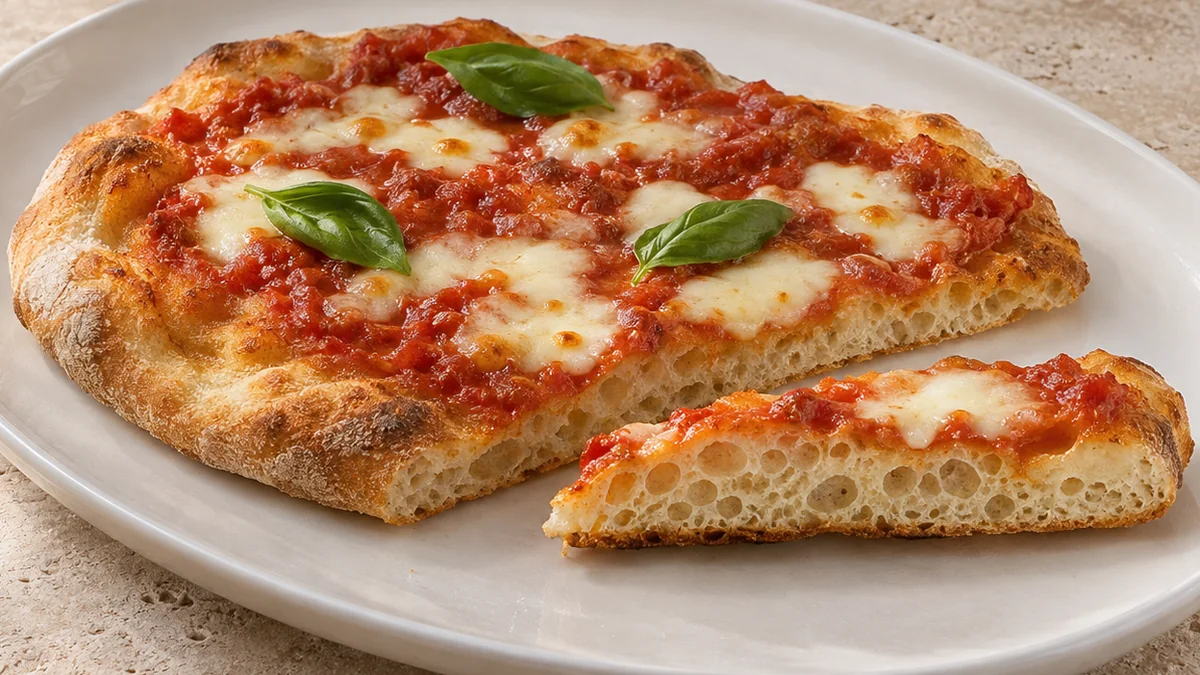
- Parbake the first base before topping Parbake the first base plain for six to eight minutes until it supports itself and shows early golden patches underneath. Remove, add 70 g tomato and 70 g mozzarella per base (one pinsa), then bake for a further five to seven minutes. The centre should be cooked through, the underside dry and the cheese melted.
- Bake the second at the same size in two stages Rest the first pinsa on a rack for two minutes and finish with 2 g basil per base. Use four to five minutes of surface recovery to open the next to the same size with 5 g rice flour per base. Again bake plain for six to eight minutes and with 70 g tomato and 70 g mozzarella per base for five to seven minutes. Rest two minutes and add 2 g basil per base.
Estimated nutrition
What is included
- Estimate per stated serving from all listed base ingredients. Optional variations are excluded. Residue left after draining, frying or brushing is not deducted from the calculation.
| Nutrient | ½ pinsa | 2 oval pinse, each about 20 × 30 cm / 8 × 12 in |
|---|---|---|
| Energy | 477 kcal | 1906 kcal |
| Protein | 21.1 g | 84.3 g |
| Carbohydrate | 71.7 g | 286.6 g |
| Fat | 10.8 g | 43.2 g |
| Salt | 2.36 g | 9.44 g |
Mixed flours and a two-stage bake
340 g wheat flour, 40 g rice flour and 20 g full-fat soy flour make 400 g dough flour. Add 320 g water for exactly 80% hydration. Gradual water additions, folds and 48 hours of cold fermentation build structure in the soft dough. A first bake without cheese sets the oval base; the second heats tomato and mozzarella.
A Roman-inspired home recipe
The original commercial pinsa uses its own flour blend including a sourdough component. This is an expressly independent blend with instant yeast, rather than that unchanged original formula or an ancient Roman bread. No claim about easier digestion or inherently fewer calories follows from it.
Dusting flour changes the water calculation
An additional 10 g rice flour for shaping is listed separately. The 80% refers to 400 g flour mixed into the dough. If all 10 g dusting flour were incorporated, it would be 320 ÷ 410 × 100 = 78.05%. Nutrition conservatively includes all 10 g; do not return used dusting flour to its container.
Sticky does not automatically mean wrong
The dough stays soft. Fold using a scraper and damp hands instead of kneading in lots of flour. If it cannot hold together after chilling, the wheat flour may be too weak or the refrigerator too warm. Strong wheat flour and a genuinely 4°C/39°F-or-colder refrigerator matter more than a Tipo 00 label.
Parbaking makes the base support itself
End the first bake once the base supports itself and shows early golden patches underneath; do not dry it completely. Only then add tomato and cheese. Each pinsa is baked twice, in sequence, so the complete plan includes all four oven stages. Serve the first after its brief rest if desired.
Change toppings while preserving the airy base
The base recipe finishes with a few fresh basil leaves. Another variation is 100 g cooked, cooled mushrooms across both pinse; avoid adding a thick extra cheese layer as well. A vegan version needs a suitable melting alternative; the base recipe contains milk and soy.
Storage and food safety
The base is crispest freshly baked. Refrigerate cooked leftovers in shallow containers within two hours, store at 4°C/39°F or colder and eat within two days. Reheat only what is needed until hot throughout; 74°C/165°F at the centre is a clear leftover-reheating target. Do not taste raw flour or dough. Clean hands and work surfaces after handling dough.
US measuring-cup equivalents
More info: US measures
Weigh this flour blend: 340 g wheat flour is about 2.83 US cups and 320 g water about 1.35 US cups. Rice and soy flour have different cup weights from wheat flour; do not use its cup conversion for them.
Bake several pieces of the same size
For a larger batch make several rolls, flatbreads or loaves at the stated original size. Per-piece quantities stay fixed; divide the total dough accordingly and distribute topping over all pieces. Finish further pieces in the same way. Additional sequential bakes extend the schedule; do not multiply baking time or thickness by the ingredient factor.
Related recipes and help with baking
Component recipes: Tomato Pizza Sauce for a Crisp Base
Hydration: Calculate Water Correctly · Fermentation: Judge Maturity, Not Just Hours · Oven Heat: Air Temperature versus Baking Surface
Comments are optional. By submitting a comment, you consent to public display of your text and any name you provide; you may withdraw this consent at any time for the future. The text is sent to OpenAI for abuse screening. Privacy and deletion.