Timing for this recipe
Includes the full unleavened dough with a 60-minute rest and both bakes. Start heating the stone or steel for 45–60 minutes immediately after kneading; prepare bacon and cream during the rest. Parallel frying is not added to elapsed time a second time.
| Preheat alongside preparation | 45 min–1 hr |
|---|---|
| Knead the unleavened dough | 8–10 min |
| Rest dough; prepare topping and heat oven in parallel | 1 hr |
| Roll and top the first flammkuchen | 7–9 min |
| Bake the first flammkuchen crisp | 8–11 min |
| Recover surface and top the second flatbread | 4–5 min |
| Bake the second flammkuchen | 8–11 min |
| Let steam escape briefly | 2 min |
| Approximate elapsed time | 1 hr 37 min–1 hr 48 min |
| From mature dough made to this recipe | 1 hr 7 min–1 hr 29 min |
These times include the work and rests described here. Temperature, equipment and ripeness can make things quicker or slower.
Heat the oven during the preparation or rest. If it still needs longer, add that extra time.
Additional schedule from mature homemade dough
From mature, warmed dough made to this exact recipe. From a cold home oven, including preheating and all stated bakes.
The schedule shows the longer option. All times start with mature dough.
| Phase | Start from this point | Duration in the longer schedule |
|---|---|---|
| Preheat oven | 0 min | 1 hr |
| Precook bacon and prepare cream | 0 min | 18 min |
| Roll and top the first flatbread | 18 min | 9 min |
| Bake first flatbread | 1 hr | 11 min |
| Top second flatbread and recover surface | 1 hr 11 min | 5 min |
| Bake second flatbread | 1 hr 16 min | 11 min |
| Rest briefly | 1 hr 27 min | 2 min |
Cooking mode
Selected quantity: 2 flammkuchen
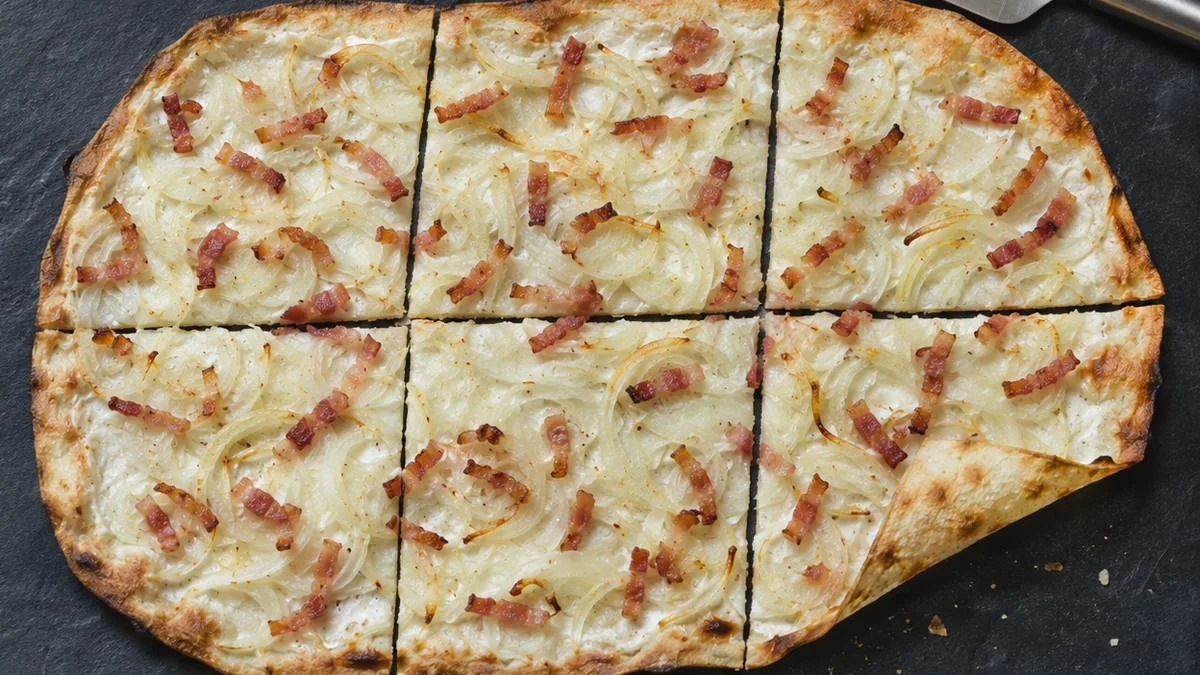
Original yield: 2 thin flammkuchen, each about 25 × 35 cm / 10 × 14 in · 4 standard servings
Choose a whole number. Each item keeps the size, weight and shape given in the recipe.
Nutrition is estimated per standard serving and for the whole selection.
US units show weights in ounces and liquids in US fluid ounces.
More info
Measuring spoons use 1 tsp = 5 ml and 1 tbsp = 15 ml here.
Estimated nutrition for your selection
| Nutrition | ½ flammkuchen | Selected quantity |
|---|---|---|
| Energy | 383 kcal | 1,532 kcal |
| Protein | 14.8 g | 59.2 g |
| Carbohydrate | 45.8 g | 183.1 g |
| Fat | 15.2 g | 60.7 g |
| Salt | 1.75 g | 7 g |
Ingredients
2 flammkuchen · 1× original recipe
Original yield/size: 2 thin flammkuchen, each about 25 × 35 cm / 10 × 14 in
The ingredient list shows the totals for this selection. Amounts per item stay the same.
- 250 g (8.82 oz) strong white wheat flour, about 12–13% protein
- 137.5 g (4.85 oz) water
- 15 g (0.53 oz) neutral rapeseed oil for the dough
- 4 g (0.14 oz) fine salt
- 80 g (2.82 oz) crème fraîche, about 30% fat
- 80 g (2.82 oz) low-fat quark
- 100 g (3.53 oz) onion
- 90 g (3.17 oz) raw smoked streaky bacon, without rind
- 0.3 g (0.01 oz) black pepper, about a small pinch
- 0.1 g (0.004 oz) ground nutmeg, about a very small pinch
Equipment
- Bowl
- scale
- rolling pin
- stone or steel
- peel
- wide frying pan
- rack
Method
Before shaping or topping, divide the ingredients between 2 flammkuchen at their original size. Prepare each item as described. Do not multiply cooking times by the number of items. Extra batches still take extra time. Look for the doneness cues in the recipe.
- Knead the simple oil dough Knead flour, water, rapeseed oil and salt for eight to ten minutes into a smooth firm dough. Cover and rest for 60 minutes at about 20–23°C/68–73°F. Immediately after kneading preheat the stone or steel for 45–60 minutes at 250°C/482°F conventional or 230°C/446°F fan, approximately Gas 9.
- Precook bacon and mix the cream cold During the dough rest, cut bacon into fine strips and cook completely in a wide dry pan for six to eight minutes. Drain excess fat and cool for five minutes. Slice onion into very thin half-rings. Mix quark and crème fraîche with pepper and nutmeg until smooth and refrigerate until topping.
- Roll the first flatbread very thin Divide into two equal pieces of approximately 203 g (7.2 oz) each. Keep one covered. Roll the other on a barely floured surface to an oval about 25 × 35 cm / 10 × 14 in and no more than 2 mm thick. Transfer to the peel and check movement before topping.
- Spread a thin cream layer with onion and bacon Per base use 80 g cream, 50 g onion and the cooked share from 45 g raw bacon. Spread thinly, leaving about 1 cm / ⅜ in bare at the edge, without a mound of cream at the centre. Load onto the fully heated surface immediately.
- Bake the first flammkuchen crisp Bake for eight to eleven minutes on a lower-middle rack. The edge should have brown patches and the thin centre should be dry and browned underneath, supporting itself when lifted. Move lower if the top darkens early; do not add grill heat.
- Bake the second on the recovered surface Lift the first onto a rack. Use four to five minutes of surface recovery to roll the second piece and add the same quantities per base. Bake for eight to eleven minutes too. Let each flatbread steam off for two minutes before cutting.
Estimated nutrition
What is included
- Estimate per stated serving from all listed base ingredients. Optional variations are excluded. Residue left after draining, frying or brushing is not deducted from the calculation.
| Nutrient | ½ flammkuchen | 2 thin flammkuchen, each about 25 × 35 cm / 10 × 14 in |
|---|---|---|
| Energy | 383 kcal | 1532 kcal |
| Protein | 14.8 g | 59.2 g |
| Carbohydrate | 45.8 g | 183.1 g |
| Fat | 15.2 g | 60.7 g |
| Salt | 1.75 g | 7 g |
Paper-thin dough without yeast
This flammkuchen has its own unleavened flour, water, oil and salt dough. At 55% hydration a full hour of resting helps it roll thin. A restrained quark and crème fraîche layer, precooked bacon and finely sliced onions add flavour without loading the base with raw moisture.
Two flatbreads, two bakes
The ingredients make two flat ovals, each roughly 25 × 35 cm / 10 × 14 in. Bake them in sequence on the same fully heated surface. The 8–11 minute bake is per flatbread; the schedule includes both bakes and a brief recovery of the stone or steel between them.
If the base stays soft
Check thickness first: two millimetres is the upper limit and the centre may be thinner. A thick cream layer delays drying. Top the first flatbread only when the surface is fully heated and load immediately. Let steam escape briefly on a rack after baking.
Choose bacon and cream deliberately
Base nutrition uses raw streaky smoked bacon and low-fat quark; any discarded rendered fat remains counted. Choose crème fraîche around 30% fat. This is an Alsatian-inspired home formula rather than a claim that every regional bakery uses precisely this mixture.
Vegetarian with precooked mushrooms
Replace bacon with 100 g cooked, dry mushrooms. A little chive after baking is another optional variation. Thick raw mushrooms are not a straight swap because they release water during the short bake. This changes nutrition and preparation time.
Storage and food safety
The base is crispest freshly baked. Refrigerate cooked leftovers in shallow containers within two hours, store at 4°C/39°F or colder and eat within two days. Reheat only what is needed until hot throughout; 74°C/165°F at the centre is a clear leftover-reheating target. Do not taste raw flour or dough. Clean hands and work surfaces after handling dough.
US measuring-cup equivalents
More info: US measures
250 g flour is about 2.08 US cups, 137.5 g water about 0.58 US cup and 15 g oil about 1.1 US tablespoons. Weigh the quark and cream.
Bake several pieces of the same size
For a larger batch make several rolls, flatbreads or loaves at the stated original size. Per-piece quantities stay fixed; divide the total dough accordingly and distribute topping over all pieces. Finish further pieces in the same way. Additional sequential bakes extend the schedule; do not multiply baking time or thickness by the ingredient factor.
Related recipes and help with baking
Component recipes: Homemade Crème Fraîche
Developing Gluten: Mix, Rest and Fold · Oven Heat: Air Temperature versus Baking Surface
Comments are optional. By submitting a comment, you consent to public display of your text and any name you provide; you may withdraw this consent at any time for the future. The text is sent to OpenAI for abuse screening. Privacy and deletion.