Practical guide
Pizza Stone, Steel or Tray: Choose Your Setup
Steel transfers heat rapidly to a base in a home oven; stone behaves differently and may suit very hot cooking. A tray is readily available and often forms part of a pan-pizza method. No setup is best independently of temperature, dough and the desired result.
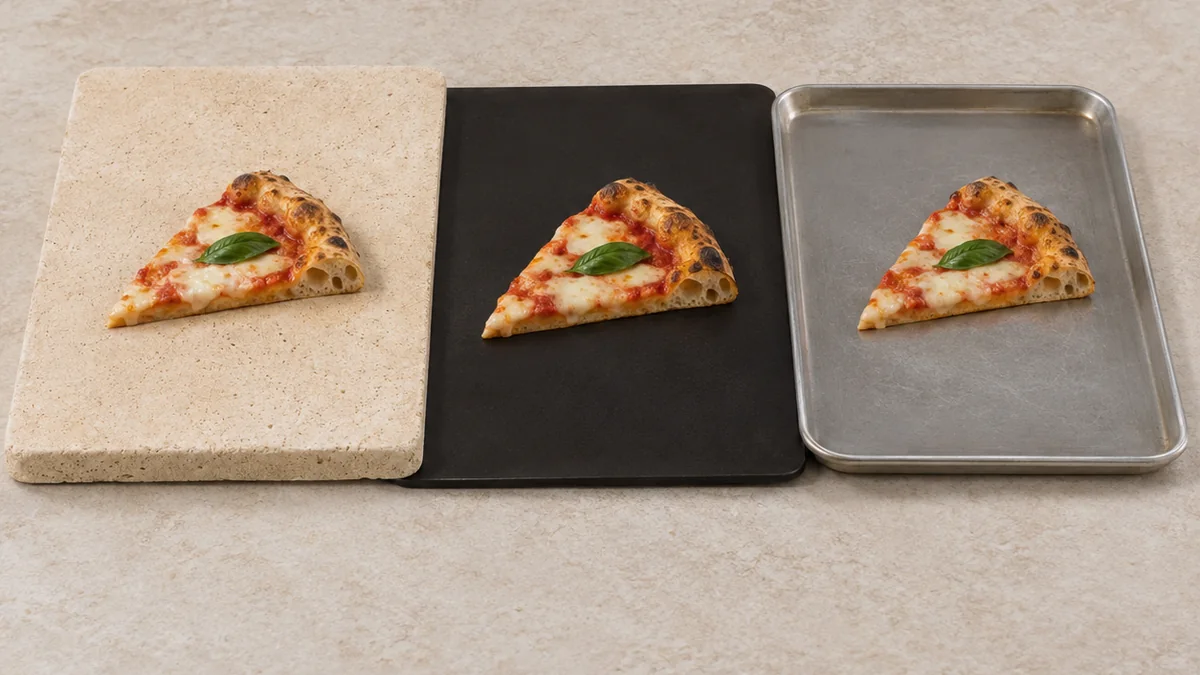
Three setups with different strengths
| Setup | Useful for | What to plan |
|---|---|---|
| Baking steel | Thin home-oven pizza with a well-browned underside | Weight, thorough preheating and rack position; reduce aggressive bottom heat if it scorches. |
| Pizza stone | Methods needing a gentler base; suitably rated stones in pizza ovens | Respect temperature ratings and avoid thermal shock. |
| Tray or pizza pan | Oiled pan pizza, small bases or readily available equipment | Check material, thickness and coating; a thin tray stores less heat than a heavy steel. |
Preheat the surface, not just the oven air
A cold steel or stone is not fully heated the moment the thermostat reaches its setting. Allow the recipe’s and accessory maker’s preheating time. Heavy surfaces often need about an hour, but that is a planning value, not proof that all equipment reaches the same surface temperature.
An infrared thermometer measures a surface, not the dough interior or oven air. Shiny bare metal can give unreliable readings because of its emission properties. Likewise, a high air setting is not a measured stone temperature.
Rack and topping are part of the choice
If the base darkens before the cheese melts, an aggressive steel and its rack position may be ahead of the top. If cheese burns first, the base may need more support or the pizza a lower rack. Neither “always at the top” nor “always at the bottom” suits every recipe.
Coatings, inverted trays and parchment
Only invert and preheat sturdy uncoated metal rated for the temperature. Non-stick trays, silicone, glass and serving trays are not interchangeable with steel. Keep parchment within its manufacturer’s limit; do not assume it belongs in a 450°C/842°F pizza oven or next to the broiler.
When a frying pan is what you have
Choose a complete pan recipe rather than merely shrinking a pizza-oven formula. A lid can melt cheese but does not reproduce an oven’s top heat. A cold pizza stone placed on a hob is not a safe shortcut.
References and context
These references explain ingredients and physical principles. The small kitchen comparisons are reproducible suggestions, not a claim of laboratory testing. Follow product labels and appliance instructions.